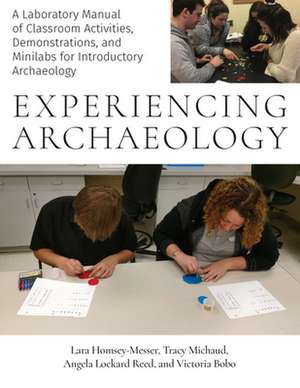
Experiencing Archaeology
Autor Lara Homsey-Messer, Tracy S. Michaud, Angela Lockard Reeden Limba Engleză Paperback – oct 2019
From creating complex stratigraphy with piles of clothes, to illustrating optimal forging theory with nothing more than a handful of coins, as well as activities based on writing, drawing, and provided cutout sheets, there are many ways to use this book for online 'at home' lab classes.
Today, many general-education archaeology courses are large, lecture-style class formats that present a challenge to providing students, particularly non-majors, with opportunities to learn experientially. This laboratory-style manual compiles a wide variety of uniquely designed, hands-on classroom activities to acquaint advanced high school and introductory college students to the field of archaeology. Ranging in length from five to thirty minutes, activities created by archaeologists are designed to break up traditional classroom lectures, engage students of all learning styles, and easily integrate into large classes and/or short class periods that do not easily accommodate traditional laboratory work.
Preț: 251.73 lei
Puncte Express: 378
Carte tipărită la comandă
Livrare economică 25 noiembrie-09 decembrie
Livrare prin curier în România Termenul estimat este afișat lângă disponibilitate.
Transport gratuit de la 400.00 lei Plată online sau ramburs, în funcție de opțiunile comenzii.
Retur gratuit în 14 zile Comandă securizată și suport în română.
Specificații
ISBN-13: 9781789203493
ISBN-10: 178920349X
Pagini: 368
Dimensiuni: 216 x 280 x 20 mm
Greutate: 0.93 kg
Editura: BERGHAHN BOOKS
ISBN-10: 178920349X
Pagini: 368
Dimensiuni: 216 x 280 x 20 mm
Greutate: 0.93 kg
Editura: BERGHAHN BOOKS
Notă biografică
Tracy S. Michaud is Assistant Professor and Chair of the Tourism & Hospitality program at the University of Southern Maine. Her classes and research focus on anthropologically-based community arts, culture, and tourism development. The Tourism and Hospitality Program at USM, under her leadership, recently received the Visit Portland's Leadership in Education Award.
Cuprins
List of Figures and Tables
Acknowledgments
Introduction
Module 1: Frameworks for Exploring Anthropological Archaeology
Chapter 1. The Scientific Method (TSM) Cube
Chapter 2. Cultural Bingo
Chapter 3. Eclectic Challenge
Chapter 4. A Symbol Worth a Thousand Words
Chapter 5. Candle Symbolism
Module 2: Attributing Meaning to Artifacts and Formation of the Archaeological Record
Chapter 6. Archaeological Chaos
Chapter 7. Name That Thingamajig
Chapter 8. Button Classification
Chapter 9. The (Site) Matrix
Chapter 10. Body Mapping
Module 3: Frameworks for Measuring Time
Chapter 11. Human Stratigraphy
Chapter 12. Time Lines
Chapter 13. Childhood Battleship Curves
Chapter 14. Stirrup Bottle Seriation
Chapter 15. Tree-Ring Matching
Chapter 16. "Smarties" Metric Dating
Module 4: Exploring Archaeological Specialties
Chapter 17. Flaky Archaeology: Lithic Analysis
Chapter 18. Pots and People: Ceramic Analysis
Chapter 19. What's for Dinner? Faunal Analysis
Chapter 20. What's for Dinner? Botanical Analysis
Chapter 21. "Bone"-afide Archaeology: Mortuary Analysis
Module 5: Interpretation and Explanation in Archaeology
Chapter 22. Campus Garbology: Processual Archaeology
Chapter 23. Bringing Home the Bacon: Post-processual Archaeology
Chapter 24. Lend Me Your Hand: Post-processual Archaeology
Chapter 25. Optimally Foraged Money: Behavioral Ecology
Chapter 26. Tree of Life: Human Ecology
Chapter 27. Can You Spare a Penny? Economic Anthropology
Chapter 28. Can You Dough It? Linguistic Anthropology
Module 6: Archaeological Ethics and Stewardship
Chapter 29. Draw an Archaeologist Test
Chapter 30. Archaeopolitics: Who Owns the Past?
Chapter 31. Common Ground: Glacial Archaeology, Ethics, and Climate Change
Chapter 32. To List or Not to List...?
Chapter 33. The Ethical Archaeologist
Index
Acknowledgments
Introduction
Module 1: Frameworks for Exploring Anthropological Archaeology
Chapter 1. The Scientific Method (TSM) Cube
Chapter 2. Cultural Bingo
Chapter 3. Eclectic Challenge
Chapter 4. A Symbol Worth a Thousand Words
Chapter 5. Candle Symbolism
Module 2: Attributing Meaning to Artifacts and Formation of the Archaeological Record
Chapter 6. Archaeological Chaos
Chapter 7. Name That Thingamajig
Chapter 8. Button Classification
Chapter 9. The (Site) Matrix
Chapter 10. Body Mapping
Module 3: Frameworks for Measuring Time
Chapter 11. Human Stratigraphy
Chapter 12. Time Lines
Chapter 13. Childhood Battleship Curves
Chapter 14. Stirrup Bottle Seriation
Chapter 15. Tree-Ring Matching
Chapter 16. "Smarties" Metric Dating
Module 4: Exploring Archaeological Specialties
Chapter 17. Flaky Archaeology: Lithic Analysis
Chapter 18. Pots and People: Ceramic Analysis
Chapter 19. What's for Dinner? Faunal Analysis
Chapter 20. What's for Dinner? Botanical Analysis
Chapter 21. "Bone"-afide Archaeology: Mortuary Analysis
Module 5: Interpretation and Explanation in Archaeology
Chapter 22. Campus Garbology: Processual Archaeology
Chapter 23. Bringing Home the Bacon: Post-processual Archaeology
Chapter 24. Lend Me Your Hand: Post-processual Archaeology
Chapter 25. Optimally Foraged Money: Behavioral Ecology
Chapter 26. Tree of Life: Human Ecology
Chapter 27. Can You Spare a Penny? Economic Anthropology
Chapter 28. Can You Dough It? Linguistic Anthropology
Module 6: Archaeological Ethics and Stewardship
Chapter 29. Draw an Archaeologist Test
Chapter 30. Archaeopolitics: Who Owns the Past?
Chapter 31. Common Ground: Glacial Archaeology, Ethics, and Climate Change
Chapter 32. To List or Not to List...?
Chapter 33. The Ethical Archaeologist
Index
Descriere
This laboratory-style manual compiles a wide variety of uniquely designed, hands-on classroom activities to acquaint advanced high school and introductory college students to the field of archaeology.