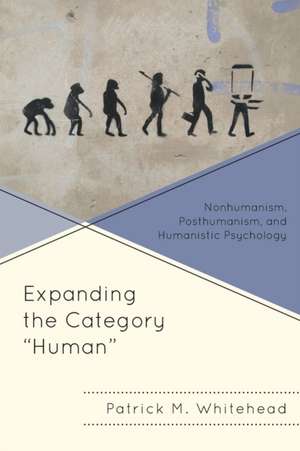
Expanding the Category "Human": Nonhumanism, Posthumanism, and Humanistic Psychology
Autor Patrick M. Whiteheaden Limba Engleză Paperback – 29 oct 2019
Preț: 249.71 lei
Preț vechi: 348.17 lei
-28%
Puncte Express: 375
Carte tipărită la comandă
Livrare economică 08-22 iunie
Specificații
ISBN-13: 9781498559379
ISBN-10: 1498559379
Pagini: 182
Dimensiuni: 154 x 229 x 14 mm
Greutate: 0.28 kg
Editura: Bloomsbury Publishing
Colecția Lexington Books
Locul publicării:New York, United States
ISBN-10: 1498559379
Pagini: 182
Dimensiuni: 154 x 229 x 14 mm
Greutate: 0.28 kg
Editura: Bloomsbury Publishing
Colecția Lexington Books
Locul publicării:New York, United States
Cuprins
Preface Introduction Chapter 1: The Cult of Humanism in Psychology Chapter 2: Problem One: Nature's DivisionsChapter 3: The Importance of Resolving this Division for Humanistic Ecopsychology Chapter 4: Problem Two: Rejecting Non-Subjective forms of Inquiry Chapter 5: Subjectivity as a Nonhuman Attribute: All Nature as Flesh Chapter 6: Problem Three: Rejecting Posthuman Possibilities Chapter 7: Recognizing how Technology has Shaped Human Being: Towards a Post-Humanisitc Psychology Chapter 8: The Radical Edge: Object-Oriented Psychology or, the Psychology of Things References
About the Author
About the Author
Recenzii
Dr. Whitehead's contribution with this book is vital and timely in a day and age where the propensity is to establish false dichotomies. Psychology, at large, typically does not display a strong appetite for deep theoretical and critical reflection on its own subject matter, methodologies, or epistemic stances. Any form of critical analysis often ends abruptly, eschewing any substantive attempt at further synthesis. Psychology, in its current form, is a house divided against itself. Nonetheless, these divisions are often arbitrary, myopic, and harmful to the craft. Unifying these theoretical divisions takes, beyond a skilled intellect, a sense of humility and candor from visionary psychologist. I consider myself lucky to observe the progression of Dr. Whitehead's views on these ideas. Psychologists and students of the discipline will benefit from navigating the progression of these ideas, as well.
In this provocative book, Patrick Whitehead argues persuasively for a path beyond traditional dichotomies that have plagued humanistic psychology for decades, one that will potentially establish a successor field, that of post-humanistic psychology.
In this provocative book, Patrick Whitehead argues persuasively for a path beyond traditional dichotomies that have plagued humanistic psychology for decades, one that will potentially establish a successor field, that of post-humanistic psychology.