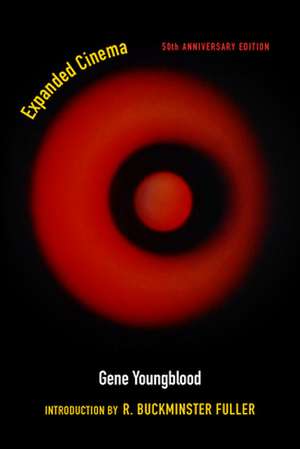
Expanded Cinema
Autor Gene Youngblooden Limba Engleză Paperback – 3 mar 2020
Explorând tehnici vizuale revoluționare pentru epoca sa — de la procesarea semnalului video și holografie până la primele experimente de artă computerizată — Expanded Cinema rămâne un document senzorial esențial pentru înțelegerea mutațiilor imaginii în mișcare. Ne-a atras atenția modul în care Gene Youngblood a reușit, încă din 1970, să identifice tranziția de la cinematografia tradițională spre un mediu fluid, definit prin sinestezie și interactivitate. Experiența de lectură este una densă, aproape tactilă, susținută de cele peste 300 de ilustrații care transformă conceptele teoretice despre 'era paleocibernetică' în realități vizuale palpabile. Recomandăm acest volum ca pe o hartă a contraculturii anilor '60, unde arta întâlnește cibernetica. Complementar lui Cinema Expanded de Jonathan Walley, care analizează expansiunea mediului spre performance și instalații din perspectiva secolului XXI, lucrarea lui Youngblood oferă avantajul perspectivei martorului ocular, capturând efervescența momentului în care Andy Warhol sau Nam June Paik redefineau limitele ecranului. Structura cărții ghidează cititorul de la critica mitului divertismentului către o explorare profundă a conștiinței oceanice și a simbiozei om-mașină. Merită menționat că această ediție aniversară, publicată de Fordham University Press, nu este doar o recuperare istorică, ci un instrument critic actual. Introducerea semnată de R. Buckminster Fuller plasează observațiile radicale ale lui Youngblood într-un context ecologic și tehnologic global, subliniind rolul artistului ca 'om de știință al designului'. Este o lectură care solicită o percepție simultană a contrariilor armonice, reflectând perfect ritmul și tonul avangardei pe care o documentează.
Preț: 211.11 lei
Carte disponibilă
Livrare economică 29 octombrie-12 noiembrie
Livrare express 14-20 octombrie pentru 74.87 lei
Specificații
ISBN-10: 0823287416
Pagini: 464
Ilustrații: 60 color illustrations and 284 b/w illustrations.
Dimensiuni: 137 x 207 x 31 mm
Greutate: 0.57 kg
Ediția:New
Editura: Fordham University Press
De ce să citești această carte
Recomandăm această carte oricărui pasionat de artele vizuale și istoria tehnologiei care dorește să înțeleagă rădăcinile culturii digitale actuale. Veți câștiga o perspectivă unică asupra modului în care arta video și cybermedia au apărut din spiritul contracultural al anilor '60. Este o resursă fundamentală pentru a înțelege cum ecranele ne-au remodelat comunicarea umană, oferind analize tehnice și estetice care rămân surprinzător de relevante astăzi.
Cuprins
Introduction to the Fiftieth Anniversary Edition | xiii
Introduction by R. Buckminster Fuller | 15
Inexorable Evolution and Human Ecology by R. Buckminster Fuller | 37
Preface | 41
Part One: The Audience and the Myth of Entertainment | 45
Radical Evolution and Future Shock in the Paleocybernetic Era | 50
The Intermedia Network as Nature | 54
Popular Culture and the Noosphere | 57
Art, Entertainment, Entropy | 59
Retrospective Man and the Human Condition | 66
The Artist as Design Scientist | 70
Part Two: Synaesthetic Cinema: The End of Drama | 75
Global Closed Circuit: The Earth as Software | 78
Synaesthetic Synthesis: Simultaneous Perception of Harmonic Opposites | 81
Syncretism and Metamorphosis: Montage as Collage | 84
Evocation and Exposition: Toward Oceanic Consciousness | 92
Synaesthetics as Kinaesthetics: The Way of All Experience | 97
Mythipoeiai: The End of Fiction | 106
Synaesthetics and Synergy | 109
Synaesthetic Cinema and Polymorphous Eroticism | 112
Synaesthetic Cinema and Extra-Objective Reality | 122
Image-Exchange and the Post-Mass Audience Age | 128
Part Three: Toward Cosmic Consciousness | 135
2001: The New Nostalgia | 139
The Stargate Corridor | 151
The Cosmic Cinema of Jordan Belson | 157
Part Four: Cybernetic Cinema and Computer Films | 179
The Technosphere: Man/Machine Symbiosis | 180
The Human Bio-Computer and His Electronic Brainchild | 183
Hardware and Software | 185
The Aesthetic Machine | 189
Cybernetic Cinema | 194
Computer Films | 207
Part Five: Television as a Creative Medium | 257
The Videosphere | 260
Cathode-Ray Tube Videotronics | 265
Synaesthetic Videotapes | 281
Videographic Cinema | 317
Closed-Circuit Television and Teledynamic Environments | 337
Part Six: Intermedia | 345
The Artist as Ecologist | 346
World Expositions and Nonordinary Reality | 352
Cerebrum: Intermedia and the Human Sensorium | 359
Intermedia Theatre | 365
Multiple-Projection Environments | 387
Part Seven: Holographic Cinema: A New World | 399
Wave-Front Reconstruction: Lensless Photography | 400
Dr. Alex Jacobson: Holography in Motion | 404
Limitations of Holographic Cinema | 407
Projecting Holographic Movies | 411
The Kinoform: Computer-Generated Holographic Movies | 414
Technoanarchy: The Open Empire | 415
Selected Bibliography | 421
Index | 427