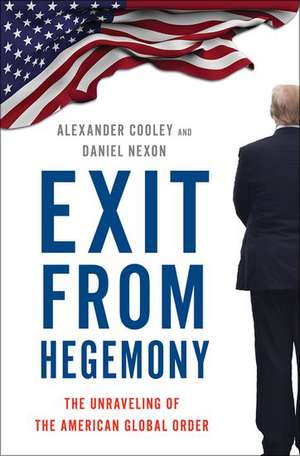
Exit from Hegemony: The Unraveling of the American Global Order
Autor Alexander Cooley, Daniel Nexonen Limba Engleză Hardback – 9 iul 2020
Notăm cu interes modul în care Exit from Hegemony deconstruiește mitul conform căruia fragilitatea actuală a ordinii globale este un fenomen recent sau accidental. Autorii Alexander Cooley și Daniel Nexon își organizează materialul în jurul unei metodologii riguroase care identifică trei căi de eroziune a sistemului internațional: de sus în jos (prin puteri precum Rusia și China), lateral (prin state mici care caută patronaj în afara sferei americane) și de jos în sus (prin rețele transnaționale naționaliste). Această structură tripartită oferă o claritate conceptuală necesară într-un domeniu marcat adesea de speculații geopolitice vagi.
Apreciem în mod deosebit perspectiva istorică a autorilor, care plasează începutul declinului cu mult înaintea anului 2016, argumentând că ordinea liberală a fost subminată discret timp de un deceniu și jumătate. Cartea este comparabilă cu Hegemonic Transition de Florian Böller în rigurozitatea analizei crizelor instituționale, dar este actualizată pentru a include dinamica specifică a rețelelor iliberale și impactul financiar al kleptocrației globale. În contextul operei lui Alexander Cooley, acest volum reprezintă o sinteză matură a temelor abordate în Great Games, Local Rules și Dictating the Agenda. Dacă lucrările anterioare se concentrau pe competiția regională sau pe instrumentele regimurilor autoritare, Exit from Hegemony ridică miza spre o teorie sistemică a modului în care o hegemonie se destramă din interiorul propriilor sale structuri. Stilul este academic, însă extrem de articulat, transformând o analiză politică densă într-o radiografie lucidă a realității noastre curente.
Preț: 298.37 lei
Preț vechi: 386.61 lei
-23%
Carte tipărită la comandă
Livrare economică 24 iulie-04 august
Specificații
ISBN-10: 0190916478
Pagini: 304
Dimensiuni: 157 x 239 x 31 mm
Greutate: 0.54 kg
Editura: Oxford University Press
Colecția OUP USA
Locul publicării:New York, United States
V-ar putea interesa
-
 -21%Preț: 231.21 lei294.14 lei
 -
 The National Security: Its Theory and Practice 1945-1960Norman a. Graebner-8%Preț: 91.18 lei98.92 lei
 -
 America's Secret Power: The CIA in a Democratic SocietyLoch K. Johnson-11%Preț: 135.22 lei152.76 lei
 -
 A Century of Spies: Intelligence in the Twentieth CenturyJeffrey T. Richelson-9%Preț: 140.95 lei154.46 lei
 -
 In Spies We Trust: The Story of Western IntelligenceRhodri Jeffreys-Jones-11%Preț: 86.61 lei97.34 lei
 -
 We Know All About You: The Story of Surveillance in Britain and AmericaRhodri Jeffreys-Jones-21%Preț: 130.86 lei165.38 lei
 -
 -25%Preț: 156.97 lei208.91 lei
 -
 Preț: 250.32 lei
 -
 -7%Preț: 373.36 lei402.40 lei
 -
 Spy WarsTennent H. BagleyPreț: 383.26 lei
 -
 Contracting States – Sovereign Transfers in International RelationsAlexander CooleyPreț: 322.47 lei
 -
 China's Security Interests in the Post-Cold War EraDr Russell Ong-18%Preț: 1458.16 lei1778.24 lei
 -
 -15%Preț: 512.33 lei602.74 lei
 -
 -15%Preț: 514.09 lei604.81 lei
 -
 -15%Preț: 560.16 lei659.01 lei
 -
 The House on Garibaldi StreetIsser Harel-18%Preț: 1474.76 lei1798.48 lei
 -
 -18%Preț: 1432.13 lei1746.51 lei
 -
 American-British-Canadian Intelligence Relations, 1939-2000Rhodri Jeffreys-Jones-15%Preț: 414.45 lei487.59 lei
 -
 Preț: 457.62 lei
 -
 Base Politics – Democratic Change and the U.S. Military OverseasAlexander CooleyPreț: 361.87 lei
 -
 Logics of HierarchyAlexander CooleyPreț: 138.14 lei
 -
 Ranking the WorldAlexander CooleyPreț: 298.45 lei
 -
 Informer 001: The Myth of Pavlik MorozovYuri Druzhnikov-18%Preț: 1083.62 lei1321.49 lei
 -
 INTELKen ConboyPreț: 158.47 lei
De ce să citești această carte
Recomandăm această carte studenților la relații internaționale și profesioniștilor din diplomație care doresc să înțeleagă mecanismele structurale din spatele știrilor cotidiene. Cititorul câștigă o perspectivă obiectivă asupra modului în care instituțiile globale se transformă sub presiunea noilor centri de putere. Este o lectură esențială pentru a distinge între zgomotul politic de moment și tendințele geopolitice pe termen lung care vor defini deceniile următoare.
Despre autor
Alexander Cooley este profesor de științe politice la Barnard College, Universitatea Columbia, și fost director al Institutului Harriman. Expert recunoscut în guvernanța globală și spațiul post-comunist, Cooley a contribuit constant cu analize în Foreign Affairs și New York Times. Opera sa, care include titluri precum Ranking the World și Dictating the Agenda, se concentrează pe intersecția dintre instituțiile internaționale și regimurile autoritare. În Exit from Hegemony, el colaborează cu Daniel Nexon pentru a aplica aceste observații la scara întregului sistem internațional, consolidându-și statutul de observator critic al dinamicii puterii globale.
Descriere
We live in a period of great uncertainty about the fate of America's global leadership. Many believe that Donald Trump's presidency marks the end of liberal international order: the very system of global institutions, rules, and values that shaped the American international system since the end of World War II. Trump's repeated rejection of liberal order, criticisms of long-term allies of the US, and affinity for authoritarian leaders certainly undermines theAmerican international system, but the truth is that liberal international order has been quietly eroding for at least 15 years.In Exit from Hegemony, Alexander Cooley and Daniel Nexon develop a new, integrated approach to understanding the rise and decline of hegemonic orders. Their approach identifies three distinct ways in which the liberal international order is undergoing fundamental transformation. First, Russia and China have targeted the order, positioning themselves as revisionist powers by establishing alternative regional institutions and pushing counter-norms. Second, weaker states are hollowing outthe order by seeking patronage and security partnership from nations outside of the order, such as Saudi Arabia and China. Even though they do not always seek to disrupt American hegemony, these new patron-client relationships lack the same liberal political and economic conditions as those involving theUnited States and its democratic allies. Third, a new series of transnational networks emphasizing illiberalism, nationalism, and right-wing values increasing challenges the anti-authoritarian, progressive transnational networks of the 1990s. These three pathways erode the primacy of the liberal international order from above, laterally, and from below. The Trump administration, with its "America First" doctrine, accelerates all three processes, critically lessening America's position as aworld power.
Recenzii
In this important book, Cooley and Nexon provide one of the best guides to understanding how global orders rise and fall.
Cooley and Nexon's assessments are refreshingly blunt.
Simultaneously pitched to international relations theorists, to assorted analysts, and to the educated, media-savvy general reader, Exit from Hegemony is a major achievement. The first reason is its conceptual clarity. "International order," we learn, is but a convenient shorthand. Rather than a discrete, bounded, and differentiated "thing," the phrase can refer only to relative stabilities in state interactions and related goings-on. This is why Cooley and Nexon conceptualize international ordering — their preferred term — as an ecosystem constituted by rules, norms, and values, on the one hand, and everyday routines, flows, and practices on the other...This framework helps us understand how "the American hegemonic system" and the broader international order co-emerged over time and space, and across institutional settings, and why attempts to revise that system are not necessarily anti-American in character.
They make a strong case for distinguishing between the old hegemonic order and the larger international order of which it is a part. As they put it, 'global international order is not synonymous with American hegemony.' They also make careful distinctions between the different components of what is often simply called the 'liberal international order': political liberalism, economic liberalism, and liberal intergovernmentalism.
We live in a world where the liberal order created by the United States is under increasing challenge. The great virtue of Cooley and Nexon's book is that it uses sophisticated theory to explore how different kinds of challenges — from other great powers, from smaller states looking to subvert the order, from social movements and sub-state actors — can interact and reinforce each other. This book will be of interest not only to international relations scholars but to anyone who wants to understand how the world is changing.
How will the US-led order end? This smart book outlines three different pathways: defections from the order by revisionist powers, exits from the order by smaller and weaker states, and counter order movements. Though trends in all three began far before 2016 and made the election of President Trump more likely, Trump's policies have also accelerated their unfolding. By showing how these different pathways could work, and influence one another, Cooley and Nexon offer a sobering analysis useful for both understanding the contemporary global political situation and working to change it.
Notă biografică
Alexander Cooley is Director of Columbia University's Harriman Institute for the study of Russia, Eurasia and Eastern Europe and the Claire Tow Professor of Political Science at Barnard College of Columbia University. His books include Great Games, Local Rules: The New Great Power Contest in Central Asia (Oxford), Ranking the World: Grading States as a Tool of Global Governance, and Dictators without Borders: Power and Money inCentral Asia. In addition to his academic work, Professor Cooley serves on a range of international advisory bodies and working groups engaged with the region and has testified for Congressional committees on Eurasian issues.Daniel Nexon is an Associate Professor in the Department of Government and the School of Foreign Service at Georgetown University. He has held fellowships from Stanford University's Center for International Security, Cooperation and at the Ohio State University's Mershon Center for International Studies. From 2009-2010, he was aCouncil on Foreign Relations International Affairs Fellow in the US Department of Defense. In 2016, he helped coordinate the unofficial foreign-policy group for the Bernie Sanders campaign, and he remains active in efforts to forge progressive foreign policy principles. He is the author of The Struggle for Power in Early Modern Europe: Religious Conflict, Dynastic Empires, and International Change. He founded, and used to blog, at The Duck of Minerva. He currentlyblogs at Lawyers, Guns and Money.