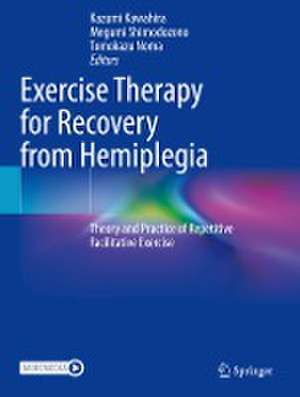
Exercise Therapy for Recovery from Hemiplegia
Editat de Kazumi Kawahira, Megumi Shimodozono, Tomokazu Nomaen Limba Engleză Paperback – 16 noi 2023
Exercise Therapy for Recovery from Hemiplegia - Theory and Practice of Repetitive Facilitative Exercise will provide rehabilitation therapists, physiotherapists, occupational therapists, and medical doctors a refreshing alternative theory and practice to current approaches. Neuroscience researchers, stroke patients, and their families would find this book informative.
Preț: 836.96 lei
Preț vechi: 881.01 lei
-5%
Puncte Express: 1255
Carte tipărită la comandă
Livrare economică 16-23 noiembrie
Livrare prin curier în România Termenul estimat este afișat lângă disponibilitate.
Transport gratuit pentru acest produs Plată online sau ramburs, în funcție de opțiunile comenzii.
Retur gratuit în 14 zile Comandă securizată și suport în română.
Specificații
ISBN-13: 9789811907913
ISBN-10: 9811907919
Pagini: 188
Ilustrații: IX, 178 p. 139 illus. in color.
Dimensiuni: 210 x 279 x 10 mm
Greutate: 0.53 kg
Ediția:1st ed. 2022
Editura: Springer
Locul publicării:Singapore, Singapore
ISBN-10: 9811907919
Pagini: 188
Ilustrații: IX, 178 p. 139 illus. in color.
Dimensiuni: 210 x 279 x 10 mm
Greutate: 0.53 kg
Ediția:1st ed. 2022
Editura: Springer
Locul publicării:Singapore, Singapore
V-ar putea interesa
-
 -29%Preț: 577.72 lei813.22 lei
 -
 Stroke Rehabilitation: A Function-Based ApproachGlen Gillen-5%Preț: 895.22 lei942.33 lei
 -
 Umphred's Neurological RehabilitationRolando T. Lazaro-5%Preț: 1065.21 lei1121.28 lei
 -
 Physical Medicine and Rehabilitation SecretsBryan J. O'Young-30%Preț: 281.23 lei399.03 lei
 -
 Neuroscience: Fundamentals for RehabilitationLaurie Lundy-Ekman-29%Preț: 575.29 lei812.40 lei
 -
 Telerehabilitation: Principles and PracticeMarcalee Alexander-28%Preț: 448.22 lei625.11 lei
 -
 Robotics in Physical Medicine and RehabilitationDouglas P. Murphy-29%Preț: 835.73 lei1183.69 lei
 -
 -28%Preț: 453.96 lei631.01 lei
 -
 Atlas of Orthoses and Assistive DevicesDouglas P. Murphy-28%Preț: 1141.83 lei1590.55 leiRecomandat
 -
 -5%Preț: 689.54 lei725.83 lei
 -
 -29%Preț: 310.56 lei438.97 lei
 -
 Neurologic Rehabilitation, Second Edition: Neuroscience and Neuroplasticity in Physical Therapy PracticeDeborah S. Nichols Larsen-31%Preț: 563.19 lei820.13 lei
 -
 -5%Preț: 358.02 lei376.87 lei
 -
 -28%Preț: 620.63 lei856.12 lei
 -
 Identity Theft, Second Edition: Rediscovering Ourselves After StrokeDebra E. Meyerson-17%Preț: 98.85 lei118.48 leiRecomandat
 -
 Advances in Occupational Therapy ResearchLea R Sherman-23%Preț: 1586.03 lei2073.24 lei
 -
 -5%Preț: 591.97 lei623.13 lei
 -
 -5%Preț: 383.27 lei403.44 leiRecomandat
 -
 Brain Fitness BlueprintPatrick PorterPreț: 122.57 lei
 -
 Neuroplasticity-based NeurorehabilitationJens Bo Nielsen-5%Preț: 826.03 lei869.51 lei
Cuprins
Part I: Basics.- Chapter 1. Theory of Repetitive Facilitative Exercise.- Part II: Practice.- Chapter 2. Principles and Basic Techniques for Repetitive Facilitative Exercise.- Chapter 3. Planning Treatment Program.- Chapter 4. Repetitive Facilitative Exercise for the Upper Limb.- Chapter 5. Repetitive Facilitative Exercise for the Lower Limb.- Chapter 6. Walking Training to Stimulate the Function of the Affected Lower Limb.- Chapter 7. Basic Natural Movements (Rolling Over, Sitting Up, Standing Up, and Sitting Down from a Standing Position).
Notă biografică
Kazumi Kawahira
Laboratory of Repetitive facilitative exercise
Megumi Shimodozono
The Department of Rehabilitation and Physical Medicine
Kagoshima University Graduate School of Medical and Dental Sciences
Tomokazu Noma
Department of Rehabilitation, Faculty of Health, Sciences
Nihon Fukushi University
Textul de pe ultima copertă
This book introduces an innovative, efficient, and patient-friendly neural net constructive therapy for patients with mild to severe hemiplegia, not only in the recovery phase but also in acute and chronic phases. The explanations are supported by extensive photographs of each position and a set of 72 video clips to help readers follow and reproduce the techniques. This book explains the theory of Repetitive Facilitative Exercise (RFE), which is a combination of repetitive volitional flexion and extension movements from neurofacilitation approaches. This exercise is aimed at achieving the intended movements and lessening synergistic movement patterns by reconstructing and strengthening the neuropathways of the injured nerve tract. Instead of interpreting disorders based on reflex theory and constructing treatment methods, the new approach considers scientific treatment methods that emphasize the formation of neural pathways by improving synapse formation and transmission efficiency based on functional localization, central programs, and neural nets. Chapters provide a basic theory of RFE, offering the underlying mechanisms of nerve tract formation/strengthening, such as functional localization, voluntary movement, plasticity, and neural lateral sprouting, giving readers a comprehensive understanding of the prompt and repetitive therapy. This is followed by an exposition of practice and techniques, planning of treatment programs, and facilitation techniques for voluntary movements of the upper limb, individual fingers, and lower limb. Finally, the book introduces RFE to facilitate and enhance motor skills in walking and other functions.
Exercise Therapy for Recovery from Hemiplegia - Theory and Practice of Repetitive Facilitative Exercise will provide rehabilitation therapists, physiotherapists, occupational therapists, and medical doctors a refreshing alternative theory and practice to current approaches. Neuroscience researchers, stroke patients, and their families would find this book informative.
Caracteristici
Provides an innovative, efficient, and patient’s friendly neural net constructive therapy for mild/severe hemiplegia Provides a basic theory of RFE, offering the underlying mechanisms of nerve tract formation/strengthening Offers techniques/treatment planning/RFE for upper & lower limbs/trainings to maximize the lower limb functions