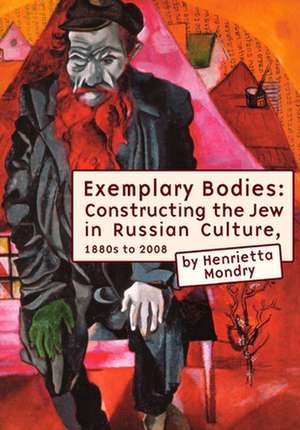
Exemplary Bodies: Constructing the Jew in Russian Culture, 1880s to 2008
Autor Henrietta Mondryen Limba Engleză Hardback – noi 2009
Preț: 584.46 lei
Preț vechi: 789.74 lei
-26%
Puncte Express: 877
Carte disponibilă
Livrare economică 04-18 noiembrie
Livrare prin curier în România Termenul estimat este afișat lângă disponibilitate.
Transport gratuit pentru acest produs Plată online sau ramburs, în funcție de opțiunile comenzii.
Retur gratuit în 14 zile Comandă securizată și suport în română.
Specificații
ISBN-13: 9781934843390
ISBN-10: 1934843393
Pagini: 300
Dimensiuni: 156 x 234 x 21 mm
Greutate: 0.59 kg
Ediția:New.
Editura: Academic Studies Press
Colecția Academic Studies Press
Locul publicării:Boston, MA, United States
ISBN-10: 1934843393
Pagini: 300
Dimensiuni: 156 x 234 x 21 mm
Greutate: 0.59 kg
Ediția:New.
Editura: Academic Studies Press
Colecția Academic Studies Press
Locul publicării:Boston, MA, United States
V-ar putea interesa
-
 -27%Preț: 80.24 lei109.89 lei
 -
 The Definition of Anti-SemitismKenneth L. Marcus-11%Preț: 340.85 lei382.27 lei
 -
 -24%Preț: 192.53 lei253.67 lei
 -
 Goodbye East EndDavid MerronPreț: 114.49 lei
 -
 Preț: 429.60 lei
 -
 -19%Preț: 454.27 lei560.83 lei
 -
 New DiasporaVictoria AaronsPreț: 315.32 lei
 -
 Will to FreedomEgon BalasPreț: 155.02 lei
 -
 Jews and Genes: The Genetic Future in Contemporary Jewish ThoughtRabbi Elliot N. DorffPreț: 333.42 lei
 -
 The Rag RaceAdam D MendelsohnPreț: 246.55 lei
 -
 -26%Preț: 631.32 lei850.06 lei
 -
 -22%Preț: 205.49 lei264.07 lei
 -
 The Image of Jews in Contemporary ChinaJames R. Ross-18%Preț: 655.91 lei799.89 lei
 -
 Disintegration of the Atom and Petersburg WintersGeorgy Ivanov-25%Preț: 512.12 lei681.02 lei
 -
 -26%Preț: 549.17 lei740.07 lei
 -
 History, Memory, and Jewish IdentityIra Robinson-25%Preț: 514.64 lei682.64 lei
 -
 -25%Preț: 508.88 lei678.92 lei
 -
 -26%Preț: 549.76 lei740.46 lei
 -
 Pure, Strong and SexlessHenrietta Mondry-14%Preț: 827.15 lei961.80 lei
Cuprins
Acknowledgements. A Note on Transliteration. List of Illustrations. Introduction.1. Russian Anthropological and Biological Sciences and the “Jewish Race,” 1860s-1930. 2. Stereotypes of Pathology: The Medicalization of the Jewish Body by Anton Chekhov, 1880s.3. Carnal Jews of the Fin-de-Siècle: Vasily Rozanov, the Jewish Body and Incest.4. Ilya Ehrenburg and His Pecaresque Jewish Bodies of the 1920s. 5. Criminal Bodies and Love of The Yellow Metal: the Jewish Male and Stalinist Culture, 1930s-1950s. 6. Sadists’ Bodies of the Anti-Zionist Campaign Era: 1960s-1970s. 7. Glasnost and the Uncensored Sexed Body of the Jew. 8. The Repatriated Body: A Russian Jewish Woman Writer in Israel Or the Corporeal Fantasy of Dina Rubina, 1990s to the Present. 9. The Jewish Patient: Alexander Goldstein and the Postmodern Russian Jewish Body in Israel, 2000s.10. The “Real” Jewish Bodies of Oligarchs: Important Jewish Personalities and Post-Soviet Corporophobia.11. The Post-Soviet Assault on the Jew’s Body: The New Racial Science. Conclusion. Bibliography. Index of Names. Index of Subjects.
Recenzii
"Henrietta Mondry’s Exemplary Bodies: Constructing the Jew in Russian Culture since the 1880s is one of the most important books to appear in the burgeoning field of Russian-Jewish studies this decade. Taking seriously the problematics of real Jews in the Russian speaking lands, Mondry examines the fantasies about their bodies in writings from Anton Chekhov to the new Russian racial science of the 2000s. This is a readable and engaging study offering methodological and critical insights into anti-Semitism and its images. It provides the reader with a detailed understanding of the function of such images over the past century from Romanoff Russia through the short and bloody history of the USSR to Putin’s Russia. It gives one pause about the continuities in Russian images of the Jew into the future."
"Dipping into a number of writers from the 1880s to the 2000s Mondry (Russian, U. of Canterbury, New Zealand) shows how the construct of the Jewish body, psyche, and character has been modeled by Russian culture, and how Russian culture has responded to this construct during the period. She argues that is the Jewish body that culture inscribed meaning onto, and that this body had a surface and inner organs — the psyche being as material and biological as the brain — and this is responsible for a special kind of behavior. Her topics include the medicalization of the Jewish body by Anton Chekhov during the 1880s, sadists' bodies of the anti-zionist campaign era in the 1960s and 1970s, glasnost and the uncensored sexed body of the Jew, and important Jewish personalities and post-Soviet corporophobia."
"This book is a welcome addition to the small but growing literature that aims to address the neglect of 'race'…It represents a welcome theoretical shift away from the tendency to view religious-based anti-Semitism and racialized anti-Semitism as being somehow distinct."
"By bringing together previously unexamined Russian Jewish and Russian antiemetic texts, the book makes an important contribution to Russian Jewish cultural studies. Furthermore, Mondry expands the frame of deciphering the mechanism of othering the Jew by examining the construct of the Jewish body in the works of Jewish and Russian writers....Mondry s work is a must read for those seeking to understand the perpetual existence of a racializing and mythological vilification of the Jewish body."
"Henrietta Mondry's study of the representation of Jewish bodies in Russian culture over the past 130 years addresses a very important issue for scholars, and will be of great interest to those working in the growing field of Russian-Jewish studies. She explores a number of texts that have not been widely discussed in the field, and very effectively contextualizes them in the history of Russian attitudes toward Jewish identity. Her book shows that many of the ideas informing Judeophobic and Judeophilic sentiment have been situated in attitudes toward the Jewish body, and have remained consistent in many respects, despite vast changes in regimes and official policies...It contains a wealth of material for the study of the body in its relation to racial and national prejudice in general, as well as for students interested in problems of Jewish and Russian national identity. The author is to be commended for her work in advancing what should be a fruitful, continued discussion of these matters."
"[A] major and very timely contribution to the field of Russian–Jewish studies, given that contemporary Russian anti-Semitism still breeds on a long-standing cultural tradition of racial pseudo-science in the treatment of Jews. ‘The Jew’ has for centuries served as a trope of the universal Other in Western literary and cultural productions. In her book, Mondry examines how Russians adopted this image to construct and reassert their own sense of national identity. . . . By incorporating a whole range of disciplinary perspectives, from anthropology and psychology to genetics and political history, Mondry’s engaging study shows how the Jewish physical and ontological body became a site onto which Russian culture at various historic times inscribed a negative meaning, constructing it as pathological, carnal, incestuous, picaresque, criminal, or sadist. The monograph would be of interest to any scholar of Russia who wants to learn how Russian culture sought to tackle the ‘eternal’ question ‘what is Russianness?’ by answering a rather different one —‘what is Jewishness?’."
"Dipping into a number of writers from the 1880s to the 2000s Mondry (Russian, U. of Canterbury, New Zealand) shows how the construct of the Jewish body, psyche, and character has been modeled by Russian culture, and how Russian culture has responded to this construct during the period. She argues that is the Jewish body that culture inscribed meaning onto, and that this body had a surface and inner organs — the psyche being as material and biological as the brain — and this is responsible for a special kind of behavior. Her topics include the medicalization of the Jewish body by Anton Chekhov during the 1880s, sadists' bodies of the anti-zionist campaign era in the 1960s and 1970s, glasnost and the uncensored sexed body of the Jew, and important Jewish personalities and post-Soviet corporophobia."
"This book is a welcome addition to the small but growing literature that aims to address the neglect of 'race'…It represents a welcome theoretical shift away from the tendency to view religious-based anti-Semitism and racialized anti-Semitism as being somehow distinct."
"By bringing together previously unexamined Russian Jewish and Russian antiemetic texts, the book makes an important contribution to Russian Jewish cultural studies. Furthermore, Mondry expands the frame of deciphering the mechanism of othering the Jew by examining the construct of the Jewish body in the works of Jewish and Russian writers....Mondry s work is a must read for those seeking to understand the perpetual existence of a racializing and mythological vilification of the Jewish body."
"Henrietta Mondry's study of the representation of Jewish bodies in Russian culture over the past 130 years addresses a very important issue for scholars, and will be of great interest to those working in the growing field of Russian-Jewish studies. She explores a number of texts that have not been widely discussed in the field, and very effectively contextualizes them in the history of Russian attitudes toward Jewish identity. Her book shows that many of the ideas informing Judeophobic and Judeophilic sentiment have been situated in attitudes toward the Jewish body, and have remained consistent in many respects, despite vast changes in regimes and official policies...It contains a wealth of material for the study of the body in its relation to racial and national prejudice in general, as well as for students interested in problems of Jewish and Russian national identity. The author is to be commended for her work in advancing what should be a fruitful, continued discussion of these matters."
"[A] major and very timely contribution to the field of Russian–Jewish studies, given that contemporary Russian anti-Semitism still breeds on a long-standing cultural tradition of racial pseudo-science in the treatment of Jews. ‘The Jew’ has for centuries served as a trope of the universal Other in Western literary and cultural productions. In her book, Mondry examines how Russians adopted this image to construct and reassert their own sense of national identity. . . . By incorporating a whole range of disciplinary perspectives, from anthropology and psychology to genetics and political history, Mondry’s engaging study shows how the Jewish physical and ontological body became a site onto which Russian culture at various historic times inscribed a negative meaning, constructing it as pathological, carnal, incestuous, picaresque, criminal, or sadist. The monograph would be of interest to any scholar of Russia who wants to learn how Russian culture sought to tackle the ‘eternal’ question ‘what is Russianness?’ by answering a rather different one —‘what is Jewishness?’."