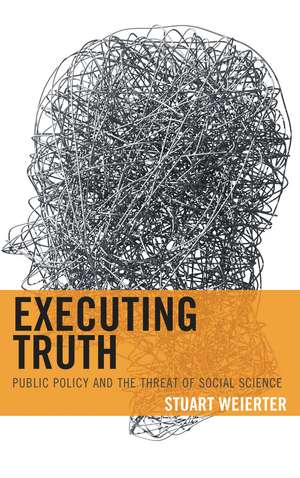
Executing Truth
Autor Stuart Weierteren Limba Engleză Hardback – 26 apr 2019
The author works his way back from the debates in politically applied social science (or policy science) to the foundational thinkers. These include Harold Lasswell, John Dewey, Max Weber, and Georg Hegel. At the end of this journey, Executing Truth calls for a return to the everyday (or the most comprehensive basis for distinguishing between theoretical perspectives), and outlines the implications of this return for those political advisors - state executive actors - tasked with 'speaking truth to power.'
Preț: 582.91 lei
Preț vechi: 863.82 lei
-33%
Puncte Express: 874
Carte tipărită la comandă
Livrare economică 07-21 decembrie
Livrare prin curier în România Termenul estimat este afișat lângă disponibilitate.
Transport gratuit pentru acest produs Plată online sau ramburs, în funcție de opțiunile comenzii.
Retur gratuit în 14 zile Comandă securizată și suport în română.
Specificații
ISBN-13: 9781793603319
ISBN-10: 1793603316
Pagini: 214
Dimensiuni: 157 x 235 x 17 mm
Greutate: 0.49 kg
Editura: Lexington Books
Locul publicării:New York, United States
ISBN-10: 1793603316
Pagini: 214
Dimensiuni: 157 x 235 x 17 mm
Greutate: 0.49 kg
Editura: Lexington Books
Locul publicării:New York, United States
Cuprins
Chapter 1: Introduction
Chapter 2: Truth, Politics, and Public Policy
Chapter 3: Harold Lasswell and the Possibility of Political Science
Chapter 4: John Dewey's Politics of Poetic Craftsmanship
Chapter 5: Rationality in Action: Max Weber's Political Science
Chapter 6: Hegel's Resolution
Chapter 7: Self-Knowledge and the Everyday
Chapter 8: Conclusion - Theory in Practice
Chapter 2: Truth, Politics, and Public Policy
Chapter 3: Harold Lasswell and the Possibility of Political Science
Chapter 4: John Dewey's Politics of Poetic Craftsmanship
Chapter 5: Rationality in Action: Max Weber's Political Science
Chapter 6: Hegel's Resolution
Chapter 7: Self-Knowledge and the Everyday
Chapter 8: Conclusion - Theory in Practice
Recenzii
A bold, philosophically nuanced account of what is truly at stake in the 'perennial problem' of truth and politics. Negatively, the book demonstrates that modern executive attempts to resolve the problem by allying politics with 'impartial' social science necessarily fails; positively, it delineates (via an analysis of key thinkers - Lasswell, Dewey, Weber and Hegel) a path toward adequate resolution. Weierter argues we must turn from the abstract 'truths' of social scientific 'theory' toward philosophical understanding of the 'everyday' in which all, including policy-makers, are necessarily embedded. A challenging book recommended for anyone interested in the enduring conundrum of good policy-making.