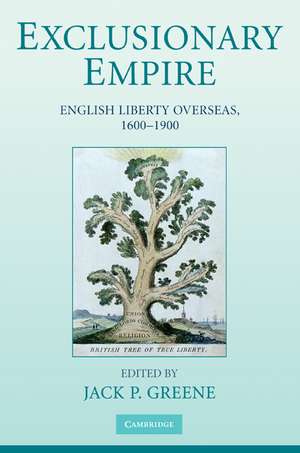
Exclusionary Empire
Editat de Jack Greeneen Limba Engleză Paperback – 16 mar 2017
Lucrarea Exclusionary Empire aduce o perspectivă critică esențială asupra modului în care conceptul de „libertate engleză” a fost exportat în teritoriile de peste mări, demonstrând că acest transfer nu a fost universal, ci profund restrictiv. Observăm cum această ediție coordonată de Jack P. Greene reușește să sintetizeze contribuțiile a zece specialiști pentru a cartografia evoluția instituțiilor juridice și politice britanice în diverse contexte geografice, de la America de Nord și Irlanda până în India și Australia. Spre deosebire de abordările care celebrează simplist statul de drept, acest volum analizează mecanismele prin care accesul la aceste drepturi a fost rezervat exclusiv coloniștilor de origine europeană. Recomandăm acest volum ca o alternativă la Legal Histories of the British Empire de Shaunnagh Dorsett pentru cursurile de istorie imperială, având avantajul unei focalizări specifice pe tensiunea dintre retorica libertății și realitatea excluderii rasiale și de gen. Dacă Shaunnagh Dorsett explorează varietatea abordărilor interdisciplinare ale legii, Exclusionary Empire se concentrează pe „moștenirea culturală” ca instrument de segregare socială. În contextul operei sale, acest volum continuă preocupările lui Jack P. Greene din Negotiated Authorities și Intellectual Construction of America. Dacă în lucrările anterioare autorul a explorat construcția identității americane și dezvoltarea constituțională a coloniilor, aici el extinde cadrul analitic la întreg Imperiul Britanic. Stilul este riguros, academic, iar structura capitolelor facilitează o analiză comparativă între coloniile de așezare și cele de tip administrativ, precum India, oferind o resursă fundamentală pentru înțelegerea limitelor democrației liberale în context colonial.
Preț: 287.10 lei
Carte tipărită la comandă
Livrare economică 21 iulie-04 august
Specificații
ISBN-10: 0521132703
Pagini: 320
Dimensiuni: 156 x 234 x 19 mm
Greutate: 0.55 kg
Editura: Cambridge University Press
Locul publicării:New York, United States
V-ar putea interesa
-
 Lusting for LondonP. MortonPreț: 381.66 lei
 -
 A History In Fragments: Europe in the Twentieth CenturyRichard Vinen-25%Preț: 89.70 lei119.69 lei
 -
 Edward I and the Governance of England, 1272 1307Caroline Burt-14%Preț: 690.90 lei803.37 lei
 -
 The Sexual StateRoger Davidson-26%Preț: 592.56 lei797.46 lei
 -
 Stolen Women in Medieval EnglandCaroline Dunn-14%Preț: 718.61 lei835.60 lei
 -
 Oaths and the English ReformationJonathan Michael Gray-11%Preț: 683.95 lei768.49 lei
 -
 Making Thatchers BritainBen JacksonPreț: 250.15 lei
 -
 Modern Britain, 1750 to the PresentJames VernonPreț: 270.05 lei
 -
 The State of FreedomPatrick JoycePreț: 438.62 lei
 -
 The Letters of Queen VictoriaQueen Victoria-19%Preț: 463.29 lei571.96 lei
De ce să citești această carte
Această carte este esențială pentru cercetătorii și studenții la istorie care doresc să înțeleagă rădăcinile inegalității în fostele colonii britanice. Cititorul câștigă o perspectivă nuanțată asupra modului în care legile și libertățile au fost folosite atât ca instrumente de guvernare, cât și ca bariere sociale. Este un studiu documentat despre cum ideea de libertate a fost, timp de trei secole, un privilegiu definit prin excludere.
Despre autor
Jack P. Greene este un istoric de renume, specialist în istoria colonială britanică și în perioada revoluționară americană. A predat la universități prestigioase precum Michigan State și University of Michigan, înainte de a se stabili la Johns Hopkins University, unde a activat timp de aproape patru decenii. Opera sa vastă include titluri de referință precum The Quest for Power, fiind recunoscut pentru analizele sale profunde asupra dezvoltării politice și constituționale a coloniilor americane. Expertiza sa în evoluția autorității și a identității imperiale conferă volumului Exclusionary Empire o rigoare științifică deosebită.
Descriere scurtă
Cuprins
Recenzii
'The spread of English liberal traditions overseas has long been a central theme in British Imperial history but this is the first book to examine the subject in detail from a comparative perspective. The specialist authors of the various case studies are sensitive to the fact that the extension of liberal traditions to overseas Britons frequently meant the denial of liberty to subordinated peoples throughout the Empire. The result is a volume of wide-ranging, stimulating and nuanced essays that should be required reading for students and scholars interested in the spread of British constitutional ideas across the globe.' Phillip Buckner, University of London
'When the English moved overseas, they expected to take with them their proudest possession - their passionate devotion to liberty. This collection of ten bold, brilliant and often breathtakingly insightful essays on English liberty overseas ranges from colonial North America and the West Indies, to India, and to the white dominion colonies of South Africa and the Antipodes. They help us understand why white settlers were so attached to freedom for themselves and so opposed to freedom for others. Exclusionary Empire, edited by Jack P. Greene, the world's leading historian of politics and identity in the British Empire, is a landmark work in imperial history. In its cosmopolitan and expansive vision of imperial history, it shows us all how exciting, and how relevant, imperial history, done in a non-parochial way, can be. It deserves an extremely wide readership.' Trevor Burnard, University of Warwick
'This extraordinary volume strides across the globe to track the shifting meanings of 'liberty' over four centuries of colonization. Its incisive case studies of North America, the West Indies, Ireland, Canada, India, Australia, and New Zealand show how the extension of British liberty was far from a simple or benign bequest to the world. Exported abroad, political liberalism triggered revolutionary ruptures and rationalized new modes of subjugation. Taken together, these essays imagine a British world defined by the unexpected legal, political, and ideological consequences of colonial settlement.' S. Max Edelson, University of Virginia
'The essays in this excellent book show how British communities overseas formulated claims to the liberty to which the British at home were deemed to be entitled and how they extracted recognition of their rights from metropolitan authority by means varying from armed rebellion to persuasion. 'Free' British societies were created throughout the world, free that is, for people of British origin. The extent to which liberty might be extended to non-British people, especially to conquered indigenous populations, was quite another matter. The obverse of British freedom often turned out to be the subjection of others. This complex theme is explored in a series of powerful studies which deal with a wide variety of colonial societies over a long period of time.' P. J. Marshall, Professor Emeritus, King's College, London
'Exclusion and empire have always been uneasy yet inseparable companions, and the transference overseas of 'English liberties' a persistent leit-motif in the history of British colonial expansion. Shared identity in this world was explicitly exclusive. Against a background of revived interest in white settlement and the 'British world', this valuable collection draws attention to the repressiveness of transferred liberties – self-government, property rights, and the rule of law – as claimed and monopolised by white settlers. Drawing on older traditions of commonwealth history, it also highlights the importance of viewing comparatively the illiberal trajectories of different colonial territories.' Andrew Porter, King's College, London