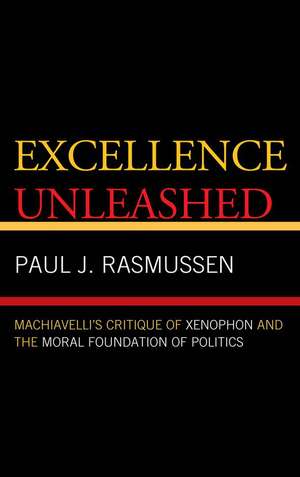
Excellence Unleashed: Machiavelli's Critique of Xenophon and the Moral Foundation of Politics
Autor Paul J. Rasmussenen Limba Engleză Hardback – 16 ian 2009
Excellence Unleashedis a detailed comparison of Machiavelli and Xenophon's political philosophy, focusing on Xenophon's Education of Cyrus and Hiero or On Tyranny and Machiavelli's The Prince and Discourses on Livy. This study examines a number of major themes essential to both writers: the moral and political requirements of healthy republics; imperial expansion; the relationship between human nature, politics, and virtue; the role of religion in politics; the distinction between legitimate and illegitimate rule; and the influence of philosophy on politics. By elucidating the remarkable scope, depth, and subtlety of the debate between these two great thinkers, this book offers a fresh perspective on the philosophic and political significance of Machiavelli's proto-modern break from the classical tradition.
Preț: 599.54 lei
Preț vechi: 909.78 lei
-34%
Puncte Express: 899
Carte tipărită la comandă
Livrare economică 02-16 decembrie
Livrare prin curier în România Termenul estimat este afișat lângă disponibilitate.
Transport gratuit pentru acest produs Plată online sau ramburs, în funcție de opțiunile comenzii.
Retur gratuit în 14 zile Comandă securizată și suport în română.
Specificații
ISBN-13: 9780739128244
ISBN-10: 0739128248
Pagini: 149
Dimensiuni: 161 x 238 x 18 mm
Greutate: 0.39 kg
Editura: Bloomsbury Publishing
Colecția Lexington Books
Locul publicării:New York, United States
ISBN-10: 0739128248
Pagini: 149
Dimensiuni: 161 x 238 x 18 mm
Greutate: 0.39 kg
Editura: Bloomsbury Publishing
Colecția Lexington Books
Locul publicării:New York, United States
Cuprins
Chapter 1 Introduction
Part 2 Part One. Republics and Tyrants
Chapter 3 Chapter 1. Xenophon's Persian Republic
Chapter 4 Chapter 2. Tumults, Liberty, and Tyranny: Machiavelli's Unconventional Republicanism
Chapter 5 Chapter 3. The Reform of Tyranny in Xenophon's Hiero
Part 6 Part Two. Princes and Philosophers
Chapter 7 Chapter 4. The Legacy of Cyrus and the Limits of Politics
Chapter 8 Chapter 5. Cyrus' Socratic Education
Chapter 9 Chapter 6. Machiavelli's Cyrus and the Humanity of Effective Rule
Chapter 10 Chapter 7. Glory, Moral Innovation, and the Christian Prince
Chapter 11 Conclusion: The Philosopher and Politics
Part 2 Part One. Republics and Tyrants
Chapter 3 Chapter 1. Xenophon's Persian Republic
Chapter 4 Chapter 2. Tumults, Liberty, and Tyranny: Machiavelli's Unconventional Republicanism
Chapter 5 Chapter 3. The Reform of Tyranny in Xenophon's Hiero
Part 6 Part Two. Princes and Philosophers
Chapter 7 Chapter 4. The Legacy of Cyrus and the Limits of Politics
Chapter 8 Chapter 5. Cyrus' Socratic Education
Chapter 9 Chapter 6. Machiavelli's Cyrus and the Humanity of Effective Rule
Chapter 10 Chapter 7. Glory, Moral Innovation, and the Christian Prince
Chapter 11 Conclusion: The Philosopher and Politics
Recenzii
Excellence Unleashed is a fine comparison of Machiavelli and his favorite classical author Xenophon that is long overdue. Rasmussen accompanies his careful analysis with useful strictures and shrewd insights.
Excellence Unleashed is an analysis at once compact and penetrating of Machiavelli's critique of Xenophon. . . . Ramussen's book is undoubtedly a valuable addition to the literature on Machiavelli and Xenophon. His prose is remarkably clear and his analyses are forceful, convincing and well grounded in the texts he considers.
When it comes to the qualities characteristic of contemporary academic writing, lucidity is in the underrepresented minority. Rasmussen's prose exemplifies this virtue as it explores two authors who delight us even as they quicken our thoughts. His crisp formulations make familiar points seem new, and he then goes beyond them by establishing such new connections as the relationship between Machiavelli's critique of Xenophon and his critique of Christianity. This tour de force is accurately described by its own title.
Excellence Unleashed is an analysis at once compact and penetrating of Machiavelli's critique of Xenophon. . . . Ramussen's book is undoubtedly a valuable addition to the literature on Machiavelli and Xenophon. His prose is remarkably clear and his analyses are forceful, convincing and well grounded in the texts he considers.
When it comes to the qualities characteristic of contemporary academic writing, lucidity is in the underrepresented minority. Rasmussen's prose exemplifies this virtue as it explores two authors who delight us even as they quicken our thoughts. His crisp formulations make familiar points seem new, and he then goes beyond them by establishing such new connections as the relationship between Machiavelli's critique of Xenophon and his critique of Christianity. This tour de force is accurately described by its own title.