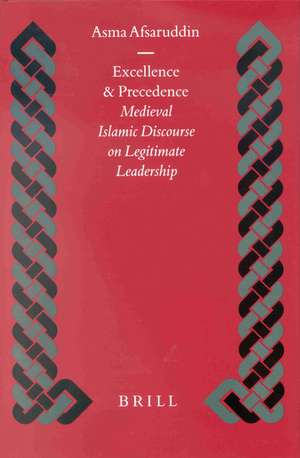
Excellence and Precedence
Autor Asma Afsaruddinen Limba Engleză Hardback – 20 feb 2002
Preț: 760.68 lei
Preț vechi: 927.66 lei
-18%
Puncte Express: 1141
Preț estimativ în valută:
134.67€ • 156.81$ • 116.99£
134.67€ • 156.81$ • 116.99£
Carte indisponibilă temporar
Doresc să fiu notificat când acest titlu va fi disponibil:
Se trimite...
Preluare comenzi: 021 569.72.76
Specificații
ISBN-13: 9789004120433
ISBN-10: 9004120432
Pagini: 324
Dimensiuni: 167 x 243 x 27 mm
Greutate: 0.73 kg
Editura: Brill
ISBN-10: 9004120432
Pagini: 324
Dimensiuni: 167 x 243 x 27 mm
Greutate: 0.73 kg
Editura: Brill
Public țintă
All those interested in Islamic studies, early religious and political history of Islam, ḥadīth literature, Qur'ānic studies, and Sunnī-Shī‘ī relations.Notă biografică
Asma Afsaruddin, Ph.D. (1993) in Near Eastern Studies, the Johns Hopkins University, is Assistant Professor of Arabic and Islamic Studies at the University of Notre Dame. She recently edited Hermeneutics and Honor: Negotiating Female "Public" Space in Islamic/ate Societies (Cambridge, Mass., 1999).
Recenzii
'Scholars of Islamic history should breathe a communal sigh of relief with the appearance of Afsaruddin's in-depth analysis in Excellence and Precedence...Afsaruddin's study, notably its meticulous approach to surveying an impressive range of primary sources in Arabic, will be appreciated by those scholars who wish to know more about such polemics and the theoretical underpinnings that come with them.'
Colin Paul Mitchell, Journal of the American Oriental Society, 2004.
'Afsaruddin’s work…is truly seminal…the book’s epistemic value is immense…In academe, the work should be a vital part of any reading list for graduate comprehensive examinations in Islamic studies.'
Khaleel Mohammed, H-Net Reviews, 2004.
Colin Paul Mitchell, Journal of the American Oriental Society, 2004.
'Afsaruddin’s work…is truly seminal…the book’s epistemic value is immense…In academe, the work should be a vital part of any reading list for graduate comprehensive examinations in Islamic studies.'
Khaleel Mohammed, H-Net Reviews, 2004.