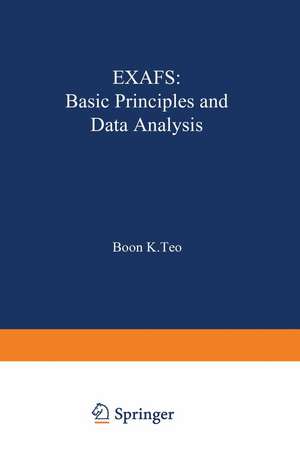
EXAFS: Basic Principles and Data Analysis: Inorganic Chemistry Concepts, cartea 9
Autor Boon K. Teoen Limba Engleză Paperback – 14 apr 2014




Preț: 416.71 lei
Puncte Express: 625
Carte tipărită la comandă
Livrare economică 28 noiembrie-04 decembrie
Livrare prin curier în România Termenul estimat este afișat lângă disponibilitate.
Transport gratuit pentru acest produs Plată online sau ramburs, în funcție de opțiunile comenzii.
Retur gratuit în 14 zile Comandă securizată și suport în română.
Specificații
ISBN-13: 9783642500336
ISBN-10: 3642500331
Pagini: 368
Ilustrații: XVIII, 349 p.
Dimensiuni: 156 x 244 x 20 mm
Greutate: 0.58 kg
Ediția:1986
Editura: Springer
Colecția Inorganic Chemistry Concepts
Seria Inorganic Chemistry Concepts
Locul publicării:Berlin, Heidelberg, Germany
ISBN-10: 3642500331
Pagini: 368
Ilustrații: XVIII, 349 p.
Dimensiuni: 156 x 244 x 20 mm
Greutate: 0.58 kg
Ediția:1986
Editura: Springer
Colecția Inorganic Chemistry Concepts
Seria Inorganic Chemistry Concepts
Locul publicării:Berlin, Heidelberg, Germany
V-ar putea interesa
-
 The Elements: A Very Short IntroductionPhilip Ball-19%Preț: 57.73 lei71.46 lei
 -
 -40%Preț: 343.20 lei567.28 lei
 -
 Encyclopedia of the Alkaline Earth CompoundsRichard C. Ropp-30%Preț: 1815.56 lei2577.20 lei
 -
 Magnetism and Transition Metal ComplexesF E MabbsPreț: 82.53 lei
 -
 Concise Inorganic ChemistryJ D Lee-8%Preț: 632.93 lei687.97 lei
 -
 Principles of Inorganic ChemistryBrian W. Pfennig-23%Preț: 1316.36 lei1709.56 lei
 -
 Luminescence of Lanthanide Ions in Coordination Compounds and NanomaterialsAna De Bettencourt-Dias-23%Preț: 1051.11 lei1365.08 lei
 -
 RareKeith VeronesePreț: 217.17 lei
 -
 Calcium Phosphate: Structure, Synthesis, Properties, & ApplicationsRobert B. Heimann-26%Preț: 1230.10 lei1667.81 lei
 -
 Preț: 355.97 lei
Public țintă
GraduateCuprins
1. X-Rays and Electrons.- 1.1 Introduction.- 1.2 Generation of X-Rays.- 1.3 Properties of X-Rays and Electrons.- 1.4 Electronic Structure of Atoms.- 1.5 Absorption Coefficients and Absorption Edges.- 1.6 Interactions of Photons and Electrons with Matter.- 2. Extended X-Ray Absorption Fine Structure (EXAFS) Spectroscopy.- 2.1 EXAFS Spectroscopy.- 2.2 Theory.- 2.3 Data Analysis.- 3. EXAFS Parameters.- 3.1 Variables and Functions.- 3.2 Effects of Important Parameters.- 3.3 Convention of Changing E0.- 4. Theory of EXAFS.- 4.1 Introduction.- 4.2 Derivations of EXAFS Theory.- 4.3 EXAFS of L Edges.- 4.4 The Photoelectron and the Excited Atom.- 5. Improvement of EXAFS Theory.- 5.1 Energy Threshold — The Phase Problem.- 5.2 Inelastic Scatterings — The Amplitude Problem.- 5.3 Static and Thermal Disorder Effects.- 5.4 Multiple Scattering EXAFS Formalism.- 6. Data Analysis in Practice.- 6.1 Data Reduction.- 6.2 Fourier Transform (FT).- 6.3 Fourier Filtering (FF).- 6.4 Curve Fitting (CF).- 6.5 Parameter Correlation and the FABM Method.- 6.6 The “Difference” Technique.- 6.7 The Min-Max Method.- 6.8 Decomposition into Amplitude and Phase.- 6.9 The Beat-node Method.- 6.10 The Lee and Beni Method.- 6.11 The r Space Method.- 6.12 The Phase Linearization Method.- 6.13 The Regularization Algorithm.- 6.14 Other More Specialized Methods.- 7. Theoretical Amplitude and Phase Functions.- 7.1 Introduction.- 7.2 Theoretical Methods.- 7.3 Theoretical Amplitude and Phase Functions.- 7.4 Properties of Amplitude and Phase Functions.- 7.5 Comparison of Theory and Experiment.- 8. Multiple Scattering and Bond Angle Determination.- 8.1 Scattering Amplitude and Phase.- 8.2 Multiple Scattering.- 8.3 Comparison of Theory and Experiment.- 8.4 Angle Determination.- 8.5 Conclusion.- Appendix I. ThePeriodic Table.- Appendix II. X-Ray Absorption Edges and Characteristic X-Ray Emission Lines.- Appendix III. Victoreen’s C and D Values for True Absorption.- Appendix IV. Fluorescence Yields.- Appendix V. Backscattering Amplitude, Backscattering Phase, and Central Atom Phase.