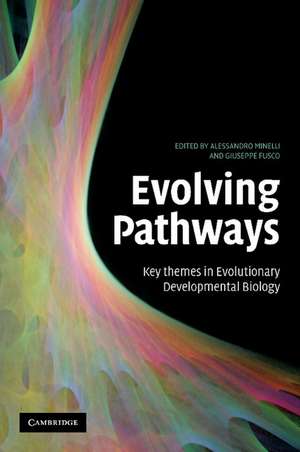
Evolving Pathways
Autor Giuseppe Fusco Editat de Alessandro Minellien Limba Engleză Paperback – 20 mar 2012
Preț: 451.24 lei
Puncte Express: 677
Carte tipărită la comandă
Livrare economică 18 noiembrie-02 decembrie
Livrare prin curier în România Termenul estimat este afișat lângă disponibilitate.
Transport gratuit pentru acest produs Plată online sau ramburs, în funcție de opțiunile comenzii.
Retur gratuit în 14 zile Comandă securizată și suport în română.
Specificații
ISBN-13: 9781107405455
ISBN-10: 1107405459
Pagini: 446
Dimensiuni: 152 x 229 x 25 mm
Greutate: 0.64 kg
Editura: Cambridge University Press
Locul publicării:New York, United States
ISBN-10: 1107405459
Pagini: 446
Dimensiuni: 152 x 229 x 25 mm
Greutate: 0.64 kg
Editura: Cambridge University Press
Locul publicării:New York, United States
V-ar putea interesa
-
 -24%Preț: 730.69 lei965.70 lei
 -
 Perspectives in Animal Phylogeny and EvolutionAlessandro Minelli-25%Preț: 524.70 lei697.88 lei
 -
 Preț: 105.53 lei
 -
 Probability and Mathematical GeneticsN. H. Bingham-11%Preț: 631.67 lei709.73 lei
 -
 Information Theory, Evolution, and the Origin of LifeYockey Hubert P.Preț: 443.06 lei
 -
 Essential BioinformaticsJin Xiong-19%Preț: 627.94 lei775.24 lei
 -
 Genomes, Browsers and DatabasesPeter SchattnerPreț: 402.08 lei
 -
 The Phylogenetic HandbookPhilippe Lemey-11%Preț: 518.87 lei583.01 lei
 -
 BLASTIan KorfPreț: 289.01 lei
 -
 A Primer of Genome ScienceGreg Gibson-27%Preț: 901.72 lei1235.23 lei
 -
 Dance to the Tune of LifeDenis NoblePreț: 192.27 lei
 -
 -5%Preț: 412.30 lei434.00 lei
 -
 Preț: 201.72 lei
Cuprins
Preface; Introduction: pathways of change; Part I. Thinking about Evolution by Taking Development Seriously: 1. Evo-devo as a discipline Gerd B. Müller; 2. Making evolutionary predictions about the structure of development and morphology: beyond the neo-Darwinian and constraints paradigms Isaac Salazar-Ciudad; 3. Conflicting hypotheses on the nature of mega-evolution Wallace Arthur; 4. Prospects of evo-devo for linking pattern and process in the evolution of morphospace Paul M. Brakefield; 5. The molecular biology underlying developmental evolution Claudio R. Alonso; 6. Evo-devo's identity: from model organisms to developmental types Ronald A. Jenner; Part II. Evo-Devo - Materials and Methods: 7. A pragmatic approach for selecting evo-devo model species in Amniotes Athanasia Tzika and Michel C. Milinkovitch; 8. On comparisons and causes in evolutionary developmental biology Gerhard Scholtz; 9. Evolution and development: towards a synthesis of macro- and micro-evolution with ecology Hans Zauner and Ralf J. Sommer; 10. When is a hox gene not a hox gene? The importance of gene nomenclature David E. K. Ferrier; 11. Plants are used to having identity crises Rolf Rutishauser, Valentin Grob and Evelin Pfeifer; Part III. Evolving Diversity: 12. Unravelling body-plan and axial evolution in the bilateria with molecular phylogenetic markers Jaume Baguñà, Pere Martinez, Jordi Paps and Marta Riutort; 13. Are transposition events at the origin of the bilaterian hox complexes? Jean S. Deutsch and Philippe Lopez; 14. Many roads lead to Rome: different ways to construct a nematode Einhard Schierenberg and Jens Schulze; 15. Basal Euarthropod development: a fossil-based perspective Nigel C. Hughes, Joachim Haug and Dieter Waloszek; 16. Developmental transitions during the evolution of plant form Jane A. Langdale and C. Jill Harrison; Part IV. Evolving Body Features: 17. Urbisexuality: the evolution of bilaterian germ cell specification and reproductive systems Cassandra G. M. Extavour; 18. Thoughts and speculations on the ancestral arthropod segmentation pathway Ariel D. Chipman; 19. Evolution of neurogenesis in arthropods Angelika Stollewerk; 20. Arthropod appendages: a prime example for the evolution of morphological diversity and innovation Nikola-Michael Prpic and Wim G. M. Damen; 21. Ontogeny of the spiralian brain Claus Nielsen.
Recenzii
"This is a book rich and diverse in content, which renders it impossible to do justice to every individual chapter in the context of a book review."
Olivier Rieppel, Evolution & Development
Olivier Rieppel, Evolution & Development
Descriere
This is an integrated overview of a diverse range of approaches to studying 'evo-devo', for researchers and graduate students.