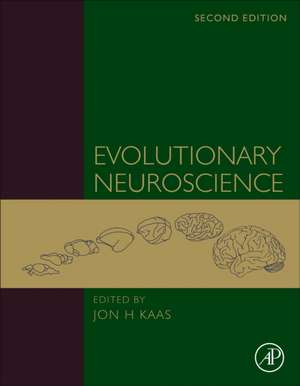
Evolutionary Neuroscience
Editat de Jon H. Kaasen Limba Engleză Hardback – iun 2020
Evoluția neuroștiințelor din ultimele decenii a fost marcată de o tranziție de la observații pur morfologice către o înțelegere integrată a mecanismelor genetice și funcționale care au modelat sistemul nervos. Evolutionary Neuroscience, editat de Jon H. Kaas și publicat de ELSEVIER SCIENCE, reflectă această maturizare a domeniului, oferind o sinteză riguroasă a modului în care structurile neuronale s-au diversificat de la primele vertebrate până la complexitatea umană. Notăm cu interes faptul că această a doua ediție nu este doar o revizuire, ci o recalibrare a materialului sursă din monumentala serie Evolution of Nervous Systems, fiind optimizată pentru a servi drept resursă de sine stătătoare pentru studiile universitare.
Comparabil cu Evolution of the Brain, Cognition, and Emotion in Vertebrates în ceea ce privește rigoarea abordării, volumul de față se distinge prin actualizarea datelor conform celor mai recente deducții din studiile comparate și prin accentul pus pe reconstrucția caracterelor filogenetice. Structura cărții este exemplară pentru un tratat academic: începe cu fundamentele teoretice și istorice, progresează prin analiza peștilor, amfibienilor și reptilelor, culminând cu secțiuni detaliate despre neocortexul mamiferelor și specializările creierului de primată. Această progresie logică permite cititorului să urmărească firul transformărilor evolutive prin prisma principiilor de scalare și a modificărilor sistemelor senzoriale majore.
Poziția lui Jon H. Kaas ca editor este esențială; experiența sa acumulată în lucrări precum Cerebral Cortex și The Primate Visual System se traduce aici printr-o rigoare editorială care armonizează contribuțiile unor lideri de opinie din domeniu. Prezența celor 300 de ilustrații color facilitează înțelegerea unor concepte abstracte, transformând cele peste 900 de pagini într-un instrument de lucru vizual și analitic indispensabil.
Preț: 1049.09 lei
Preț vechi: 1375.50 lei
-24%
Carte tipărită la comandă
Livrare economică 28 noiembrie-12 decembrie
Specificații
ISBN-10: 0128205849
Pagini: 962
Ilustrații: Approx. 300 illustrations (300 in full color)
Dimensiuni: 216 x 276 x 91 mm
Greutate: 3.06 kg
Ediția:2nd edition
Editura: ELSEVIER SCIENCE
V-ar putea interesa
-
 -19%Preț: 718.01 lei890.08 lei
 -
 -25%Preț: 815.67 lei1081.10 lei
 -
 The Laughing BabyCaspar Addyman-29%Preț: 97.07 lei136.77 lei
Public țintă
Comparative neuroanatomists, biologists and neuroscientists, neuroscience graduate students and undergraduate majorsDe ce să citești această carte
Această ediție a doua reprezintă resursa definitivă pentru oricine studiază biologia evolutivă și neuroanatomia. Cititorul câștigă acces la o sinteză a celor mai noi cercetări despre dezvoltarea neocortexului și a sistemelor senzoriale, beneficiind de expertiza unor cercetători de talie mondială. Este o investiție necesară pentru bibliotecile universitare și pentru specialiștii care doresc să înțeleagă arhitectura creierului uman dintr-o perspectivă istorică și biologică vastă.
Cuprins
Part 1: History, Concepts, and Theory 1. History of Ideas on Brain Evolution 2. Phylogenetic Character Reconstruction 3. The role of endocasts in the study of brain evolution 4. Invertebrate origins of vertebrate nervous systems
Part 2: The Brains of Fish, Amphibians, Reptiles and Birds 5. The nervous systems of jawless vertebrates 6. The brains of cartilaginous fishes 7. The organization of the central nervous system of amphibians 8. The brains of reptiles and birds 9. Function and evolution of the reptilian cerebral cortex 10. The cerebellum of non-mammalian vertebrates
Part 3: Early Mammals and Subsequent Adaptations 11. Emergence of mammals 12. Mammalian Evolution: The phylogenetic story 13. Organization of neocortex in early mammals 14. What modern mammals teach us about the cellular composition of early brains and mechanisms of brain evolution 15. Consistencies and variances in the anatomical organization of aspects of the mammalian brain stem 16. Comparative anatomy of glial cells in mammals 17. The monotreme nervous system 18. Evolution of flight and echolocation in bats 19. Carnivore brains: Effects of sociality on inter- and intra-specific comparisons of regional brain volumes
Part 4: Primates 20. Phylogeny of primates 21. Expansion of the cortical sheet in primates 22. Scaling up the simian primate cortex: A conserved pattern of expansion across brain sizes 23. Evolution of visual cortex in primates 24. Evolution of subcortical pathways to the extrastriate cortex 25. Evolved mechanisms of high-level visual perception in primates 26. Evolution of parietal cortex in primates 27. Evolution of parietal-frontal networks in primates 28. Evolution of the prefrontal cortex in early primates and anthropoids
Part 5: Evolution of Human Brains 29. Introduction to human brain evolutionary studies 30. Human evolutionary history 31. Evolution of human life history 32. The fossil evidence of human brain evolution 33. Remarkable, but not special: What human brains are made of 34. Timing of brain maturation, early experience, and the human social niche 35. Human association cortex: Expanded, untethered, neoteneous, and plastic 36. On the evolution of the frontal eye field: comparisons of monkeys, apes and humans 37. The evolution of auditory cortex in humans 38. Language evolution 39. The search for human cognitive specializations
Descriere
Evolutionary Neuroscience, Second Edition, is a collection of chapters on brain evolution that combines selected topics from the recent comprehensive reference, Evolution of Nervous Systems (Elsevier, Academic Press, 2017, https://www.elsevier.com/books/evolution-of-nervous-systems/kaas/978-0-12-804042-3). The selected chapters cover a broad range of topics, from historical theory, to the most recent deductions from comparative studies of brains. The articles are organized in sections focused on history, concepts and theory, the evolution of brains from early vertebrates to present-day fishes, amphibians, reptiles and birds, the evolution of mammalian brains, and the evolution of primate brains, including human brains.
Each chapter is written by a leader or leaders in the field. Specific topics include brain character reconstruction, principles of brain scaling, basic features of vertebrate brains, the evolution of the major sensory systems, other parts of brains, what we can learn from fossils, the origin of neocortex, and the evolution of specializations of human brains. The collection of articles will be interesting to anyone who is curious about how brains evolved from the simpler nervous systems of the first vertebrates into the many different complex forms now found in present-day vertebrates.
- Provides the most comprehensive, authoritative and up-to-date single volume collection on brain evolution
- Presents a full color treatment, with many illustrations
- Written by leading scholars and experts
- Features chapters on brain character reconstruction, principles of brain scaling, basic features of vertebrate brains, the evolution of the major sensory systems, and other parts of brains
- Discusses what we can learn from fossils, the origin of neocortex, and the evolution of specializations of human brains