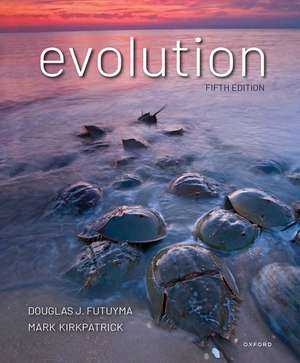
Evolution
Autor Douglas Futuyma, Mark Kirkpatricken Limba Engleză Hardback – 20 oct 2022
Remarcăm în această a cincea ediție a Evolution o schimbare strategică în prezentarea biologiei evoluționiste, menită să transforme disciplina dintr-o succesiune de fapte istorice într-un proces viu de cercetare. Suntem de părere că integrarea casetelor „What We Don't Know” reprezintă un element distinctiv esențial; acestea nu doar că semnalizează limitele actuale ale cunoașterii, dar încurajează studenții să vadă știința ca pe un sistem aflat în continuă revizuire. Textul ghidează cititorul prin metodologia testării ipotezelor, oferind un cadru riguros pentru formularea predicțiilor și validarea lor prin observație.
Notăm cu interes atenția sporită acordată capitolului 21, „The Evolutionary Story of Homo sapiens”. Această secțiune a fost recalibrată pentru a evidenția conexiunile directe dintre biologia evoluționistă și sănătatea umană, oferind contextul necesar studenților de la medicină. Din punct de vedere pedagogic, Douglas Futuyma și Mark Kirkpatrick au structurat cele 592 de pagini folosind obiective de învățare clare și marcaje de sinteză, asigurând un ritm de lectură alert și o structură logică.
Acoperă aceeași arie ca Evolutionary Analysis de Scott Freeman, dar cu o abordare mai tehnică și mai axată pe instrumentarul cantitativ. În timp ce manualul lui Freeman pune accent pe entuziasmul cercetării prin întrebări deschise, Evolution oferă un suport mai dens pentru analiza datelor, incluzând un „Statistics Primer” care familiarizează studentul cu distribuțiile de probabilitate și estimările statistice. Această lucrare se înscrie în linia de rigoare academică stabilită de autor prin proiecte anterioare, precum Oxford Surveys in Evolutionary Biology: Volume 7: 1990, unde sinteza între teorie și datele empirice era deja prioritară. Ediția de față, publicată de Oxford University Press, rămâne un standard pentru curricula universitară, oferind claritate într-un domeniu care integrează ecologia, genetica și paleobiologia.
Preț: 791.52 lei
Preț vechi: 920.37 lei
-14%
Carte disponibilă
Livrare economică 19-24 noiembrie
Specificații
ISBN-10: 0197619614
Pagini: 592
Dimensiuni: 276 x 229 mm
Greutate: 2.25 kg
Ediția:5
Editura: Oxford University Press
Colecția OUP USA
Locul publicării:New York, United States
De ce să citești această carte
Recomandăm acest volum studenților și cercetătorilor care doresc să depășească nivelul descriptiv al biologiei. Prin exercițiile de analiză a datelor și fundamentarea statistică, Evolution oferă instrumentele practice necesare pentru a gândi analitic. Cititorul câștigă o înțelegere profundă a mecanismelor selecției naturale, beneficiind în același timp de cele mai noi perspective asupra evoluției umane, într-un format academic de referință.
Despre autor
Douglas Futuyma este un distins profesor și cercetător, recunoscut la nivel internațional pentru contribuțiile sale fundamentale în biologia evoluționistă. Lucrările sale sunt piloni ai educației academice, autorul fiind cunoscut pentru capacitatea de a sintetiza domenii complexe precum genetica populațiilor și sistematica. A coordonat publicații prestigioase, precum Oxford Surveys in Evolutionary Biology: Volume 7: 1990, reflectând un angajament pe termen lung față de avansul teoretic al disciplinei. Alături de Mark Kirkpatrick, specialist în genetică și modelare matematică, Futuyma aduce în această ediție de la Oxford University Press o perspectivă actualizată asupra modului în care datele genomice revoluționează înțelegerea noastră despre viață.
Descriere
Because all organisms, and all their characteristics, are products of a history of evolutionary change, the scope of an evolutionary biology course can be an overwhelming challenge for students; organismal biology, including paleobiology, ecology, animal behavior, physiology and systematics are all central to evolutionary biology. Instructors want students to gain a big picture view in which they understand the general principles of evolution and the process of evolutionary change. In Evolution, 5e the authors provide learning objectives for each major section that are supported by signposts at key points in the manuscript to highlight and summarize key takeaways. A broader view of the subject is presented by using abstract concepts, such as natural selection, and providing a range of applications and implications so that students can recognize evolutionary patterns of change. Students in this course also struggle with thinking like scientists-they need to understand theoretical hypotheses and ideas, and how and why the empirical study provides evidence for them.Evolution guides the student through hypothesis testing by posing informed hypotheses, making predictions based on what we do know, and judging the validity of each hypothesis vis-a-vis observations. Part of any discussion of hypothesis testing is acknowledging that evolution, like other branches of science, is evolving. In this edition, the authors include What We Don't Know boxes that convey that scientific ideas are constantly being tested and revised. Students struggle with quantitative skills and need practice manipulating data in this course. End of chapter Data Analysis questions gives students practice in performing calculations, experimental design, and interpreting and analyzing data. As additional support, the authors have included a Statistics Primer that introduces the concept of a probability distribution, reviews how statistics are used to describe populations, looks at how to estimate quantities, and discusses how hypotheses are tested. Evolution can be a required course for biology majors with health career aspirations and they don't see the relevance of evolutionary biology to their professional goals. In Evolution, 5e the authors focus on deepening and highlighting the coverage of human biology to engage students, both through in text examples and a stronger focus on human evolution in Chapter 21, The Evolutionary Story of Homo sapiens. The 5e will also feature an enhanced eBook which will include embedded self-assessment questions, interactive figures, data exercises with white board videos that use real data sets from the literature, and simulation exercises. BoClip videos, if available, will round out this robust enhanced ebook.
Recenzii
Very good combination of large-scale evolutionary trends and overview of our understanding of evolution of Homo sapiens." - Alyssa Bell, Cal Poly Pomona
Generally quite well-organized and clearly written. Important topics are generally covered to a level that I would feel is appropriate for students in my class. The examples are generally interesting and well-illustrated." - Rene Malenfant, University of New Brunswick