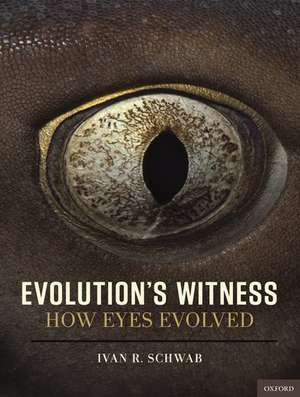
Evolution's Witness: How eyes evolved
Autor Ivan R. Schwaben Limba Engleză Hardback – 5 ian 2012
Preț: 656.14 lei
Preț vechi: 959.00 lei
-32%
Puncte Express: 984
Carte tipărită la comandă
Livrare economică 27 noiembrie-08 decembrie
Livrare prin curier în România Termenul estimat este afișat lângă disponibilitate.
Transport gratuit pentru acest produs Plată online sau ramburs, în funcție de opțiunile comenzii.
Retur gratuit în 14 zile Comandă securizată și suport în română.
Specificații
ISBN-13: 9780195369748
ISBN-10: 0195369742
Pagini: 328
Dimensiuni: 282 x 224 x 25 mm
Greutate: 1.35 kg
Editura: Oxford University Press
Colecția OUP USA
Locul publicării:New York, United States
ISBN-10: 0195369742
Pagini: 328
Dimensiuni: 282 x 224 x 25 mm
Greutate: 1.35 kg
Editura: Oxford University Press
Colecția OUP USA
Locul publicării:New York, United States
V-ar putea interesa
-
 -19%Preț: 68.56 lei85.15 lei
 -
 Origins of Life: From the Birth of Life to the Origin of LanguageJohn Maynard Smith-17%Preț: 162.40 lei195.86 lei
 -
 The Artful Species: Aesthetics, Art, and EvolutionStephen Davies-18%Preț: 272.58 lei333.68 lei
 -
 Behavioural EcologyÉtienne Danchin-19%Preț: 537.17 lei666.10 lei
 -
 -24%Preț: 561.95 lei743.81 lei
 -
 Darwin the WriterGeorge Levine-16%Preț: 208.86 lei249.23 lei
 -
 Moral OriginsChristopher BoehmPreț: 235.00 lei
 -
 Epigenetics – Linking Genotype and Phenotype in Development and EvolutionBenedikt Hallgrímsson-5%Preț: 721.77 lei759.75 lei
 -
 Programming of LifeDonald E. JohnsonPreț: 79.13 lei
 -
 -19%Preț: 110.01 lei136.31 lei
Recenzii
I found myself being drawn further into it the more I read.
Amazing color photos on nearly every page ensure a vivid trek through evolution of the eye....Evolution's Witness in whole or part, is an essential mainstay for multiple disciplines, irreplaceable for vision scientists and eye care professionals.
Ivan Schwabs landmark new book,Evolutions Witness, which charts the development of eyes in all major taxa, comes at a propitious time.... it is a comprehensive reference but also a source of inspiration and ideas for new ways to study myriad aspects of vision.
In Evolutions witness: how eyes evolved, Ivan R Schwab ventures back nearly 4,000 million years to witness the key events that have shaped the ability to form an image and trace the evolution of an organ that was considered by Charles Darwin to be almost perfect... Any person interested in comparative neurobiology will find this book a must and will marvel at how natural selection has driven adaptational change... this comprehensive and beautifully illustrated text should sit on the shelves of all students, graduates and academics with an interest in evolution, adaptation, neural plasticity and natural history. For those more intimately working in the field of visual neuroscience (including optometrists and ophthalmologists), it provides a unique and holistic perspective that provides the context in which we are all working.
Amazing color photos on nearly every page ensure a vivid trek through evolution of the eye....Evolution's Witness in whole or part, is an essential mainstay for multiple disciplines, irreplaceable for vision scientists and eye care professionals.
Ivan Schwabs landmark new book,Evolutions Witness, which charts the development of eyes in all major taxa, comes at a propitious time.... it is a comprehensive reference but also a source of inspiration and ideas for new ways to study myriad aspects of vision.
In Evolutions witness: how eyes evolved, Ivan R Schwab ventures back nearly 4,000 million years to witness the key events that have shaped the ability to form an image and trace the evolution of an organ that was considered by Charles Darwin to be almost perfect... Any person interested in comparative neurobiology will find this book a must and will marvel at how natural selection has driven adaptational change... this comprehensive and beautifully illustrated text should sit on the shelves of all students, graduates and academics with an interest in evolution, adaptation, neural plasticity and natural history. For those more intimately working in the field of visual neuroscience (including optometrists and ophthalmologists), it provides a unique and holistic perspective that provides the context in which we are all working.
Notă biografică
Ivan R. Schwab M.D. is currently a professor at the University of California, Davis where he has worked as an Ophthalmologist for over twenty years, and was on the faculty at West Virginia University for seven years before coming to UCD. His strong interest in biology and natural history has led him to investigate a diverse range of topics including ocular stem cells, bioengineered tissues for the eye and comparative optics and physiology. He has published extensively in these fields, with three previous books to his credit, and he was the winner of the 2006 IgNobel for Ornithology. He has combined those interests with one in evolution to produce this text on the evolution of the eye.