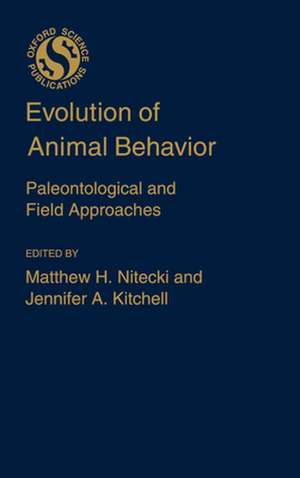
Evolution of Animal Behaviour: Paleontological and Field Approaches
Editat de Matthew H. Nitecki, Jennifer A. Kitchellen Limba Engleză Hardback – 6 noi 1986
Preț: 661.58 lei
Preț vechi: 960.49 lei
-31%
Puncte Express: 992
Carte tipărită la comandă
Livrare economică 27 noiembrie-08 decembrie
Livrare prin curier în România Termenul estimat este afișat lângă disponibilitate.
Transport gratuit pentru acest produs Plată online sau ramburs, în funcție de opțiunile comenzii.
Retur gratuit în 14 zile Comandă securizată și suport în română.
Specificații
ISBN-13: 9780195040067
ISBN-10: 0195040066
Pagini: 184
Ilustrații: halftones, linecuts, tables
Dimensiuni: 160 x 243 x 18 mm
Greutate: 0.49 kg
Editura: Oxford University Press
Colecția OUP USA
Locul publicării:New York, United States
ISBN-10: 0195040066
Pagini: 184
Ilustrații: halftones, linecuts, tables
Dimensiuni: 160 x 243 x 18 mm
Greutate: 0.49 kg
Editura: Oxford University Press
Colecția OUP USA
Locul publicării:New York, United States
V-ar putea interesa
-
 Anything I Can Do... You Can Do BetterTessa SouterPreț: 89.37 lei
 -
 Evolutionary Ecology of BirdsPeter Bennett-28%Preț: 451.51 lei631.08 lei
 -
 Sexual Selection and the Barn SwallowAnders Pape Møller-20%Preț: 308.32 lei383.53 lei
 -
 Harriers of the World: Their Behaviour and EcologyRobert Simmons-32%Preț: 526.76 lei779.66 lei
 -
 Who Killed the Great Auk?Jeremy Gaskell-33%Preț: 633.73 lei939.76 lei
 -
 -31%Preț: 828.25 lei1197.33 lei
 -
 Ecological and Environmental Physiology of AmphibiansStanley S. Hillman-22%Preț: 505.19 lei647.81 lei
 -
 Ptilochronology: Feather time and the biology of birdsThomas C. Grubb, Jr.-33%Preț: 754.92 lei1123.31 lei
 -
 Raptors of the World: A Field GuideJames Ferguson-Lees-41%Preț: 198.49 lei336.43 lei
Cuprins
INTRODUCTION; Jennifer A Kitchell & Matthew H Nitecki: Evolution and behaviour; HISTORICAL APPROACHES TO THE EVOLUTION OF BEHAVIOUR: George V Lauder: Homology, analogy, and the evolution of behaviour; John H Ostrom-Peabody: Social and unsocial behaviour in dinosaurs; Adolf Seilacher: Evolution of behaviour as expressed in marine trace fossils; Jennifer A Kitchell: The evolution of predator-prey behaviour: Naticid gastropods and their molluscan prey; FIELD AND EXPERIMENTAL APPROACHES TO THE EVOLUTION OF BEHAVIOUR: Randy Thornhill: Relative parental contribution of the sexes to their offspring and the operation of sexual selection; John W Fitzpatrick & Glen E Woolfenden: Demographic routes to cooperative breeding in some New World jays; Jean Altmann: Parent-offspring interactions in Arthropoid Primates: an evolutionary perspective; Index.
Recenzii
'This is a valuable book that contains a good blend of topics.' Animal Behaviour
Any successful treatment of the phylogeny of the animal kingdom these days should have three things: 1) a solid knowledge of all the groups, 2) a cladistic approach, and 3) a love of the myriad diversity of the creatures themselves. Claus Nielsen's new book has all three of these ... I find that the author has done a remarkable job of making sense of invertebrates ... a find piece of work.
Claus NIELSEN writes that his book is "not meant as an alternative to the several recent textbooks of systematic zoology, but as a supplement ...". Compared to these, Claus NIELSEN provides more original illustrations, a more elaborate discussion of alternative hypotheses, more intriguing phylogenetic arguments, and definitely easier reading.
Any successful treatment of the phylogeny of the animal kingdom these days should have three things: 1) a solid knowledge of all the groups, 2) a cladistic approach, and 3) a love of the myriad diversity of the creatures themselves. Claus Nielsen's new book has all three of these ... I find that the author has done a remarkable job of making sense of invertebrates ... a find piece of work.
Claus NIELSEN writes that his book is "not meant as an alternative to the several recent textbooks of systematic zoology, but as a supplement ...". Compared to these, Claus NIELSEN provides more original illustrations, a more elaborate discussion of alternative hypotheses, more intriguing phylogenetic arguments, and definitely easier reading.