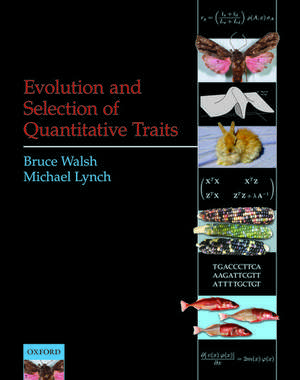
Evolution and Selection of Quantitative Traits
Autor Bruce Walsh, Michael Lynchen Limba Engleză Hardback – 12 iul 2018
Preț: 1088.12 lei
Preț vechi: 1566.60 lei
-31%
Puncte Express: 1632
Carte disponibilă
Livrare economică 06-11 noiembrie
Livrare prin curier în România Termenul estimat este afișat lângă disponibilitate.
Transport gratuit pentru acest produs Plată online sau ramburs, în funcție de opțiunile comenzii.
Retur gratuit în 14 zile Comandă securizată și suport în română.
Specificații
ISBN-13: 9780198830870
ISBN-10: 0198830874
Pagini: 1496
Dimensiuni: 223 x 284 x 62 mm
Greutate: 3.76 kg
Editura: OUP OXFORD
Colecția OUP Oxford
Locul publicării:Oxford, United Kingdom
ISBN-10: 0198830874
Pagini: 1496
Dimensiuni: 223 x 284 x 62 mm
Greutate: 3.76 kg
Editura: OUP OXFORD
Colecția OUP Oxford
Locul publicării:Oxford, United Kingdom
V-ar putea interesa
-
 -20%Preț: 462.99 lei575.87 lei
 -
 Experimental Design for the Life SciencesGraeme D. Ruxton-12%Preț: 329.93 lei373.37 lei
 -
 Molecular Biology: A Very Short IntroductionAysha Divan-20%Preț: 57.15 lei71.12 lei
 -
 Blood: A Very Short IntroductionChris Cooper-5%Preț: 55.29 lei57.96 lei
 -
 Molecular Biology of RNADavid Elliott-19%Preț: 466.50 lei575.92 lei
 -
 Campbell BiologyJane B. Reece-23%Preț: 695.23 lei902.90 lei
 -
 Scientific Practice and Ordinary ActionMichael LynchPreț: 356.15 lei
 -
 -14%Preț: 234.74 lei272.68 lei
 -
 The Spectacle of HistoryDavid BogenPreț: 292.09 lei
 -
 Baseball's Untold HistoryMichael LynchPreț: 90.75 lei
 -
 Leistner, Breckle - Pharmazeutische Biologie kompaktEckhard Leistner-7%Preț: 538.18 lei578.69 lei
 -
 Flora briofítica epífita de MarruecosIsabel Draper-8%Preț: 487.82 lei530.25 lei
 -
 -8%Preț: 520.86 lei566.14 lei
 -
 Producción de fructanos bacterianosMaría Laura MolinariPreț: 313.84 lei
 -
 Preț: 464.93 lei
 -
 Ubiquitination et ciblage du CMH-II aux exosomesMarie-Elaine GauvreauPreț: 486.42 lei
Recenzii
...the authors have done an admirable job at integrating the newest results to provide an unusually current and comprehensive guide. It is hard to imagine that anyone publishing in this area could make the case that they have added to what is known without consulting this wonderful book.
Decades in the making, the somewhat audacious conceit of collecting everything that we know about evolutionary genetics into a single tome pays dividends in the form a book that will serve as a central resource in the library of every evolutionary biologist.
This book has the same outstanding merits as the previous volume. It is authoritative, comprehensive (covering an extremely wide range of topics) and beautifully written. It will remain as the definitive account of the material that it considers for many years to come.
Their 1998 book has been an essential and popular teaching and reference text for quantitative geneticists for 20 years. At last the long promised and awaited second volume is available, structured to provide both an introduction for the graduate student and a reference volume for the seasoned professional. The authors display both an impressive breadth and depth of knowledge and ability to explain it.
The book is a fabulous resource; it will be the go-to place to learn about a broad variety of topics in population and quantitative genetics, from measuring differences among populations to estimating selection from genomic sequence data. A real strength of the book is the expert overview of the topics alongside pointers to the key papers for more details.
This long-awaited volume gives an exceptionally comprehensive and thoughtful overview of the field, and will be invaluable to all those who are trying to understand the genetics of complex traits. As well as covering quantitative genetics, it gives a thorough treatment of the most recent methods for making inferences from DNA sequence data.
This book is a virtuoso synthesis of the theory and application of selection and evolution of complex traits. Much more than an advanced textbook, it is the most comprehensive treatment and synthesis of the theory and analysis of selection and evolution of quantitative traits to date.
A masterful synthesis of the growing points in selection analysis.
Decades in the making, the somewhat audacious conceit of collecting everything that we know about evolutionary genetics into a single tome pays dividends in the form a book that will serve as a central resource in the library of every evolutionary biologist.
This book has the same outstanding merits as the previous volume. It is authoritative, comprehensive (covering an extremely wide range of topics) and beautifully written. It will remain as the definitive account of the material that it considers for many years to come.
Their 1998 book has been an essential and popular teaching and reference text for quantitative geneticists for 20 years. At last the long promised and awaited second volume is available, structured to provide both an introduction for the graduate student and a reference volume for the seasoned professional. The authors display both an impressive breadth and depth of knowledge and ability to explain it.
The book is a fabulous resource; it will be the go-to place to learn about a broad variety of topics in population and quantitative genetics, from measuring differences among populations to estimating selection from genomic sequence data. A real strength of the book is the expert overview of the topics alongside pointers to the key papers for more details.
This long-awaited volume gives an exceptionally comprehensive and thoughtful overview of the field, and will be invaluable to all those who are trying to understand the genetics of complex traits. As well as covering quantitative genetics, it gives a thorough treatment of the most recent methods for making inferences from DNA sequence data.
This book is a virtuoso synthesis of the theory and application of selection and evolution of complex traits. Much more than an advanced textbook, it is the most comprehensive treatment and synthesis of the theory and analysis of selection and evolution of quantitative traits to date.
A masterful synthesis of the growing points in selection analysis.
Notă biografică
Bruce Walsh is Professor of Ecology and Evolutionary Biology at the University of Arizona. He has taught advanced classes on quantitative genetics in 25 different countries and his research interests are at the interface of biology, genetics, mathematical modelling, and statistics. He is also an avid lepidopterist, having described over two dozen species of new moths and has three species named after him.Michael Lynch is Professor in the Schoool of Life Sciences at Arizona State University and is Center Director of the Biodesign Center for Mechanims of Evolution. His research is focused on mechanisms of evolution at the gene, genomic, cellular, and phenotypic levels, with special attention being given to the roles of mutation, random genetic drift, and recombination. He is a member of the US National Academy of Sciences, and a fellow of the American Academy of Arts and Sciences.
Cuprins
- Preface
- I
- Introduction
- 1: Changes in quantitative traits over time
- II
- Evolution at one and two loci
- 2: Neutral evolution in one- and two-locus systems
- 3: The genetic effective size of a population
- 4: The nonadaptive forces of evolution
- 5: The population genetics of selection
- 6: Theorems of natural selection: Results of Price, Fisher, and Robertson
- 7: Interaction of selection, mutation, and drift
- 8: Hitchhiking and selective sweeps
- 9: Using molecular data to detect selection: Signatures from recent single events
- 10: Using molecular data to detect selection: Signatures from multiple historical events
- III
- Drift and quantitative traits
- 11: Changes in genetic variance induced by drift
- 12: The neutral divergence of quantitative traits
- IV
- Short-term response on a single character
- 13: Short-term changes in the mean: 1. The breeder's equation
- 14: Short-term changes in the mean: 2. Truncation and threshold selection
- 15: Short-term changes in the mean: 3. Permanent versus transient response
- 16: Short-term changes in the variance: 1. Changes in the additive variance
- 17: Short-term changes in the variance: 2. Changes in environmental variance
- 18: Analysis of short-term selection experiments: 1. Least-squares approaches
- 19: Analysis of short-term selection experiments: 2. Mixed-model and bayesian approaches
- 20: Selection response in natural populations
- V
- Selection in structured populations
- 21: Family-based selection
- 22: Associative effects: Competition, social interactions, group and kin selection
- 23: Selection under inbreeding
- VI
- Population-genetic models of trait response
- 24: The infinitesimal model and its extensions
- 25: Long-term response: 1. Deterministic aspects
- 26: Long-term response: 2. Finite population size and mutation
- 27: Long-term response: 3. Adaptive walks
- 28: Maintenance of quantitative genetic variation
- VII
- Measuring selection on traits
- 29: Individual fitness and the measurement of univariate selecton
- 30: Measuring multivariate selection
- VIII
- Appendices
- A1: Diffusion theory
- A2: Introduction to Bayesian Analysis
- A3: Markov Chain Monte Carlo and Gibbs sampling
- A4: Multiple comparisons: Bonferroni corrections, false-discovery rates, and meta-analysis
- A5: The geometry of vectors and matrices: Eigenvalues and eigenvectors
- A6: Derivatives of vectors and vector-valued functions
- Literature Cited
- Author Index
- Organism and Trait Index
- Subject Index