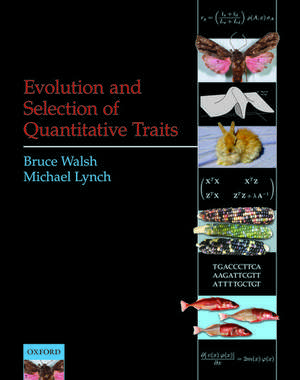
Evolution and Selection of Quantitative Traits
Autor Bruce Walsh, Michael Lynchen Limba Engleză Hardback – 12 iul 2018
În cadrul programelor avansate de studiu în biologia evoluționistă și genetică, Evolution and Selection of Quantitative Traits se poziționează ca o resursă fundamentală pentru înțelegerea modului în care trăsăturile complexe — de la morfologie la niveluri de expresie a proteinelor — variază și evoluează sub presiunea selecției. Remarcăm efortul autorilor Bruce Walsh și Michael Lynch de a transforma genetica cantitativă într-o punte metodologică solidă între abstracția modelelor matematice și rigoarea datelor de teren. Acest volum masiv, de aproape 1500 de pagini, reprezintă a doua etapă a unei trilogii monumentale, mutând accentul de la bazele genetice către mecanismele evolutive propriu-zise.
Subliniem rigoarea cu care este abordată detectarea selecției, autorii utilizând un spectru larg de date, de la cele istorice și genomice până la observații ecologice directe. Această lucrare completează perspectiva oferită de Genetics and Analysis of Quantitative Traits, primul volum al seriei, care se concentra pe analiza variației, adăugând acum stratul critic al consecințelor selecției și al dinamicii populaționale pe termen lung. Față de abordări mai concise, precum cea din Quantitative Genetics de Armando Caballero, care vizează o accesibilitate sporită pentru studenți, volumul de față este o sinteză exhaustivă, adresată cercetătorilor care necesită o tratare aprofundată a problemelor statistice legate de estimarea parametrilor biologici.
Structura textului reflectă o integrare multidisciplinară, extrăgând exemple din agricultură, medicină și antropologie. Analiza este precisă, evitând generalizările și ancorând fiecare model teoretic în dovezi empirice, ceea ce o face indispensabilă pentru cei care studiază evoluția caracterelor complexe în populații naturale sau experimentale.
Preț: 1029.78 lei
Preț vechi: 1498.21 lei
-31%
Carte disponibilă
Livrare economică 02-08 iulie
Specificații
ISBN-10: 0198830874
Pagini: 1496
Dimensiuni: 223 x 284 x 62 mm
Greutate: 3.88 kg
Editura: OUP OXFORD
Colecția OUP Oxford
Locul publicării:Oxford, United Kingdom
V-ar putea interesa
-
 -21%Preț: 446.49 lei566.92 lei
 -
 Experimental Design for the Life SciencesGraeme D. Ruxton-13%Preț: 325.86 lei372.72 lei
 -
 Molecular Biology: A Very Short IntroductionAysha Divan-21%Preț: 55.07 lei70.00 lei
 -
 Blood: A Very Short IntroductionChris Cooper-21%Preț: 54.99 lei69.94 lei
 -
 Molecular Biology of RNADavid Elliott-19%Preț: 456.55 lei563.65 lei
 -
 Campbell BiologyJane B. Reece-23%Preț: 695.23 lei902.90 lei
 -
 Scientific Practice and Ordinary ActionMichael LynchPreț: 356.15 lei
 -
 The University of EdinburghRobert D. Anderson-15%Preț: 231.72 lei272.68 lei
 -
 The Spectacle of HistoryDavid BogenPreț: 285.78 lei
 -
 Baseball's Untold History: The World SeriesMichael LynchPreț: 86.96 lei
 -
 Leistner, Breckle - Pharmazeutische Biologie kompaktEckhard Leistner-7%Preț: 517.18 lei556.11 lei
 -
 Flora briofítica epífita de MarruecosIsabel Draper-8%Preț: 463.28 lei503.56 lei
 -
 -8%Preț: 520.86 lei566.14 lei
 -
 Producción de fructanos bacterianosMaría Laura MolinariPreț: 313.84 lei
 -
 Preț: 464.93 lei
 -
 Preț: 465.82 lei
De ce să citești această carte
Recomandăm această lucrare cercetătorilor și studenților la doctorat care au nevoie de un fundament teoretic și statistic de neclintit în genetica complexă. Cititorul câștigă o înțelegere profundă a modului în care selecția modelează variația biologică, beneficiind de un instrumentar metodologic ce permite aplicarea modelelor matematice pe date reale din genomică și ecologie. Este resursa definitivă pentru analiza selecției trăsăturilor cantitative.
Despre autor
Bruce Walsh este profesor de ecologie și biologie evoluționistă, recunoscut la nivel mondial pentru contribuțiile sale în genetica cantitativă și biostatistică. Alături de Michael Lynch, a redefinit standardele academice în domeniu prin publicarea unor tratate de referință care sintetizează decenii de cercetare. Opera sa se distinge prin capacitatea de a unifica genetica populațiilor cu statistica aplicată, oferind soluții practice pentru ameliorarea plantelor, animalelor și pentru înțelegerea evoluției umane. Activitatea sa academică este marcată de o rigoare matematică pusă în serviciul explicării fenomenelor biologice complexe.
Descriere
Recenzii
Decades in the making, the somewhat audacious conceit of collecting everything that we know about evolutionary genetics into a single tome pays dividends in the form a book that will serve as a central resource in the library of every evolutionary biologist.
This book has the same outstanding merits as the previous volume. It is authoritative, comprehensive (covering an extremely wide range of topics) and beautifully written. It will remain as the definitive account of the material that it considers for many years to come.
Their 1998 book has been an essential and popular teaching and reference text for quantitative geneticists for 20 years. At last the long promised and awaited second volume is available, structured to provide both an introduction for the graduate student and a reference volume for the seasoned professional. The authors display both an impressive breadth and depth of knowledge and ability to explain it.
The book is a fabulous resource; it will be the go-to place to learn about a broad variety of topics in population and quantitative genetics, from measuring differences among populations to estimating selection from genomic sequence data. A real strength of the book is the expert overview of the topics alongside pointers to the key papers for more details.
This long-awaited volume gives an exceptionally comprehensive and thoughtful overview of the field, and will be invaluable to all those who are trying to understand the genetics of complex traits. As well as covering quantitative genetics, it gives a thorough treatment of the most recent methods for making inferences from DNA sequence data.
This book is a virtuoso synthesis of the theory and application of selection and evolution of complex traits. Much more than an advanced textbook, it is the most comprehensive treatment and synthesis of the theory and analysis of selection and evolution of quantitative traits to date.
A masterful synthesis of the growing points in selection analysis.