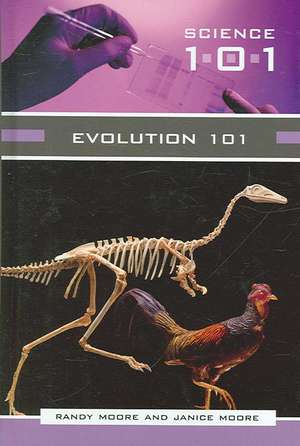
Evolution 101
Autor Randy Moore, Janice Mooreen Limba Engleză Hardback – 30 sep 2006
Evolution 101 provides an introduction for non-scholars to this most powerful scientific theory, covering such issues as: the history of evolutionary thought, from before Darwin to the present day; the evidence for evolution, from fields as diverse as geology, molecular biology, paleontology, and more, that show how strongly supported evolution is; how evolution works, including topics ranging from behavior (e.g., sexual selection) to molecular biology (e.g., mutation); and evolution in our daily lives, including how evolution accounts for phenomena such as antibiotic resistance and pesticide resistance. This essential resource will answer the questions students and lay people have regarding evolution, and will point them on the path to further understanding.
Preț: 255.74 lei
Preț vechi: 456.53 lei
-44%
Puncte Express: 384
Carte tipărită la comandă
Livrare economică 25 noiembrie-09 decembrie
Livrare prin curier în România Termenul estimat este afișat lângă disponibilitate.
Transport gratuit de la 400.00 lei Plată online sau ramburs, în funcție de opțiunile comenzii.
Retur gratuit în 14 zile Comandă securizată și suport în română.
Specificații
ISBN-13: 9780313332920
ISBN-10: 0313332924
Pagini: 240
Dimensiuni: 156 x 235 x 22 mm
Greutate: 0.5 kg
Ediția:New.
Editura: Bloomsbury Publishing
Colecția Greenwood
Locul publicării:New York, United States
ISBN-10: 0313332924
Pagini: 240
Dimensiuni: 156 x 235 x 22 mm
Greutate: 0.5 kg
Ediția:New.
Editura: Bloomsbury Publishing
Colecția Greenwood
Locul publicării:New York, United States
V-ar putea interesa
-
 Big BangSimon SinghPreț: 120.97 lei
 -
 The Descent of Man, and Selection in Relation to SexCharles Darwin-25%Preț: 83.24 lei111.65 lei
 -
 Climbing Mount ImprobableRichard Dawkins-19%Preț: 74.60 lei92.40 lei
 -
 Evolution of Biological DiversityAnne Magurran-32%Preț: 526.76 lei779.01 lei
 -
 How Homo Became Sapiens: On the evolution of thinkingPeter Gärdenfors-28%Preț: 437.70 lei612.11 lei
 -
 The Comparative Method in Evolutionary BiologyPaul H. Harvey-29%Preț: 450.80 lei630.64 lei
 -
 -32%Preț: 533.28 lei782.96 lei
 -
 The Dragons of EdenCarl SaganPreț: 55.79 lei
 -
 The Moral Animal: Why We Are The Way We AreRobert Wright-26%Preț: 79.59 lei108.08 lei
 -
 Charles Darwin's Beagle DiaryCharles Darwin-19%Preț: 472.23 lei582.99 lei
 -
 Evolution and the Theory of GamesJohn Maynard Smith-11%Preț: 443.07 lei497.82 lei
 -
 Evolutionary CatastrophesV. CourtillotPreț: 343.74 lei
 -
 The Case of the Female OrgasmElisabeth A LloydPreț: 203.71 lei
 -
 Evolutionary Dynamics - Exploring the Equations of LifeMartin A. Nowak-13%Preț: 508.64 lei584.64 lei
 -
 Pleasurable KingdomJonathan BalcombePreț: 135.70 lei
 -
 What Makes Us Human?Charles PasternakPreț: 79.69 lei
Cuprins
Series Foreword
Preface
1 The History of Evolutionary Thought
Early Ideas About Life's Diversity
Naming Life
Lamarck Proposes the First Testable Theory of Evolution
Charles Darwin
Darwin Sets Sail Aboard the Beagle and Sees the World
Darwin's Life Back in England
Down House
Wallace Provokes Darwin to Announce His Idea
The Theory of Evolution After Darwin
Darwin's Bold Prediction
Summary
2 Evidence for Evolution
The Evidence for Evolution
The Age of the Earth
Determining the Ages of Fossils and Rocks
Fossils
Extinctions
Artificial Selection
Embryology
Biogeography
Comparative Anatomy
Vestigial Structures
Molecular Biology
We Can Watch Evolution Happen
Evolution, Life, and Death: The Evolution of Drug Resistance
Can Evolution Be Stopped?
Contradictory Evidence?
Evolution in the Courtroom
Summary
3 How Evolution Works
Genes Link Generations
Pesticide Resistance
DNA and Chromosomes
The Frequencies of Genes Can Change
What Causes Genetic Variation?
Mutation Can Cause Genetic Variation
Gene Flow Can Cause Genetic Variation
Genetic Mixing Can Cause Genetic Variation
Evolution Is Change in Gene Frequency-How Do Gene Frequencies Change?
Conservation and Genetic Diversity
Natural Selection Produces Adaptive Change in Gene Frequencies
Sexual Reproduction Increases Genetic Variation
The Red Queen and Sexual Reproduction
Mate Choice Can Be Adaptive
Selection for One Extreme, Both Extremes, or the Middle
Nice Guys Don't Have to Finish Last
Calculating Coefficients of Relatedness
Mutualism
Summary
4 The Scale and Products of Evolution
Microevolution Occurs Within Populations
Macroevolution Produces Species Diversity
What Is a Species?
How Do Species Form?
Species Form by Geographic Isolation, A Disturbance in Gene Flow
Species Form When Shifts in Resources Disturb Gene Flow
Species Form When Mate Choice Restricts Gene Flow
Species Form When Genetic Changes Disturb Gene Flow
The Common Theme of Speciation Is Reproductive Isolation
A Phylogeny Traces the History of Speciation
Shared Traits Reveal Shared Ancestry
Three Types (Branches) of Living Organisms
Where Did Life Come From?
The Evolution of Multicellular Organisms
Adaptive Radiation Fuels Biodiversity
Poisonous Oceans, Death Stars, and Mass Extinction
Summary
5 Evolution and Our Daily Lives
Darwin's Predictions Continue to Ring True
Social Darwinism
Eugenics
The Evolution of Pathogens
Sociobiology and Evolutionary Psychology
Human Evolution
Summary
Appendices
Appendix 1: The Geological Timescale
Appendix 2: Legal Decisions Involving the Teaching of Evolution and Creationism in Public Schools
Appendix 3: A Timeline for Evolutionary Thought
Appendix 4: Meiosis and Crossing Over
Appendix 5: The Products of Evolution
Glossary
Selected Bibliography
Index
Preface
1 The History of Evolutionary Thought
Early Ideas About Life's Diversity
Naming Life
Lamarck Proposes the First Testable Theory of Evolution
Charles Darwin
Darwin Sets Sail Aboard the Beagle and Sees the World
Darwin's Life Back in England
Down House
Wallace Provokes Darwin to Announce His Idea
The Theory of Evolution After Darwin
Darwin's Bold Prediction
Summary
2 Evidence for Evolution
The Evidence for Evolution
The Age of the Earth
Determining the Ages of Fossils and Rocks
Fossils
Extinctions
Artificial Selection
Embryology
Biogeography
Comparative Anatomy
Vestigial Structures
Molecular Biology
We Can Watch Evolution Happen
Evolution, Life, and Death: The Evolution of Drug Resistance
Can Evolution Be Stopped?
Contradictory Evidence?
Evolution in the Courtroom
Summary
3 How Evolution Works
Genes Link Generations
Pesticide Resistance
DNA and Chromosomes
The Frequencies of Genes Can Change
What Causes Genetic Variation?
Mutation Can Cause Genetic Variation
Gene Flow Can Cause Genetic Variation
Genetic Mixing Can Cause Genetic Variation
Evolution Is Change in Gene Frequency-How Do Gene Frequencies Change?
Conservation and Genetic Diversity
Natural Selection Produces Adaptive Change in Gene Frequencies
Sexual Reproduction Increases Genetic Variation
The Red Queen and Sexual Reproduction
Mate Choice Can Be Adaptive
Selection for One Extreme, Both Extremes, or the Middle
Nice Guys Don't Have to Finish Last
Calculating Coefficients of Relatedness
Mutualism
Summary
4 The Scale and Products of Evolution
Microevolution Occurs Within Populations
Macroevolution Produces Species Diversity
What Is a Species?
How Do Species Form?
Species Form by Geographic Isolation, A Disturbance in Gene Flow
Species Form When Shifts in Resources Disturb Gene Flow
Species Form When Mate Choice Restricts Gene Flow
Species Form When Genetic Changes Disturb Gene Flow
The Common Theme of Speciation Is Reproductive Isolation
A Phylogeny Traces the History of Speciation
Shared Traits Reveal Shared Ancestry
Three Types (Branches) of Living Organisms
Where Did Life Come From?
The Evolution of Multicellular Organisms
Adaptive Radiation Fuels Biodiversity
Poisonous Oceans, Death Stars, and Mass Extinction
Summary
5 Evolution and Our Daily Lives
Darwin's Predictions Continue to Ring True
Social Darwinism
Eugenics
The Evolution of Pathogens
Sociobiology and Evolutionary Psychology
Human Evolution
Summary
Appendices
Appendix 1: The Geological Timescale
Appendix 2: Legal Decisions Involving the Teaching of Evolution and Creationism in Public Schools
Appendix 3: A Timeline for Evolutionary Thought
Appendix 4: Meiosis and Crossing Over
Appendix 5: The Products of Evolution
Glossary
Selected Bibliography
Index
Recenzii
[E]ven younger, motivated students should be able to gain some understanding of these topics without assistance or prior knowledge. Teachers will appreciate the depth and clairity.
NSTA Recommends Seldom is a book so well written and so well researched that it ought to be required reading for every thinking person. Moores one-volume reference on the theory of evolution comes as close as anything I have ever encountered in my career as both a biologist and an educator. From its thorough history of the development of the theory over the course of the 18th and 19th centuries to its painstaking analysis of how evolution works and the evidence for it, this book explains in simple but accurate language everything any person needs to know to grasp the essence of one of the most important scientific explanations of all time..Not only should every high school, community, and university library have a copy of Evolution 101 but every science teacher in the country should as well.
[T]his book is a valuable, concise introduction to evolutionary thought. The authors have succeeded in providing a simple explanation of evolutionary theory that should be understandable to the average reader. This book should be essential for school and public libraries, and would be a valuable resource for any biology teacher concerned about teaching this subject accurately.
Written to be fully accessible and with a minimum of jargon, this covers what general readers should know about evolution for them to apply to further reading or study. Randy Moore and Janice Moore take a practical approach but also offer the theory necessary to get the point across, starting with the history of evolutionary thought (Darwin and the Beagle), extension and elaboration of Darwin's basic theories, and the impact of those who thought they knew Darwin's work but wandered off a bit by themselves. They describe the evidence for evolution in fossils, rocks and drug resistance, examine how evolution works (DNA, genetic variation and gene frequency, mate choices and coefficients of relatedness), the scale and products of evolution and the role of evolution in our daily lives.
NSTA Recommends Seldom is a book so well written and so well researched that it ought to be required reading for every thinking person. Moores one-volume reference on the theory of evolution comes as close as anything I have ever encountered in my career as both a biologist and an educator. From its thorough history of the development of the theory over the course of the 18th and 19th centuries to its painstaking analysis of how evolution works and the evidence for it, this book explains in simple but accurate language everything any person needs to know to grasp the essence of one of the most important scientific explanations of all time..Not only should every high school, community, and university library have a copy of Evolution 101 but every science teacher in the country should as well.
[T]his book is a valuable, concise introduction to evolutionary thought. The authors have succeeded in providing a simple explanation of evolutionary theory that should be understandable to the average reader. This book should be essential for school and public libraries, and would be a valuable resource for any biology teacher concerned about teaching this subject accurately.
Written to be fully accessible and with a minimum of jargon, this covers what general readers should know about evolution for them to apply to further reading or study. Randy Moore and Janice Moore take a practical approach but also offer the theory necessary to get the point across, starting with the history of evolutionary thought (Darwin and the Beagle), extension and elaboration of Darwin's basic theories, and the impact of those who thought they knew Darwin's work but wandered off a bit by themselves. They describe the evidence for evolution in fossils, rocks and drug resistance, examine how evolution works (DNA, genetic variation and gene frequency, mate choices and coefficients of relatedness), the scale and products of evolution and the role of evolution in our daily lives.