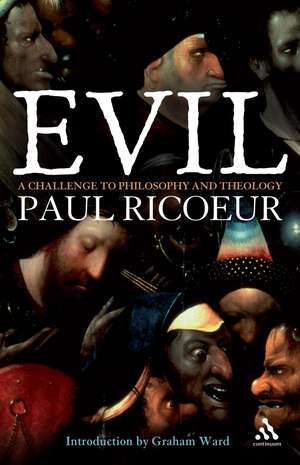
Evil
Autor Paul Ricoeur Traducere de John Bowdenen Limba Engleză Paperback – iul 2007
Preț: 82.98 lei
Preț vechi: 144.70 lei
-43%
Puncte Express: 124
Carte tipărită la comandă
Livrare economică 26 noiembrie-10 decembrie
Livrare prin curier în România Termenul estimat este afișat lângă disponibilitate.
Transport gratuit de la 400.00 lei Plată online sau ramburs, în funcție de opțiunile comenzii.
Retur gratuit în 14 zile Comandă securizată și suport în română.
Specificații
ISBN-13: 9780826494764
ISBN-10: 0826494765
Pagini: 80
Dimensiuni: 124 x 194 x 8 mm
Greutate: 0.1 kg
Editura: Bloomsbury Publishing
Locul publicării:London, United Kingdom
ISBN-10: 0826494765
Pagini: 80
Dimensiuni: 124 x 194 x 8 mm
Greutate: 0.1 kg
Editura: Bloomsbury Publishing
Locul publicării:London, United Kingdom
V-ar putea interesa
-
 Mere ChristianityClive Staples LewisPreț: 98.37 lei
 -
 Their Rock Is Not Like Our Rock: A Theology of ReligionsDaniel StrangePreț: 164.87 lei
 -
 By HeartJohn BowdenPreț: 298.17 lei
 -
 The Ratzinger Reader: Mapping a Theological JourneyDr Lieven Boeve-24%Preț: 259.41 lei342.58 lei
 -
 Atonement: A Guide for the PerplexedDr Adam J. Johnson-17%Preț: 192.03 lei230.70 lei
 -
 The Case for JesusBrant PitrePreț: 155.73 lei
 -
 Resurrection of JesusJohn Dominic CrossanPreț: 186.18 lei
 -
 The Gospel According to HereticsDavid E. WilhitePreț: 244.26 lei
 -
 Exploring Catholic TheologyRobert BarronPreț: 157.63 lei
 -
 The Trinity Guide to EschatologyWilliam J. La Due-17%Preț: 184.85 lei222.11 lei
 -
 God's Gift Giving: In Christ and Through the SpiritRev. R. Kevin Seasoltz-16%Preț: 278.68 lei329.91 lei
 -
 The Good Life: Ethics and the Pursuit of HappinessFather Herbert McCabe-17%Preț: 113.44 lei137.01 lei
 -
 Christ CrucifiedDonald Mac LeodPreț: 197.29 lei
 -
 The Mosaic of Christian BeliefRoger E. OlsonPreț: 194.38 lei
 -
 On the Path of the ImmortalsThomas HornPreț: 172.98 lei
 -
 Theological Perspectives on God and BeautyProf. John MilbankPreț: 209.51 lei
 -
 The Reason for GodTimothy KellerPreț: 107.58 lei
 -
 Stealing from GodFrank TurekPreț: 105.61 lei
 -
 Unimaginable: What We Imagine and What We Can’tProf. Graham Ward-42%Preț: 226.54 lei389.49 lei
 -
 -40%Preț: 102.96 lei172.56 lei
 -
 The Atonement and Intercession of Jesus ChristWilliam SymingtonPreț: 147.32 lei
 -
 Das BösePaul RicoeurPreț: 101.62 lei
Cuprins
Extended Introduction by Graham Ward
Preface by Pierre Gisel
1. The experience of evil
2. The levels of discussion and discourse on evil
3. Thinking, acting, feeling
Preface by Pierre Gisel
1. The experience of evil
2. The levels of discussion and discourse on evil
3. Thinking, acting, feeling
Recenzii
Offers rich philosophical resources for theological reflection.
One of the most important achievements of Catani's work is to demonstrate that literature, as a discourse of knowledge that can intersect with science, theology, politics, and history, deserves to play a decisive role in deepening and complexifying the terms of public debate.
Mention in Church Times, January 2009
Evil: A History in Modern French Literature and Thought offers a rich study of French thought on evil in its development over almost two centuries. Catani succeeds in the ambitious task of placing in dialogue with one another upwards of forty key thinkers in order to establish a series of significant shifts in understanding evil that will greatly benefit scholars of intellectual history.
With engaging prose, Damian Catani pays close attention to linguistic choices- his own and those of the authors he studies, as they attempt to find and forge a language capable of representing evil. Other strengths include Catani's mastery of a broad corpus of literary and theoretical works, as well as Evil's compelling overarching narrative, which propels the reader forward and regularly underscores connections among chapters and disparate authors and periods. This valuable contribution to the field will appeal to scholars of intellectual history and modern French literature, in addition to readers interested in the public debate surrounding recent (counter)terrorist actions and rhetoric.
One of the most important achievements of Catani's work is to demonstrate that literature, as a discourse of knowledge that can intersect with science, theology, politics, and history, deserves to play a decisive role in deepening and complexifying the terms of public debate.
Mention in Church Times, January 2009
Evil: A History in Modern French Literature and Thought offers a rich study of French thought on evil in its development over almost two centuries. Catani succeeds in the ambitious task of placing in dialogue with one another upwards of forty key thinkers in order to establish a series of significant shifts in understanding evil that will greatly benefit scholars of intellectual history.
With engaging prose, Damian Catani pays close attention to linguistic choices- his own and those of the authors he studies, as they attempt to find and forge a language capable of representing evil. Other strengths include Catani's mastery of a broad corpus of literary and theoretical works, as well as Evil's compelling overarching narrative, which propels the reader forward and regularly underscores connections among chapters and disparate authors and periods. This valuable contribution to the field will appeal to scholars of intellectual history and modern French literature, in addition to readers interested in the public debate surrounding recent (counter)terrorist actions and rhetoric.