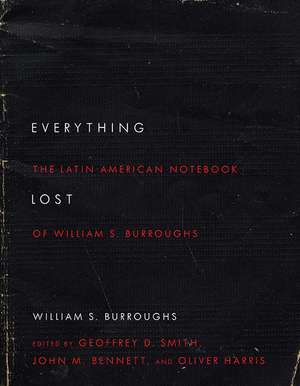
Everything Lost: The Latin American Notebook of William S. Burroughs, Revised Edition
Autor William S. Burroughsen Limba Engleză Paperback – 26 mai 2017
In late summer 1953, as he returned to Mexico City after a seven-month expedition through the jungles of Ecuador, Colombia, and Peru, William Burroughs began a notebook of final reflections on his four years in Latin America. His first novel, Junkie, had just been published and he would soon be back in New York to meet Allen Ginsberg and together complete the manuscripts of what became The Yage Letters and Queer. Yet this notebook, the sole survivor from that period, reveals Burroughs not as a writer on the verge of success, but as a man staring down personal catastrophe and visions of looming cultural disaster.
Losses that will not let go of him haunt Burroughs throughout the notebook: “Bits of it keep floating back to me like memories of a daytime nightmare.” However, out of these dark reflections we see emerge vivid fragments of Burroughs’ fiction and, even more tellingly, unique, primary evidence for the remarkable ways in which his early manuscripts evolved. Assembled in facsimile and transcribed by Geoffrey D. Smith, John M. Bennett, and Burroughs scholar Oliver Harris, the notebook forces us to change the way we see both Burroughs and his writing at a turning point in his literary career.
Losses that will not let go of him haunt Burroughs throughout the notebook: “Bits of it keep floating back to me like memories of a daytime nightmare.” However, out of these dark reflections we see emerge vivid fragments of Burroughs’ fiction and, even more tellingly, unique, primary evidence for the remarkable ways in which his early manuscripts evolved. Assembled in facsimile and transcribed by Geoffrey D. Smith, John M. Bennett, and Burroughs scholar Oliver Harris, the notebook forces us to change the way we see both Burroughs and his writing at a turning point in his literary career.
Preț: 109.47 lei
Puncte Express: 164
Preț estimativ în valută:
19.38€ • 22.57$ • 16.84£
19.38€ • 22.57$ • 16.84£
Carte tipărită la comandă
Livrare economică 24 februarie-10 martie
Preluare comenzi: 021 569.72.76
Specificații
ISBN-13: 9780814253830
ISBN-10: 0814253830
Pagini: 160
Dimensiuni: 178 x 229 x 13 mm
Greutate: 0.3 kg
Ediția:1
Editura: Ohio State University Press
Colecția Ohio State University Press
ISBN-10: 0814253830
Pagini: 160
Dimensiuni: 178 x 229 x 13 mm
Greutate: 0.3 kg
Ediția:1
Editura: Ohio State University Press
Colecția Ohio State University Press
V-ar putea interesa
-
 Exterminator!William S. Burroughs-29%Preț: 52.96 lei74.26 lei
 -
 The Job: Interviews with William S. BurroughsWilliam S. BurroughsPreț: 87.89 lei
 -
 -21%Preț: 58.66 lei74.66 lei
 -
 Cities of the Red NightWilliam S. Burroughs-14%Preț: 65.26 lei75.61 lei
 -
 The Western LandsWilliam S. Burroughs-21%Preț: 64.31 lei81.67 lei
 -
 Nova Express: The Restored TextWilliam S. BurroughsPreț: 68.88 lei
 -
 QueerWilliam S. BurroughsPreț: 87.38 lei
 -
 The Great Masters of Russian LiteratureErnest DupuyPreț: 221.73 lei
 -
 The Educational World of Daniel DefoeD. P. Leinster-MacKayPreț: 63.69 lei
 -
 TristanaBenito Perez GaldosPreț: 57.31 lei
 -
 La jeune fille de l'eauYgrecPreț: 83.33 lei
 -
 Preț: 73.17 lei
 -
 Preț: 64.10 lei
 -
 Preț: 185.97 lei
 -
 Tiraden eines genialen TaugenichtsHerr SteinmannPreț: 117.63 lei
 -
 Auf schwarzen SeenGudrun Thomas-FeukerPreț: 162.22 lei
 -
 Als würde man nicht erwartenThomas BellerPreț: 51.23 lei
 -
 The Golden Gandhi Statue From AmericaMisra SubimalPreț: 54.08 lei
Recenzii
“From the opening page we immediately get an extraordinarily vivid picture of Burroughs himself, sitting alone in some dingy bar in the Peruvian coastal town of Talara, pencil in hand—his “rum” in the other—pressing his thoughts and observations onto the paper in his own, instantly recognizable style.” —from the introduction by Oliver Harris
“A disturbing impressionist travelogue, a flawed but brilliant prose poem, and one writer’s beginnings all at once, the notebook gives us a taste of the real Burroughs, pure and uncut.” —The Georgia Review
“Everything Lost was written during the same period as Junky, Queer, and The Yage Letters, and it sheds light on all of them, as well as on Burroughs’s methods of composition, the way he worked his material out in letters or journal entries before incorporating it into his books. Here we have a portrait of the artist in the act of becoming, a glimpse beneath the icon and its aftermath.” —David L. Ulin, The Los Angeles Times
“Burroughs was an authentic American original and any doubts on that should be quelled by this journal.” —The Morning News
Notă biografică
William Burroughs is recognized as one of the most innovative, politically trenchant, and influential artists of the twentieth century. Born in 1914 into a social register St. Louis family, he became a key figure, along with Jack Kerouac and Allen Ginsberg, in the Beat Generation of writers who emerged in the early 1950s. After leaving America, Burroughs documented his experiences as a heroin addict and a homosexual in Junky and Queer, and his adventures in South America seeking the drug yagé in The Yage Letters, before achieving international notoriety in 1959 with Naked Lunch. Based in Paris, Burroughs then launched his cut-up project and, inspired by the artist Brion Gysin, produced a trilogy of novels—The Soft Machine, The Ticket That Exploded, Nova Express—as well as experiments in tape, film, and photomontage. Having lived in Mexico, Morocco, and Europe, in the 1970s Burroughs returned to America, where he eventually settled in Lawrence, Kansas. He completed a final trilogy of novels—Cities of the Red Night, The Place of Dead Roads, The Western Lands—as well as collaborating with many artists in various media. He died on August 2, 1997.
Extras
From the introduction by Oliver Harris:
The publication of a notebook written by William Burroughs in Latin America during July and August 1953 might seem a matter of some marginal interest, but appearances are deceptive and this is a rare object of four-fold significance. Firstly, its content must make us revise and rethink Burroughs’ biography at a key point early in his literary career. Biographers have been able to narrate his South American quest for yagé by drawing on his letters from this period—both those in The Letters of William S. Burroughs, 1945–1959, and the dozen attributed to his persona, William Lee, that appeared as “In Search of Yage” within The Yage Letters. But the focus of this notebook lies elsewhere and tells a very different story of Burroughs’ life as it stood in late summer 1953. Secondly, there is the specific importance of the notebook form in Burroughs’ development as a writer. This, the only surviving example, allows us to recognise for the first time the notebook’s role in Burroughs’ creative practice, as we see him working autobiographical fragments
into the fabric of his fictional universe. We can now therefore also measure the notebook’s genetic and formal relation to the creative use Burroughs was starting to make of his letters, a decisive factor in the evolution of Naked Lunch. Thirdly, the notebook provides striking, detailed revelations about the fluid state of Burroughs’ manuscripts and the ways in which he reworked them. In particular, it offers primary evidence for a far more complex picture of how he wrote major parts of what became Queer and The Yage Letters. Finally, this notebook is a unique physical remnant, and it is its singularity as a material object that makes it so fitting to be the subject of this, the first facsimile edition of a text by William Burroughs.
To begin by expanding on this final point, The Latin American Notebook of William S. Burroughs marks an important advance in Burroughs textual scholarship and editing. It does so by building on two decades’ of publications that have enlarged incrementally our knowledge of Burroughs’ writing during the 1950s—starting with the release of Queer in 1985, followed by the Interzone collection (1989), The Letters, 1945–1959 (1993), and three major new editions: Naked Lunch: the restored text (2003), edited by James Grauerholz and Barry Miles, and my own Junky: the definitive text of “Junk” (2003) and The Yage Letters Redux (2006). Shedding further light on Burroughs’ foundational decade as a writer, the Notebook takes its place in this expansion of the scholarly field. But as an object it is entirely singular, which is why it is so appropriate that Geoffrey D. Smith and John M. Bennett
should have assembled with such care this facsimile reproduction and transcription for The Ohio State University Press. For none of Burroughs’ other manuscripts from this era have survived in complete form but exist only as pieces scattered across various archives—a state of disarray that reflects his lack of care as an archivist of his own material and the chaotic circumstances in which he wrote on his travels. In contrast, this notebook, the sole survivor from that past, retains a distinct physical existence whose appearance and particular feel is conveyed so well in facsimile. And so, from the opening page we immediately get an extraordinarily vivid picture of Burroughs himself, sitting alone in some dingy bar in the Peruvian coastal town of Talara, pencil in hand—his “5 p . m . rum” in the other—pressing his thoughts and observations onto the paper in his own, instantly recognisable style (“Got to watch drinking,” he adds in parentheses, noting dryly, “I can black out on 4 drinks now”).
The entries run from mid-July to early August 1953, and they fill out numerous minor gaps in the record of Burroughs’ travels: as well as learning more about his stays in Panama and Mexico City, we now know of his stopovers in Talara, Guatemala City, and Tapachulla, and about his short trips to Vera Cruz, on the Gulf of Mexico, and to Mérida, on the Yucatan Peninsula. But the initial impression of a standard travel diary is misleading, and it soon becomes clear that Burroughs is using the notebook to sketch scenes that dramatize a critical moment in his life. A year that had begun with the inauguration of Eisenhower in Washington and the opening of The Crucible on Broadway, saw Burroughs depart Mexico City—since late 1949 his haven from Cold War America, but also the site of his blackest hour: the shooting of his wife, Joan—and start out, via a stopover in Miami, on his seven-month journey through the jungles of Colombia, Ecuador, and Peru. Burroughs would remain in exile for a quarter-of-a-century, dividing his time between Tangier, Paris, and London, but this was his one true expedition, and only in 1953 did he live and write constantly on the move. The Notebook begins on the last leg of the travels made familiar through The Yage Letters, and ends with Burroughs about to leave for New York and a long-awaited rendezvous with Allen Ginsberg. And yet, although his debut novel, Junkie, had just been published and although he had completed an adventure that would generate “an awful lot of copy” for future work,1 the Notebook reveals a man contemplating dead-end despair and disaster, rather than
anticipating any kind of success. Some of the early sketches recall the vignettes of “In Search of Yage,” and are written similarly in “a style which has the bitter irony of Daumier, the briefness of a Webern song.” But a more anguished and literally ominous element comes increasingly to the fore. Take his recollections of Lima, which run like a refrain through the Notebook. On the second page, Burroughs glumly notes, “Last few days in Lima. Cold and damp.” Six pages later, after describing his arrival in Panama, he returns to “Last days in Lima,” now reporting the “feeling of urgency” that makes him want to leave “at once.” Thirty pages further on, these “last days” turn first into “a nightmare” and then an apocalyptic vision in the shape of a dream in which an “atomic cloud” spreads over the city. Drawn back to his memories, rewriting them as ever more sinister omens, Burroughs gives his last days in Lima an eschatological twist, literalising them as millennial end times.
The publication of a notebook written by William Burroughs in Latin America during July and August 1953 might seem a matter of some marginal interest, but appearances are deceptive and this is a rare object of four-fold significance. Firstly, its content must make us revise and rethink Burroughs’ biography at a key point early in his literary career. Biographers have been able to narrate his South American quest for yagé by drawing on his letters from this period—both those in The Letters of William S. Burroughs, 1945–1959, and the dozen attributed to his persona, William Lee, that appeared as “In Search of Yage” within The Yage Letters. But the focus of this notebook lies elsewhere and tells a very different story of Burroughs’ life as it stood in late summer 1953. Secondly, there is the specific importance of the notebook form in Burroughs’ development as a writer. This, the only surviving example, allows us to recognise for the first time the notebook’s role in Burroughs’ creative practice, as we see him working autobiographical fragments
into the fabric of his fictional universe. We can now therefore also measure the notebook’s genetic and formal relation to the creative use Burroughs was starting to make of his letters, a decisive factor in the evolution of Naked Lunch. Thirdly, the notebook provides striking, detailed revelations about the fluid state of Burroughs’ manuscripts and the ways in which he reworked them. In particular, it offers primary evidence for a far more complex picture of how he wrote major parts of what became Queer and The Yage Letters. Finally, this notebook is a unique physical remnant, and it is its singularity as a material object that makes it so fitting to be the subject of this, the first facsimile edition of a text by William Burroughs.
To begin by expanding on this final point, The Latin American Notebook of William S. Burroughs marks an important advance in Burroughs textual scholarship and editing. It does so by building on two decades’ of publications that have enlarged incrementally our knowledge of Burroughs’ writing during the 1950s—starting with the release of Queer in 1985, followed by the Interzone collection (1989), The Letters, 1945–1959 (1993), and three major new editions: Naked Lunch: the restored text (2003), edited by James Grauerholz and Barry Miles, and my own Junky: the definitive text of “Junk” (2003) and The Yage Letters Redux (2006). Shedding further light on Burroughs’ foundational decade as a writer, the Notebook takes its place in this expansion of the scholarly field. But as an object it is entirely singular, which is why it is so appropriate that Geoffrey D. Smith and John M. Bennett
should have assembled with such care this facsimile reproduction and transcription for The Ohio State University Press. For none of Burroughs’ other manuscripts from this era have survived in complete form but exist only as pieces scattered across various archives—a state of disarray that reflects his lack of care as an archivist of his own material and the chaotic circumstances in which he wrote on his travels. In contrast, this notebook, the sole survivor from that past, retains a distinct physical existence whose appearance and particular feel is conveyed so well in facsimile. And so, from the opening page we immediately get an extraordinarily vivid picture of Burroughs himself, sitting alone in some dingy bar in the Peruvian coastal town of Talara, pencil in hand—his “5 p . m . rum” in the other—pressing his thoughts and observations onto the paper in his own, instantly recognisable style (“Got to watch drinking,” he adds in parentheses, noting dryly, “I can black out on 4 drinks now”).
The entries run from mid-July to early August 1953, and they fill out numerous minor gaps in the record of Burroughs’ travels: as well as learning more about his stays in Panama and Mexico City, we now know of his stopovers in Talara, Guatemala City, and Tapachulla, and about his short trips to Vera Cruz, on the Gulf of Mexico, and to Mérida, on the Yucatan Peninsula. But the initial impression of a standard travel diary is misleading, and it soon becomes clear that Burroughs is using the notebook to sketch scenes that dramatize a critical moment in his life. A year that had begun with the inauguration of Eisenhower in Washington and the opening of The Crucible on Broadway, saw Burroughs depart Mexico City—since late 1949 his haven from Cold War America, but also the site of his blackest hour: the shooting of his wife, Joan—and start out, via a stopover in Miami, on his seven-month journey through the jungles of Colombia, Ecuador, and Peru. Burroughs would remain in exile for a quarter-of-a-century, dividing his time between Tangier, Paris, and London, but this was his one true expedition, and only in 1953 did he live and write constantly on the move. The Notebook begins on the last leg of the travels made familiar through The Yage Letters, and ends with Burroughs about to leave for New York and a long-awaited rendezvous with Allen Ginsberg. And yet, although his debut novel, Junkie, had just been published and although he had completed an adventure that would generate “an awful lot of copy” for future work,1 the Notebook reveals a man contemplating dead-end despair and disaster, rather than
anticipating any kind of success. Some of the early sketches recall the vignettes of “In Search of Yage,” and are written similarly in “a style which has the bitter irony of Daumier, the briefness of a Webern song.” But a more anguished and literally ominous element comes increasingly to the fore. Take his recollections of Lima, which run like a refrain through the Notebook. On the second page, Burroughs glumly notes, “Last few days in Lima. Cold and damp.” Six pages later, after describing his arrival in Panama, he returns to “Last days in Lima,” now reporting the “feeling of urgency” that makes him want to leave “at once.” Thirty pages further on, these “last days” turn first into “a nightmare” and then an apocalyptic vision in the shape of a dream in which an “atomic cloud” spreads over the city. Drawn back to his memories, rewriting them as ever more sinister omens, Burroughs gives his last days in Lima an eschatological twist, literalising them as millennial end times.