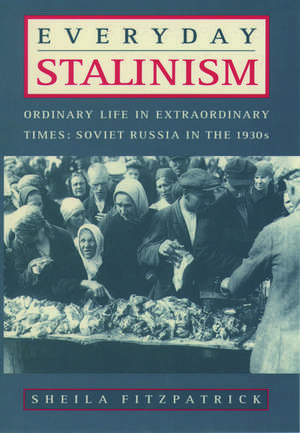
Everyday Stalinism: Ordinary Life in Extraordinary Times: Soviet Russia in the 1930s
Sheila Fitzpatricken Limba Engleză Paperback – 12 apr 2001
Preț: 114.81 lei
Preț vechi: 142.17 lei
-19%
Puncte Express: 172
Carte tipărită la comandă
Livrare economică 10-16 decembrie
Livrare express 03-07 noiembrie pentru 49.66 lei
Livrare prin curier în România Termenul estimat este afișat lângă disponibilitate.
Transport gratuit de la 400.00 lei Plată online sau ramburs, în funcție de opțiunile comenzii.
Retur gratuit în 14 zile Comandă securizată și suport în română.
Specificații
ISBN-13: 9780195050011
ISBN-10: 0195050010
Pagini: 312
Ilustrații: 10 halftones
Dimensiuni: 130 x 211 x 15 mm
Greutate: 0.26 kg
Editura: Oxford University Press
Colecția OUP USA
Locul publicării:New York, United States
ISBN-10: 0195050010
Pagini: 312
Ilustrații: 10 halftones
Dimensiuni: 130 x 211 x 15 mm
Greutate: 0.26 kg
Editura: Oxford University Press
Colecția OUP USA
Locul publicării:New York, United States
V-ar putea interesa
-
 The Peloponnesian WarThucydides-15%Preț: 82.71 lei96.96 lei
 -
 War and PeaceLeo TolstoyPreț: 85.85 lei
 -
 The Soviet Union: A Very Short IntroductionStephen Lovell-18%Preț: 58.22 lei71.42 lei
 -
 Russia: A HistoryGregory L. Freeze-15%Preț: 113.00 lei133.64 lei
 -
 NapoleonMichael BroersPreț: 124.12 lei
 -
 On the EdgeRobert Duck-16%Preț: 272.12 lei324.91 lei
 -
 Byzantium in the Iconoclast Era, c. 680-850Leslie BrubakerPreț: 398.96 lei
 -
 Fear and the Muse Kept WatchAndy McSmithPreț: 121.99 lei
 -
 A Spy in the Archives: A Memoir of Cold War RussiaSheila Fitzpatrick-20%Preț: 193.75 lei241.41 lei
Recenzii
Of the two, Fitzpatrick is incomparably the finer historian . . . . There is no doubt abou the quality of Fitzpatrick's research . . .
"A fine work--engrossing, well written, superbly documented, and much needed to boot....[The book's sources] make absolutely fascinating reading....An assiduous scholar, Professor Fitzpatrick seems to have scrutinized every relevant scrap of paper. Her explication is a model of balance and judiciousness....Individual memoirs apart, most histories of this period were written from the top--that is, showing how the policies were shaped and implemented, rather than how they were perceived and experienced by their subjects. It is the latter...that constitutes the major distinction of Fitzpatrick's book."--Abraham Brumberg, The Nation
"The author's rich materials challenge readers to build their own model of Stalin's people, their complicity and resistance."--Wilson Quarterly
"A most welcome addition to the literature on Stalin's Russia....Fitzpatrick has used the entire range of sources available, from familiar memoirs and postwar interview material to contemporary research and an array of archival information....The book is a major contribution to understanding this extraordinary period. Its lucid prose and the inherent interest of its subject matter should make it accessible to undergraduates, as well as to more specialized readers."--Choice
"One of the most influential historians of the Soviet period describes what it was like to live under Stalin in the 1930s--the frantic, heroic, tragic decade of collectivization, forced-draft industrialization, and purges, when ordinary Russians struggled to a find a wearable pair of shoes and lined up in subzero weather at two o'clock in the morning in the hope of getting 16 grams of bread....They were years of unimaginable hardship and brutality but also of idealism, a surreal melange that [Fitzpatrick] captures with admirable matter-of-factness."--Foreign Affairs
"A fine crossover book for both upperlevel and introductory courses....Well written."--Roger W. Haughey, Georgetown University
"Everyday Stalinism should prove invaluable for any course on Soviet history. Knowing how a nation's people actually lived, thought, and felt is essential to any real understanding of the past. On this, Fitzpatrick--who has done more than any other scholar to make the complexities of the social history of the Stalin years come alive--delivers as no one else can."--John McCannon, Norwich University
Review from previous edition "Fitzpatrick makes subtle use of the press and of police reports that assist in giving us one of the most comprhensive accounts of what it meant to live in Stalin's Russia in the 1930's"
"A fine work--engrossing, well written, superbly documented, and much needed to boot....[The book's sources] make absolutely fascinating reading....An assiduous scholar, Professor Fitzpatrick seems to have scrutinized every relevant scrap of paper. Her explication is a model of balance and judiciousness....Individual memoirs apart, most histories of this period were written from the top--that is, showing how the policies were shaped and implemented, rather than how they were perceived and experienced by their subjects. It is the latter...that constitutes the major distinction of Fitzpatrick's book."--Abraham Brumberg, The Nation
"The author's rich materials challenge readers to build their own model of Stalin's people, their complicity and resistance."--Wilson Quarterly
"A most welcome addition to the literature on Stalin's Russia....Fitzpatrick has used the entire range of sources available, from familiar memoirs and postwar interview material to contemporary research and an array of archival information....The book is a major contribution to understanding this extraordinary period. Its lucid prose and the inherent interest of its subject matter should make it accessible to undergraduates, as well as to more specialized readers."--Choice
"One of the most influential historians of the Soviet period describes what it was like to live under Stalin in the 1930s--the frantic, heroic, tragic decade of collectivization, forced-draft industrialization, and purges, when ordinary Russians struggled to a find a wearable pair of shoes and lined up in subzero weather at two o'clock in the morning in the hope of getting 16 grams of bread....They were years of unimaginable hardship and brutality but also of idealism, a surreal melange that [Fitzpatrick] captures with admirable matter-of-factness."--Foreign Affairs
"A fine crossover book for both upperlevel and introductory courses....Well written."--Roger W. Haughey, Georgetown University
"Everyday Stalinism should prove invaluable for any course on Soviet history. Knowing how a nation's people actually lived, thought, and felt is essential to any real understanding of the past. On this, Fitzpatrick--who has done more than any other scholar to make the complexities of the social history of the Stalin years come alive--delivers as no one else can."--John McCannon, Norwich University
Review from previous edition "Fitzpatrick makes subtle use of the press and of police reports that assist in giving us one of the most comprhensive accounts of what it meant to live in Stalin's Russia in the 1930's"
Notă biografică
Sheila Fitzpatrick is Bernadotte E. Schmitt Professor of History at the University of Chicago.