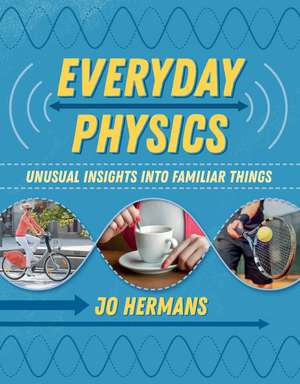
Everyday Physics: Unusual insights into familiar things
Autor Jo Hermansen Limba Engleză Paperback – 2 sep 2021
How can you tell where a sound is coming from? What is the human energy equivalent of a vacuum cleaner? How does GPS work? Why do eggs explode in the microwave? Is there a vacuum inside double-glazed windows? Can you get less wet by cycling faster?
With clear explanations and hundreds of colourful photos and diagrams, Everyday Physics is an engaging physics book accessible for all ages. You can read this brilliant book in whatever order you want, dipping in and out of the different sections. Based on Hermans' Everyday physics lecture series, it combines deep physical insights with back-of-the-envelope calculations, relating abstract physics concepts to the real world, often in a surprising way.
Everyday Physics also features lots of intriguing home experiments to further demonstrate the explanations. Most of these can be done using simple items from the kitchen, such as using a glass of water, a torch, and a few drops of milk to understand why the sky is blue and the setting sun red. If you want to dig a bit deeper, there are extra resources in the shaded boxes throughout.
Whether you're a parent, grandparent, college student or just have a healthy interest in the world around you, this book will bring the magic of physics to your everyday life. Once you discover the beauty of science, ordinary things will become extraordinary.
Preț: 87.07 lei
Preț vechi: 137.27 lei
-37%
Puncte Express: 131
Carte disponibilă
Livrare economică 07-21 noiembrie
Livrare express 24-30 octombrie pentru 90.25 lei
Livrare prin curier în România Termenul estimat este afișat lângă disponibilitate.
Transport gratuit de la 400.00 lei Plată online sau ramburs, în funcție de opțiunile comenzii.
Retur gratuit în 14 zile Comandă securizată și suport în română.
Specificații
ISBN-13: 9781906860806
ISBN-10: 1906860807
Pagini: 320
Ilustrații: Hundreds of colour photos and diagrams
Dimensiuni: 152 x 196 x 18 mm
Greutate: 0.64 kg
Editura: Bloomsbury Publishing
Colecția Uit Cambridge Ltd
Locul publicării:London, United Kingdom
ISBN-10: 1906860807
Pagini: 320
Ilustrații: Hundreds of colour photos and diagrams
Dimensiuni: 152 x 196 x 18 mm
Greutate: 0.64 kg
Editura: Bloomsbury Publishing
Colecția Uit Cambridge Ltd
Locul publicării:London, United Kingdom
V-ar putea interesa
-
 How To Save Your Granny From a Runaway TrainSwapna HaddowPreț: 80.55 lei
 -
 -15%Preț: 126.85 lei148.88 lei
 -
 -16%Preț: 135.79 lei162.15 lei
 -
 -15%Preț: 121.88 lei143.37 lei
 -
 -17%Preț: 91.42 lei110.06 lei
 -
 Seven Brief Lessons on Physics. Anniversary EditionCarlo RovelliPreț: 92.41 lei
 -
 Storm in a TeacupHelen CzerskiPreț: 99.21 lei
 -
 The Flying Circus of PhysicsJearl WalkerPreț: 475.90 lei
 -
 Everyday STEM Science - PhysicsShini Somara-33%Preț: 38.73 lei57.40 lei
 -
 Preț: 59.76 lei
 -
 -27%Preț: 87.85 lei120.00 lei
 -
 Surprised by Science: Forces are Fantastic!Sabrina Rose Science Girl-37%Preț: 50.78 lei80.74 lei
 -
 -23%Preț: 51.20 lei66.33 lei
 -
 Frequently Asked Questions About the UniverseDaniel Whiteson-27%Preț: 68.00 lei93.08 lei
 -
 Storm in a TeacupHelen Czerski-18%Preț: 65.55 lei79.83 lei
 -
 Breakfast with EinsteinChad OrzelPreț: 71.46 lei
 -
 Preț: 57.23 lei
Cuprins
Part A - Outdoor Life
How does GPS navigation work? (With a nod to Albert Einstein)
Why are some mountain winds so warm?
What is wind chill?
Why is ice so slippery?
Waves at the beach
How fast do raindrops fall?
Why don't fog drops fall?
Skydiving: how fast can you fall?
How high will the sun rise today?
How hot does the sun feel?
Parallel light beams from the sun
Summer and winter, why such a big difference?
Why do you walk the way you do?
Part B - Bicycle and Car
The human engine
The human energy equivalent of a vacuum cleaner
How do you keep your temperature constant?
How efficient is cycling?
What forces affect a cyclist?
Can you cycle at 100 km/ h?
How fast can you cycle on the moon?
Is cycling really harder with a side wind?
Minimizing your journey time
The cyclist's soggy back
Can you get less wet by cycling faster?
Rolling resistance, air resistance and fuel consumption
How many cars per hour can a road take?
Part C - Light and Colour
Cosy candlelight
Why are incandescent bulbs so inefficient?
Luminous ideas: fluorescent lights and LEDs
Why is the sky blue and the setting sun is red?
Two kinds of smoke from the same cigarette?
Swimming pools are deeper than they look
Sunlight filtering through the leaves of trees
How sharply can you see?
Your eye is more sensitive than a camera
Puddles on a dry road
Seeing the sun after sunset
Transparent windowpanes and opaque lace curtains
Seeing clearly underwater
What makes rainbows?
Why are soap bubbles so colourful?
Why are CDs so colourful?
How does a hologram work?
Why does the sea look so blue?
What's special about Polaroid glasses?
Part D - Sound and Hearing
What do your ears hear?
Why isn't there more noise pollution?
The energy-cost of talking
How can you tell where a sound is coming from?
Discriminating between different voices: the cocktail party effect
Do you hear better at night?
Can the wind blow sound to you?
Do noise barriers work?
Can you hear whether the curtains are closed?
Doh-re-mi: the physics of musical scales
Why orchestras go out of tune
Part E - In and Around the House
Why do eggs explode in the microwave?
Can you cool your home with your fridge?
Curve balls, backspin and top spin
How much power can you get from solar energy?
The mystery of the wandering carpets
Common misconceptions about the radiometer
Is thick glass a better insulator than thin glass?
Is there a vacuum inside double glazing windows?
Can you feel energy consumption?
Is a black central heating radiator better than a white one?
Does black paint get hotter than white?
Does Baby really need a hot water bottle?
The lid on the saucepan
Why does the air get so dry in winter?
Why don't you die of heat in the sauna?
The wine-mixing problem
The wandering tea leaves
How does GPS navigation work? (With a nod to Albert Einstein)
Why are some mountain winds so warm?
What is wind chill?
Why is ice so slippery?
Waves at the beach
How fast do raindrops fall?
Why don't fog drops fall?
Skydiving: how fast can you fall?
How high will the sun rise today?
How hot does the sun feel?
Parallel light beams from the sun
Summer and winter, why such a big difference?
Why do you walk the way you do?
Part B - Bicycle and Car
The human engine
The human energy equivalent of a vacuum cleaner
How do you keep your temperature constant?
How efficient is cycling?
What forces affect a cyclist?
Can you cycle at 100 km/ h?
How fast can you cycle on the moon?
Is cycling really harder with a side wind?
Minimizing your journey time
The cyclist's soggy back
Can you get less wet by cycling faster?
Rolling resistance, air resistance and fuel consumption
How many cars per hour can a road take?
Part C - Light and Colour
Cosy candlelight
Why are incandescent bulbs so inefficient?
Luminous ideas: fluorescent lights and LEDs
Why is the sky blue and the setting sun is red?
Two kinds of smoke from the same cigarette?
Swimming pools are deeper than they look
Sunlight filtering through the leaves of trees
How sharply can you see?
Your eye is more sensitive than a camera
Puddles on a dry road
Seeing the sun after sunset
Transparent windowpanes and opaque lace curtains
Seeing clearly underwater
What makes rainbows?
Why are soap bubbles so colourful?
Why are CDs so colourful?
How does a hologram work?
Why does the sea look so blue?
What's special about Polaroid glasses?
Part D - Sound and Hearing
What do your ears hear?
Why isn't there more noise pollution?
The energy-cost of talking
How can you tell where a sound is coming from?
Discriminating between different voices: the cocktail party effect
Do you hear better at night?
Can the wind blow sound to you?
Do noise barriers work?
Can you hear whether the curtains are closed?
Doh-re-mi: the physics of musical scales
Why orchestras go out of tune
Part E - In and Around the House
Why do eggs explode in the microwave?
Can you cool your home with your fridge?
Curve balls, backspin and top spin
How much power can you get from solar energy?
The mystery of the wandering carpets
Common misconceptions about the radiometer
Is thick glass a better insulator than thin glass?
Is there a vacuum inside double glazing windows?
Can you feel energy consumption?
Is a black central heating radiator better than a white one?
Does black paint get hotter than white?
Does Baby really need a hot water bottle?
The lid on the saucepan
Why does the air get so dry in winter?
Why don't you die of heat in the sauna?
The wine-mixing problem
The wandering tea leaves
Recenzii
Everyday Physics is written in a very accessible style with fantastic use of pictures. It provides satisfyingly clear explanations and it covers a lot of ground. A lovely book to have.
A gold mine of physics in the world around us, ranging from light to sound and from indoors to outdoors, written in a friendly style with beautiful diagrams, photos, and explanations. Each chapter is a joy to read.
Everyday phenomena explained simply and clearly for all to understand.
This is an interesting collection of explanations & discussions of the physics of everyday situations. The range of topics and the number of situations is extensive. By providing clear information, it encourages further thought.
Do try this at home. Satisfaction guaranteed for every inquisitive soul.
A gold mine of physics in the world around us, ranging from light to sound and from indoors to outdoors, written in a friendly style with beautiful diagrams, photos, and explanations. Each chapter is a joy to read.
Everyday phenomena explained simply and clearly for all to understand.
This is an interesting collection of explanations & discussions of the physics of everyday situations. The range of topics and the number of situations is extensive. By providing clear information, it encourages further thought.
Do try this at home. Satisfaction guaranteed for every inquisitive soul.