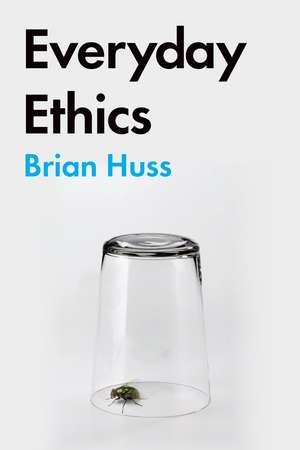
Everyday Ethics
Autor Brian Hussen Limba Engleză Paperback – noi 2024
Preț: 158.21 lei
Preț vechi: 192.34 lei
-18%
Puncte Express: 237
Carte disponibilă
Livrare economică 30 octombrie-13 noiembrie
Livrare express 15-21 octombrie pentru 58.11 lei
Livrare prin curier în România Termenul estimat este afișat lângă disponibilitate.
Transport gratuit de la 400.00 lei Plată online sau ramburs, în funcție de opțiunile comenzii.
Retur gratuit în 14 zile Comandă securizată și suport în română.
Specificații
ISBN-13: 9781554816101
ISBN-10: 1554816106
Pagini: 186
Dimensiuni: 152 x 229 x 9 mm
Greutate: 0.3 kg
Editura: BROADVIEW PR
Colecția Broadview Press
Locul publicării:Peterborough, Canada
ISBN-10: 1554816106
Pagini: 186
Dimensiuni: 152 x 229 x 9 mm
Greutate: 0.3 kg
Editura: BROADVIEW PR
Colecția Broadview Press
Locul publicării:Peterborough, Canada
Recenzii
Everyday Ethics is an engaging treatment of the ethical questions that we all must answer on a regular basis. Each of the book’s forty chapters provides short pro and con arguments on a particular issue, designed to get readers talking and thinking about obligations, rights, societal expectations, and ethical principles. Instructors are sure to appreciate the way in which Everyday Ethics generates interest and participation from their students on day one. And students will appreciate the opportunity to engage with concerns that actually arise in their day-to-day lives and over which they have control.
“Is it wrong to not leave a tip? Is it okay to date your friend’s ex? Should we lie to children about Santa Claus? Brian Huss helps students reflect on these and other questions by presenting opposing responses in pro-con format. The book will work well as a discussion starter and also as a catalyst for innovative assignments.” — Nils Rauhut, Coastal Carolina University
“Everyday Ethics provides a unique and engaging way to explore philosophical ethics by focusing on the moral challenges we face in everyday situations. It will surely spark thoughtful discussions in the classroom and beyond.” — Mark Navin, Oakland University
“A key virtue of this book is that, by design, the quality of the arguments presented varies widely. Expecting a beginner to develop a good objection to Judith Jarvis Thomson is a bit like expecting me to deadlift a car. By contrast, many of the arguments in Everyday Ethics provide excellent foils to which students can hope to develop cogent replies.” — Tristram McPherson, The Ohio State University
“Everyday Ethics is an engaging collection of chatty and clearly written essays concisely addressing many ethical problems we encounter in daily life. This book will whet its reader’s appetite for philosophical reflection on quotidian ethics, though it is anything but quotidian.” — Anthony Skelton, Western University
“Is it wrong to not leave a tip? Is it okay to date your friend’s ex? Should we lie to children about Santa Claus? Brian Huss helps students reflect on these and other questions by presenting opposing responses in pro-con format. The book will work well as a discussion starter and also as a catalyst for innovative assignments.” — Nils Rauhut, Coastal Carolina University
“Everyday Ethics provides a unique and engaging way to explore philosophical ethics by focusing on the moral challenges we face in everyday situations. It will surely spark thoughtful discussions in the classroom and beyond.” — Mark Navin, Oakland University
“A key virtue of this book is that, by design, the quality of the arguments presented varies widely. Expecting a beginner to develop a good objection to Judith Jarvis Thomson is a bit like expecting me to deadlift a car. By contrast, many of the arguments in Everyday Ethics provide excellent foils to which students can hope to develop cogent replies.” — Tristram McPherson, The Ohio State University
“Everyday Ethics is an engaging collection of chatty and clearly written essays concisely addressing many ethical problems we encounter in daily life. This book will whet its reader’s appetite for philosophical reflection on quotidian ethics, though it is anything but quotidian.” — Anthony Skelton, Western University
Cuprins
Acknowledgements
Introduction
Guide to Essays
I. The Public Sphere: Is it ok to…
Introduction
Guide to Essays
I. The Public Sphere: Is it ok to…
- 1. Ride a crowded elevator one floor?
- 2. Wait to merge when two lanes of traffic are reduced to one?
- 3. Let your lawn grow wild or to otherwise have an unkempt lawn or gar-den?
- 4. Not call strangers on their moral transgressions?
- 5. Not vote?
- 6. Line up with 16 items in the 15-items-or-fewer lane?
- 7. Not tip at a restaurant?
- 8. Complain to front-line workers?
- 9. Share access to streaming services?
- 10. Save seats in a crowded place?
- 11. Eat meat?
- 12. Cheat in a class?
- 13. Use plagiarism-detection software?
- 14. Complain to an instructor about how a course is taught?
- 15. Ignore your moral convictions in order to do your job?
- 16. Go to work or school sick?
- 17. Lie to people to spare their feelings?
- 18. Ignore your drama-prone friend?
- 19. Correct other people’s grammar?
- 20. Post about controversial topics on social media?
- 21. Borrow something without asking?
- 22. Date your friend’s ex?
- 23. Ghost someone?
- 24. Swear in the presence of children?
- 25. Discipline other people’s children?
- 26. Lie to children about Santa Claus?
- 27. Gossip?
- 28. Neglect your physical health?
- 29. Be sexually promiscuous?
- 30. Watch football?
- 31. Tell off-color jokes?
- 32. Judge people on the basis of their appearance?
- 33. Speak ill of the dead?
- 34. Celebrate someone’s death?
- 35. Reveal spoilers?
- 36. Proselytize?
- 37. Be patriotic?
- 38. Appropriate another culture?
- 39. Make use of stereotypes about races, ethnicities, genders, etc. when those stereotypes are seemingly positive?
- 40. Speak or write derogatory names for group, e.g., racial slurs?