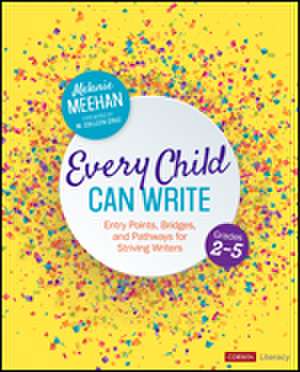
Every Child Can Write, Grades 2-5
Autor Melanie Meehanen Limba Engleză Paperback – 21 oct 2019
În volumul Every Child Can Write, Grades 2-5, aplicabilitatea practică primează în fața teoriei abstracte, oferind cadrelor didactice un set de strategii concrete pentru a transforma rezistența la scris în participare activă. Găsim în această lucrare o abordare empatică a „scriitorilor în devenire” (striving writers), privind provocările instrucționale nu ca pe niște deficite, ci ca pe trasee alternative spre succes. Suntem de părere că forța acestei cărți rezidă în modul în care utilizează principiile Universal Design for Learning (UDL) pentru a crea un mediu de clasă incluziv, unde spațiul și materialele sunt organizate special pentru a încuraja independența elevului. Spre deosebire de The Responsive Writing Teacher, Grades K-5, unde Melanie Meehan explora responsivitatea prin patru domenii largi, acest titlu se concentrează strict pe segmentul claselor 2-5, oferind soluții punctuale pentru creșterea stimei de sine și a volumului de text produs. Cartea este structurată metodic: prima parte se ocupă de configurarea spațiului fizic și a rutinelor, în timp ce secțiunile următoare detaliază tranzițiile eficiente și utilizarea tehnologiei ca factor de autonomie. Recomandăm acest titlu ca o alternativă la Instruction and Assessment for Struggling Writers de Gary A. Troia pentru cursurile de metodică a limbii engleze sau pedagogie specială, având avantajul unei structuri mai aerisite și al accentului pus pe instrumente reproductibile imediat la clasă. Prin integrarea evaluării formative și a tehnologiei adaptate, Melanie Meehan continuă misiunea începută în Answers to Your Biggest Questions About Teaching Elementary Writing, oferind de data aceasta un ghid aprofundat despre cum să onorăm punctele forte ale fiecărui copil, chiar și atunci când procesul de scriere pare blocat.
Preț: 243.84 lei
Carte disponibilă
Livrare economică 11-25 noiembrie
Specificații
ISBN-10: 1544355076
Pagini: 272
Dimensiuni: 185 x 229 x 20 mm
Greutate: 0.54 kg
Ediția:First Edition
Editura: SAGE Publications
Locul publicării:Thousand Oaks, United States
V-ar putea interesa
-
 Preț: 107.43 lei
 -
 A Proverb a Day... 366 African ProverbsFawzia El -. NurPreț: 72.61 lei
 -
 Singing in French, volume 2 - higher voicesChristopher GoldsackPreț: 165.49 lei
 -
 Singing in French, volume 2 - lower voicesChristopher GoldsackPreț: 165.49 lei
 -
 Preț: 151.89 lei
 -
 DrakestailArne B. KaiserPreț: 150.46 lei
 -
 Anansi!Arne B. KaiserPreț: 147.21 lei
 -
 Be You, Be StillMary Ward LupinacciPreț: 81.76 lei
 -
 Keys to Unlocking the Universe Via Augmented RealityKatie Ann WilsonPreț: 177.16 lei
 -
 Pokebio101Joseph StehlyPreț: 105.89 lei
 -
 The SAGE Handbook of African American EducationLinda C. Tillman-27%Preț: 745.96 lei1021.87 lei
 -
 Nourishing VocabularyShira LublinerPreț: 314.57 lei
 -
 Vocabulary Lists and Activities for the PreK-2 ClassroomSusan E. IsraelPreț: 279.13 lei
 -
 More Than 100 Ways to Learner-Centered LiteracyLaura LiptonPreț: 239.76 lei
 -
 Strategies That Promote Student EngagementErnestine G. RiggsPreț: 282.67 lei
 -
 Fierce TeachingEric JensenPreț: 190.41 lei
 -
 More Than 100 Tools for Developing LiteracyJoan F. GroeberPreț: 245.98 lei
 -
 Classroom ActivatorsJerry EvanskiPreț: 210.03 lei
 -
 USO de RazonRicardo Garcia DamboreneaPreț: 145.64 lei
 -
 Preț: 74.23 lei
 -
 Think ParksAndrew VecseyPreț: 89.67 lei
 -
 The Court Reporter's Reference of Realtime ConflictsMR Kenneth a. WickPreț: 93.32 lei
 -
 Practical Guide to Writing FictionAditi ChopraPreț: 34.51 lei
 -
 The Wise Book of WhysToday I. Found Out ComPreț: 83.90 lei
De ce să citești această carte
Recomandăm această carte educatorilor care lucrează cu elevi din ciclul primar și care caută metode non-punitive pentru a motiva copiii care evită scrisul. Cititorul câștigă acces la un arsenal de instrumente practice — de la rutine de management al clasei la soluții tehnologice accesibile — care transformă ora de scriere dintr-o sursă de frustrare într-un spațiu de reușită personală, fundamentat pe principiile moderne ale incluziunii educaționale.
Despre autor
Melanie Meehan este o specialistă recunoscută în domeniul alfabetizării și pedagogiei scrierii pentru învățământul primar. Prin lucrările sale, precum The Responsive Writing Teacher, Grades K-5 și contribuțiile din seria „Five-to-Thrive”, ea s-a impus ca o voce care pledează pentru instruirea centrată pe elev și pentru adaptarea curriculumului la nevoile sociale, emoționale și lingvistice ale acestuia. În prezent, Meehan ocupă roluri de coordonare în districte școlare, unde implementează strategii de scriere care pun accent pe independența elevului și pe utilizarea tehnologiei ca suport în procesul de învățare.
Descriere scurtă
When we think of students who have faced instructional challenges as striving writers, their path to success becomes clearer. It may not be the same path their classmates travel, but with you as their guide, they will reach their goal. This book, filled with practical strategies, classroom-management ideas, reproducible tools, as well as low and high-tech solutions for increasing output and boosting self esteem will also help you:
· Implement principles of UDL to optimize your classroom environment and student learning;
· Identify and honor students¿ strengths throughout your writing instruction;
· Maximize the power of formative assessment to set goals with students
· Integrate the most appropriate technology that empowers students and leads them to independence
Cuprins
Acknowledgments
About the Author
Introduction
Why Our Work Matters
Entry Points, Bridges, and Pathways
How This Book Is Organized and What I Hope You’ll Gain From Reading It
PART 1: CREATING A PRODUCTIVE ENVIRONMENT
Chapter 1: Come In and Look Around!
How does the classroom environment support our writers who face instructional obstacles?
Our striving writers benefit from an organized environment, and they need routines in order to maintain that organization.
Our classroom’s spaces should contain only materials that foster student learning and independence.
The more we create, provide, and encourage the use of tools for independence and repertoire, the more learning will happen in our classrooms.
Chapter 2: Listen, Learn, and Then Go Write!
How can we set up classroom management and routines to support learning and independent writing?
Transitions work best when everyone, especially striving writers, gets to where they belong during instruction and independent writing time.
In order for instruction to be effective, students must not only listen to it, they must also understand it.
Independent writing time should involve independently writing.
PART 2: FINDING ENTRY POINTS AND BUILDING BRIDGES
Chapter 3: Find the Place Where Writers Can Join the Work
How can we provide entry points so all writers get to experience success within the writing process?
We can use what we know about standards and progressions of writing to help students grow their ZPD along the continuum of mastery.
When we determine where and how students get stuck in their process, we can help them find the right entry point.
We empower students and engage them in their development as writers by teaching them to self-assess their process—and progress.
Chapter 4: Construct Bridges for Writers to Join the Journey
How can we change the steps and the process so that all writers can participate and produce?
Even though choice is a critical feature in many writing classes, sometimes we need to remove choice in order to provide temporary scaffolds that get students writing.
The bridges we provide our striving writers may need to be placed in different parts of the process.
Sometimes isolating skills is an effective way to improve overall performance.
PART 3: PROVIDING PATHWAYS
Chapter 5: The Power of Paper—Don’t Underestimate It!
How can we leverage paper choice to inspire our writers who face instructional obstacles?
Paper has the power to communicate what is important—neatness or content?
Paper choice communicates our expectations and helps students set expectations for themselves.
Paper can be one of your most powerful scaffolds for focus and organization.
Chapter 6: Co-Create Classroom Charts as Pathways Toward Independence
How can we use charts to develop students’ independence within our writing classrooms?
It’s important to be confident about the types and purposes of various charts.
Quick-Reference Guide to Classroom Charts
We need to address what gets in the way of relevant, responsive charts—and know what we can do about it.
More than anything else, classroom charts are there for students to use.
Chapter 7: Venture Forth on Higher-Tech Pathways . . . With Intention and Forethought
How can we leverage technology to find entry points and build bridges or pathways for our writers who face instructional obstacles?
Technology has the power to impact students, and it has the power to impact teachers.
Technology enables us to provide access to students so that tools, charts, and other resources can be easily accessed at points in the process where and when students need them.
It’s important to pay attention to the reason we are using any digital device, modification, or tool with students—and make sure it fits a student’s needs.
Chapter 8: Spelling and Conventions—The Pitfalls and Potholes Along the Trail
How can we address the skills involved with spelling and conventions while not losing momentum with the overall writing process?
Striving writers—no, all writers—need to see conventions and spelling done correctly.
As we teach the transcriptive elements of spelling and punctuation, our instruction must be within students’ realm of possibility and transference—within their ZPD.
We can improve correct usage by finding ways to embed conventions across the day, increasing the level of intention, and infusing elements of play during students’ independent writing time.
Chapter 9: Every Child Can Write—A Case Study
What does it look like in a real classroom when we merge entry points, bridges, and pathways?
Increasing Volume as a Crucial First Step
Establishing Routines
Providing Charts for Independence
Finding Different Entry Points
Building Independence for All
Expanding Paper Choice
Assessing Engagement
Reflecting on Student Growth and Making Adjustments
Every Child Can Write: Getting Closer to Our Goals
Appendix
A. Favorite Mentor Texts for Writing Instruction
Narrative
Information
Opinion
B. Mentor Text Charts With Craft Moves
Narrative
Information
Opinion
C. Sample of Progressions
Creating a Beginning for a Narrative Story
Creating an Ending for a Narrative Story
A Sample of a Progression of a Narrative Beginning Using Stars
A Progression of Narrative Elaboration
Introduction Progression for Information Writing
Conclusion Progression for Information Writing
D. Samples of Task Analyses
Sample Task Analyses for Narrative Story, Research-Based Essay, Information Writing
Classroom Example: Narrative Story
Classroom Example: Information Book
E. Anchor Charts
Narrative Writing Anchor Chart Sequence
Information Writing Anchor Chart Sequence
F. Writing Standards
Narrative Writing Standards
Information Writing Standards
Opinion Writing Standards
G. Convention Station Samples
Periods and Capitals
Capitals
Commas
Tricky Words
References
Index
Notă biografică
Melanie's first book, Every Child Can Write, was published by Corwin Press in October 2019. With a foundational belief that all students can learn to write, this book provides strategies and resources that teachers can use, duplicate, and gather inspiration from. The Responsive Writing Teacher, co-written with Kelsey Sorum, was published in February 2021 and emphasizes the importance of knowing and understanding students across many platforms in order to teach them powerfully. Melanie's most recent book, Answers to Your Biggest Questions About Teaching Elementary Writing, is part of Corwin Press's Five to Thrive Series.
Melanie is also a co-author of Two Writing Teachers, a blog dedicated to the teaching of writing. Additionally, she co-hosts the companion podcast. Melanie's past conference presentations and additional blogs and articles can be found here.
Melanie holds a BA from Cornell University, an MA in Special Education from the University of Hartford, and a second MA in Educational Leadership from Central Connecticut State University. Melanie also has her Masters of Fine Arts in Creative Writing through the Solstice MFA Program of Pine Manor College.