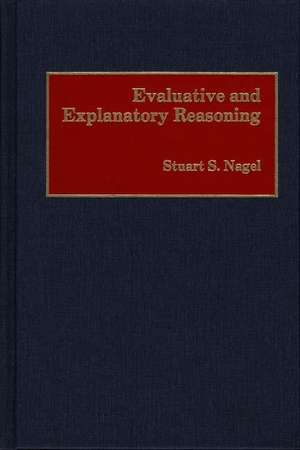
Evaluative and Explanatory Reasoning
Autor Stuart S. Nagelen Limba Engleză Hardback – 21 sep 1992
Evaluative reasoning can take several forms. It can help decision-makers select from among several public policy choices. It can enhance individual decision-making and provide means to allocate scarce resources. It can also assist in advocating and influencing decisions, mediating disputes, representing divergent viewpoints, and in assigning people to specific tasks. Explanatory reasoning, on the other hand, will help explain public policy making, and assist users in generalizing from cases and facts, and in understanding relationships. The purpose of explanatory reasoning is also to explain why superoptimum solutions are infrequently adopted and why they are seldom successfully implemented. The use of both kinds of reasoning, says Nagel, are particularly important to those who want a better understanding and want to improve the legal system.
Preț: 450.74 lei
Preț vechi: 766.28 lei
-41%
Puncte Express: 676
Preț estimativ în valută:
79.77€ • 93.23$ • 69.26£
79.77€ • 93.23$ • 69.26£
Carte tipărită la comandă
Livrare economică 20 februarie-06 martie
Preluare comenzi: 021 569.72.76
Specificații
ISBN-13: 9780899304458
ISBN-10: 0899304451
Pagini: 232
Dimensiuni: 156 x 235 x 14 mm
Greutate: 0.6 kg
Ediția:New.
Editura: Bloomsbury Publishing
Colecția Praeger
Locul publicării:New York, United States
ISBN-10: 0899304451
Pagini: 232
Dimensiuni: 156 x 235 x 14 mm
Greutate: 0.6 kg
Ediția:New.
Editura: Bloomsbury Publishing
Colecția Praeger
Locul publicării:New York, United States
V-ar putea interesa
-
 -34%Preț: 673.23 lei1019.73 lei
 -
 Handbook of Public Policy EvaluationStuart S. Nagel-27%Preț: 1040.59 lei1425.47 lei
 -
 -26%Preț: 344.50 lei467.14 lei
 -
 Resolving International Disputes Through Super-Optimum SolutionsStuart S. Nagel-25%Preț: 662.63 lei889.17 lei
 -
 -25%Preț: 527.02 lei707.23 lei
 -
 International Policy Studies CurriculumStuart S. Nagel-29%Preț: 401.31 lei562.10 lei
Cuprins
Introduction
Evaluative or Prescriptive Reasoning
Choosing Among Public Policies
Individual Decision-Making
Allocating Scarce Resources
Advocating and Influencing Decisions
Mediating Disputes
Being a Representative
Assigning People to Tasks
Optimum Sequencing
SOS Evaluation
Explanatory or Predictive Reasoning
Explaining Public Policy Making
Explaining Individual Decision-Making
Generalizing from Cases
Generalizing from Facts
Relational Reasoning
SOS Causation
Evaluative or Prescriptive Reasoning
Choosing Among Public Policies
Individual Decision-Making
Allocating Scarce Resources
Advocating and Influencing Decisions
Mediating Disputes
Being a Representative
Assigning People to Tasks
Optimum Sequencing
SOS Evaluation
Explanatory or Predictive Reasoning
Explaining Public Policy Making
Explaining Individual Decision-Making
Generalizing from Cases
Generalizing from Facts
Relational Reasoning
SOS Causation