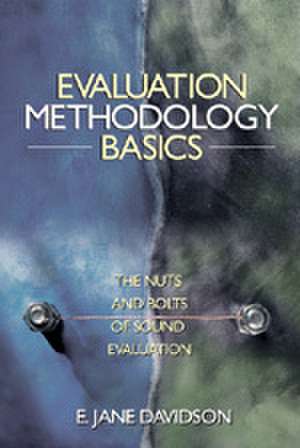
Evaluation Methodology Basics: The Nuts and Bolts of Sound Evaluation
Autor E. Jane Davidsonen Limba Engleză Electronic book text – 6 feb 2018
Preț: 382.20 lei
Puncte Express: 573
Indisponibil temporar
Doresc să fiu notificat când acest titlu va fi disponibil:
Se trimite...
Specificații
ISBN-13: 9781452208473
ISBN-10: 1452208476
Pagini: 280
Dimensiuni: 152 x 229 mm
Ediția:1
Editura: SAGE Publications
Colecția Sage Publications, Inc
Locul publicării:Thousand Oaks, United States
ISBN-10: 1452208476
Pagini: 280
Dimensiuni: 152 x 229 mm
Ediția:1
Editura: SAGE Publications
Colecția Sage Publications, Inc
Locul publicării:Thousand Oaks, United States
V-ar putea interesa
-
 Research Methods and Organization StudiesAlan Bryman-18%Preț: 1121.80 lei1368.04 lei
 -
 -18%Preț: 1113.77 lei1358.26 lei
 -
 -15%Preț: 531.31 lei625.07 lei
 -
 -15%Preț: 434.49 lei511.17 lei
 -
 -15%Preț: 462.55 lei544.18 lei
 -
 Ethnomethodology at PlayPeter Tolmie-15%Preț: 469.69 lei552.57 lei
 -
 -15%Preț: 522.77 lei615.02 lei
 -
 -15%Preț: 653.35 lei768.64 lei
 -
 Preț: 295.44 lei
 -
 Drawing Inferences From Self-selected SamplesHoward WainerPreț: 311.10 lei
 -
 Visible Numbers: Essays on the History of Statistical GraphicsMiles A. Kimball-18%Preț: 1259.28 lei1535.71 lei
Recenzii
“Amidst
the
wash
of
methods
books
available
to
evaluators,
Davidson’s
book
provides
powerful
techniques
for
asking
and
answering
the
important
foundational
questions
in
any
program
evaluation.”
“This is a very well written book that offers a unique perspective on long-practiced evaluation techniques and presents several new, potentially very useful, techniques that return “valuation” to the evaluation process.”
"What is evaluation-specific logic and methodology? This book answers that question in a way that is persuasive, accessible, and understandable. It presents a set of principles and procedures to guide the task of blending descriptive data with relevant values to draw explicitly evaluative conclusions. The book makes a significant contribution to positioning evaluation as a unique and special field of inquiry and judgment."
"Evaluation Methodology Basicsis yet another excellent book from Sage. This would be a good book to use for a graduate-level course in evaluation techniques or as a template for anyone who is new to the techniques of program evaluation."
"The text is not only a great introduction for novices, but a toolbox with new perspectives for conducting sound evaluation that integrates values with facts into evaluative conclusions. As suchEvaluation Methodology Basicsshould be on every evaluator's shelf."
"I welcome this student-friendly text to complement my favorite checklists. This text develops the core checklist framework to provide evaluation methodology basics for, presumably mainly, introductory courses on program evaluation."
“This is a very well written book that offers a unique perspective on long-practiced evaluation techniques and presents several new, potentially very useful, techniques that return “valuation” to the evaluation process.”
"What is evaluation-specific logic and methodology? This book answers that question in a way that is persuasive, accessible, and understandable. It presents a set of principles and procedures to guide the task of blending descriptive data with relevant values to draw explicitly evaluative conclusions. The book makes a significant contribution to positioning evaluation as a unique and special field of inquiry and judgment."
"Evaluation Methodology Basicsis yet another excellent book from Sage. This would be a good book to use for a graduate-level course in evaluation techniques or as a template for anyone who is new to the techniques of program evaluation."
"The text is not only a great introduction for novices, but a toolbox with new perspectives for conducting sound evaluation that integrates values with facts into evaluative conclusions. As suchEvaluation Methodology Basicsshould be on every evaluator's shelf."
"I welcome this student-friendly text to complement my favorite checklists. This text develops the core checklist framework to provide evaluation methodology basics for, presumably mainly, introductory courses on program evaluation."
Cuprins
What
is
Evaluation?
Basic Definitions
A Note About Fitting Evaluation Approach to Purpose
The Steps Involved
The Ingredients of a Good Evaluation
Identifying the Evaluand
Additional Readings
Exercises
Defining the Purpose of the Evaluation
Evaluations for Determining Overall Quality or Value
Evaluations for Finding Areas for Improvement
Questions About Absolute vs. Relative Quality/Value
Summary and Final Comments
Additional Readings
Exercises
Identifying Evaluative Criteria
Why Not Just Use Goals?
Identifying Criteria: Basic Concepts and Tools
Conducting a Needs Assessment
Identifying Other Relevant Criteria
Additional Readings
Exercises
Organizing the Criteria & Identifying Potential Sources of Evidence
The Importance of Choosing Multiple Sources of Quality Evidence
The Process Evaluation Checkpoint
The Outcome Evaluation Checkpoint
The Comparative Cost-Effectiveness Checkpoint
The Exportability Checkpoint
Additional Readings
Exercises
Dealing With the Causation Issue
Certainty about causation
Inferring causation: Basic principles
Inferring causation: Seven strategies
Choosing a blend of methods to address the causation issue
Additional Readings
Exercises
"Values" in Evaluation
The Controversy
The Three Types of Subjectivity
The Tensions Between Subjectivism and Common Sense
Where do the "Values" in an Evaluation Come From?
Additional Readings
Exercises
Determining Importance
Determining Importance: What and Why
Determining Importance: Six Strategies
Additional Readings
Exercises
The Merit Determination Step
Determining Merit: What and Why
Using Rubrics for Determining "Absolute" Merit
Using Rubrics for Determining "Relative" Merit
Making practical use of merit determination rubrics
Additional Readings
Exercises
Synthesis Methodology
Synthesis: What and Why
The Role of Costs and Comparisons in Synthesis
Synthesizing for "Grading"
Synthesizing for "Ranking"
Additional Readings
Exercises
Putting it All Together
The KEC Preliminary Checkpoints
The KEC Foundations Checkpoints
The KEC Subevaluations Checkpoints
The KEC Conclusions Checkpoints
Additional Readings
Meta-Evaluation
The five criteria for evaluating evaluations
Key points to remember in meta-evaluation
Other options for conducting a meta-evaluation
Formative meta-evaluation
Should I use meta-evaluation myself?
Additional Readings
Exercises
Answers to Selected Exercises
Sample Exam Questions
Tips for students answering these exam questions
The questions
A rubric for grading assignment and exam answers
Suggested answers to practice exam questions
Glossary
References
Basic Definitions
A Note About Fitting Evaluation Approach to Purpose
The Steps Involved
The Ingredients of a Good Evaluation
Identifying the Evaluand
Additional Readings
Exercises
Defining the Purpose of the Evaluation
Evaluations for Determining Overall Quality or Value
Evaluations for Finding Areas for Improvement
Questions About Absolute vs. Relative Quality/Value
Summary and Final Comments
Additional Readings
Exercises
Identifying Evaluative Criteria
Why Not Just Use Goals?
Identifying Criteria: Basic Concepts and Tools
Conducting a Needs Assessment
Identifying Other Relevant Criteria
Additional Readings
Exercises
Organizing the Criteria & Identifying Potential Sources of Evidence
The Importance of Choosing Multiple Sources of Quality Evidence
The Process Evaluation Checkpoint
The Outcome Evaluation Checkpoint
The Comparative Cost-Effectiveness Checkpoint
The Exportability Checkpoint
Additional Readings
Exercises
Dealing With the Causation Issue
Certainty about causation
Inferring causation: Basic principles
Inferring causation: Seven strategies
Choosing a blend of methods to address the causation issue
Additional Readings
Exercises
"Values" in Evaluation
The Controversy
The Three Types of Subjectivity
The Tensions Between Subjectivism and Common Sense
Where do the "Values" in an Evaluation Come From?
Additional Readings
Exercises
Determining Importance
Determining Importance: What and Why
Determining Importance: Six Strategies
Additional Readings
Exercises
The Merit Determination Step
Determining Merit: What and Why
Using Rubrics for Determining "Absolute" Merit
Using Rubrics for Determining "Relative" Merit
Making practical use of merit determination rubrics
Additional Readings
Exercises
Synthesis Methodology
Synthesis: What and Why
The Role of Costs and Comparisons in Synthesis
Synthesizing for "Grading"
Synthesizing for "Ranking"
Additional Readings
Exercises
Putting it All Together
The KEC Preliminary Checkpoints
The KEC Foundations Checkpoints
The KEC Subevaluations Checkpoints
The KEC Conclusions Checkpoints
Additional Readings
Meta-Evaluation
The five criteria for evaluating evaluations
Key points to remember in meta-evaluation
Other options for conducting a meta-evaluation
Formative meta-evaluation
Should I use meta-evaluation myself?
Additional Readings
Exercises
Answers to Selected Exercises
Sample Exam Questions
Tips for students answering these exam questions
The questions
A rubric for grading assignment and exam answers
Suggested answers to practice exam questions
Glossary
References
Descriere
Evaluation
Methodology
Basics:
The
Nuts
and
Bolts
of
Sound
Evaluationprovides
a
step-by-step
guide
for
doing
a
real
evaluation.
It
focuses
on
the
main
kinds
of
"big
picture"
questions
that
evaluators
usually
need
to
answer,
and
how
the
nature
of
such
questions
is
linked
to
evaluation
methodology
choices.
Jane
Davidson
explains
how
to
combine
a
mix
of
qualitative
and
quantitative
data
with
"relevant
values"
(such
as
needs)
to
draw
explicitly
evaluative
conclusions. The
book presents readers
with
useful
rubrics
and
flowcharts
that
may
be
used
during
each
stage
of
the
evaluation.
Many
of
the
concepts
presented
in
the
chapters
are
illustrated
with
specific
examples
from
a
range
of
disciplines.