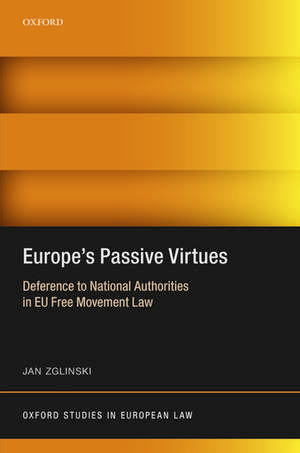
Europe's Passive Virtues: Deference to National Authorities in EU Free Movement Law: Oxford Studies in European Law
Autor Jan Zglinskien Limba Engleză Hardback – 4 iun 2020
În cadrul programelor de studii aprofundate în drept european, analiza rolului Curții de Justiție a Uniunii Europene (CJUE) în configurarea pieței interne reprezintă un pilon fundamental. Notăm cu interes modul în care Europe's Passive Virtues reușește să provoace narațiunea tradițională a activismului judiciar european. Lucrarea lui Jan Zglinski se concentrează pe o schimbare de paradigmă observată în ultimele decenii: tranziția către o atitudine mai deferentă a Curții față de autoritățile și instanțele naționale în litigiile privind libera circulație.
Credem că elementul distinctiv al acestui volum este studiul empiric riguros care acoperă patru decenii de jurisprudență (1974-2013). Autorul nu se limitează la o analiză teoretică, ci demonstrează, prin date, cum CJUE a început să utilizeze „virtuțile pasive” — marja de apreciere și descentralizarea controlului judiciar — pentru a lăsa o sferă mai largă de decizie statelor membre. Putem afirma că această abordare oferă o perspectivă nuanțată asupra echilibrului de putere dintre sistemul juridic european și cel național.
Ca alternativă la Judicial Authority in EU Internal Market Law de Vilija Velyvyte pentru cursurile de dreptul pieței interne, volumul de față aduce avantajul unei perspective istorice extinse și al unei metodologii empirice care explică nu doar limitele de competență, ci și motivele politice și constituționale din spatele auto-restricționării instanței de la Luxemburg. În timp ce The Coherence of EU Free Movement Law de Niamh Nic Shuibhne se axează pe integritatea doctrinală, Jan Zglinski propune o examinare a modului în care maturitatea dreptului pieței interne permite acum o mai mare autonomie regulatorie națională, fără a periclita proiectul european.
Din seria Oxford Studies in European Law
- 33%
 Preț: 775.76 lei
 - 33%
 Preț: 649.62 lei
 - 33%
 Preț: 620.22 lei
 - 33%
 Preț: 621.20 lei
 - 33%
 Preț: 559.00 lei
 - 33%
 Preț: 991.11 lei
 - 33%
 Preț: 804.98 lei
 - 33%
 Preț: 680.93 lei
 - 33%
 Preț: 621.64 lei
 - 33%
 Preț: 621.07 lei
 - 33%
 Preț: 651.35 lei
 - 33%
 Preț: 717.63 lei
 - 33%
 Preț: 621.07 lei
 - 33%
 Preț: 559.55 lei
 - 34%
 Preț: 647.63 lei
 - 34%
 Preț: 556.37 lei
 - 33%
 Preț: 793.61 lei
 - 34%
 Preț: 893.82 lei
 - 34%
 Preț: 859.66 lei
 - 22%
 Preț: 353.42 lei
 - 27%
 Preț: 621.71 lei
 - 14%
 Preț: 676.18 lei
 - 34%
 Preț: 888.39 lei
 - 27%
 Preț: 811.65 lei
 - 27%
 Preț: 890.64 lei
 - 27%
 Preț: 906.37 lei
 - 34%
 Preț: 938.98 lei
 - 27%
 Preț: 856.56 lei
 - 34%
 Preț: 663.98 lei
 - 27%
 Preț: 649.85 lei
 - 27%
 Preț: 614.86 lei
 - 14%
 Preț: 858.11 lei
 - 31%
 Preț: 364.69 lei
 - 24%
 Preț: 694.92 lei
 - 19%
 Preț: 491.09 lei
 - 30%
 Preț: 367.41 lei
 - 34%
 Preț: 939.35 lei
 - 34%
 Preț: 984.97 lei
 - 34%
 Preț: 814.76 lei
 - 33%
 Preț: 818.34 lei
 - 34%
 Preț: 698.91 lei
 - 31%
 Preț: 333.26 lei
 - 33%
 Preț: 789.63 lei
 - 35%
 Preț: 737.03 lei
 - 30%
 Preț: 431.98 lei
 - 33%
 Preț: 816.59 lei
 - 27%
 Preț: 895.23 lei
 - 44%
 Preț: 584.04 lei
Preț: 680.05 lei
Preț vechi: 1021.82 lei
-33%
Carte disponibilă
Livrare economică 21-27 mai
Specificații
ISBN-10: 0198844794
Pagini: 248
Dimensiuni: 161 x 240 x 20 mm
Greutate: 0.55 kg
Editura: OUP OXFORD
Colecția OUP Oxford
Seria Oxford Studies in European Law
Locul publicării:Oxford, United Kingdom
De ce să citești această carte
Recomandăm această carte cercetătorilor și studenților la masterat în drept european care doresc să înțeleagă mecanismele subtile ale suveranității în contextul integrării. Cititorul câștigă o perspectivă bazată pe date asupra modului în care CJUE își modulează controlul în funcție de contextul politic al Uniunii. Este un instrument esențial pentru a înțelege de ce Curtea a încetat să mai fie doar un „motor de integrare” și a devenit un arbitru al echilibrului instituțional.
Despre autor
Jan Zglinski este un specialist recunoscut în dreptul Uniunii Europene, cu o expertiză consolidată în funcționarea pieței interne și a sistemului judiciar european. Activitatea sa academică se concentrează pe intersecția dintre drept și politică, analizând critic evoluția instituțiilor europene. Prin cercetările sale empirice, Zglinski a adus contribuții semnificative la înțelegerea modului în care CJUE interacționează cu instanțele naționale, volumul de față fiind o referință în seria Oxford Studies in European Law.
Descriere
Recenzii
Jan Zglinski has written an impressive monograph on the rise of doctrines of deference in the case law of the European Court of Justice. The book considers, from an empirical and constitutional perspective, the rise of doctrines of deference in the case law of the European Court of Justice (ECJ) on market freedoms. It will inevitably become a classic.
Zglinski's book is a model example of legal scholarship engaging with social sciences' quantitative methods to describe legal developments as well as making the more traditional normative arguments of the discipline. The discussion of how the Court does and should administer the reach of its case law, and where it should carve out a role for member state institutions, is extremely timely and relevant.
The book presents a major original contribution to EU free movement law and, in particular, the ongoing debate on judicial deference.
What the book powerfully offers is a reminder of why the internal market should remain of central concern to EU law scholarship. While this may no longer be the area where bold doctrinal innovation in EU law is being produced, the very maturity of internal market law makes it a "most likely case" (as political scientists would put it) for observing how EU law is evolving and how the EU's foremost court is facing down its key effectiveness and legitimacy challenges. Zglinski's book demands that we look again at what we thought we knew about the substantive law of the European Union. There are plenty of EU law books with nothing to say - this is not one of them.