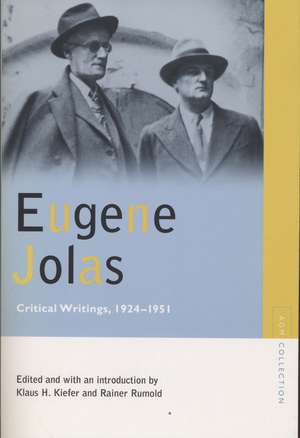
Eugene Jolas: Critical Writings, 1924-1951: Avant-Garde & Modernism Collection
Autor Eugene Jolas Editat de Klaus H. Kiefer, Rainer Rumolden Limba Engleză Paperback – 28 dec 2009
Dividing his youth between the United States and the bilingual Alsace-Lorraine, Eugene Jolas (1894–1952) flourished in three languages. As an editor and poet, he came to know the major writers and artists of his time and enjoyed a pivotal position between the Anglo-American and Continental avant-garde. His editorship of transition, the leading avant-garde journal of Paris in the twenties and early thirties, provided a major impetus to writers from James Joyce (whose Finnegans Wake was serialized in transition) to Gertrude Stein, and Samuel Beckett, with first translations of André Breton, and Franz Kafka, among others. Jolas’s critical work, collected in this volume, includes introductions to anthologies, manifestoes like the famous Vertical, essays, some published here for the first time, on writers as various as Novalis, Trakl, the major Surrealists, Heidegger, and other philosophers. An acute observer of the literary scene as well as of the roiling politics of the time, Jolas emerges here in his role at the very center of avant-garde activity between the wars. Accordingly, this book is of signal importance to anyone with an interest in modernism, avant-garde, multilingualism, and the culture of Western Europe in the first half of the twentieth century.
Preț: 225.81 lei
Puncte Express: 339
Carte disponibilă
Livrare economică 04-18 noiembrie
Livrare express 20-24 octombrie pentru 52.59 lei
Livrare prin curier în România Termenul estimat este afișat lângă disponibilitate.
Transport gratuit de la 400.00 lei Plată online sau ramburs, în funcție de opțiunile comenzii.
Retur gratuit în 14 zile Comandă securizată și suport în română.
Specificații
ISBN-13: 9780810125810
ISBN-10: 0810125811
Pagini: 624
Dimensiuni: 152 x 229 x 43 mm
Greutate: 0.85 kg
Ediția:1
Editura: Northwestern University Press
Colecția Northwestern University Press
Seria Avant-Garde & Modernism Collection
ISBN-10: 0810125811
Pagini: 624
Dimensiuni: 152 x 229 x 43 mm
Greutate: 0.85 kg
Ediția:1
Editura: Northwestern University Press
Colecția Northwestern University Press
Seria Avant-Garde & Modernism Collection
V-ar putea interesa
-
 Or Orwell – Writing and Democratic SocialismAlex WolochPreț: 411.34 lei
 -
 Beckett′s Art of MismakingLeland De La DurantayePreț: 306.92 lei
 -
 The Conscience of James JoyceDarcy O'BrienPreț: 353.96 lei
 -
 Rebel by vocationNiall CarsonPreț: 457.36 lei
 -
 Literary culture in CubaPar KumaraswamiPreț: 331.20 lei
 -
 Women's Hebrew Poetry on American ShoresShachar PinskerPreț: 263.79 lei
 -
 The Man Who Wrote Pancho Villa: Martin Luis Guzman and the Politics of Life WritingNicholas Cifuentes-Goodbody-23%Preț: 474.65 lei616.43 lei
 -
 Rereading East GermanyKaren Leeder-14%Preț: 712.19 lei828.13 lei
 -
 The Non-National in Contemporary American LiteratureDalia M. A. GomaaPreț: 399.23 lei
 -
 -15%Preț: 515.54 lei606.52 lei
 -
 Same-Sex Desire in Indian CultureOliver RossPreț: 399.89 lei
 -
 Lu Hsün and his PredecessorsV. I. Semanov-18%Preț: 920.55 lei1122.62 lei
 -
 Novelist Tagore: Gender and Modernity in Selected TextsRadha Chakravarty-15%Preț: 427.97 lei503.50 lei
 -
 Preț: 462.25 lei
 -
 The Return of the Storyteller in Contemporary FictionDr Areti Dragas-15%Preț: 285.34 lei336.31 lei
 -
 John McGahern and the Imagination of TraditionStanley van der ZielPreț: 344.02 lei
 -
 Fascist Directive: Ezra Pound and Italian Cultural NationalismCatherine E. Paul-23%Preț: 855.33 lei1110.82 lei
 -
 Diskurswandel im Werk Carl EinsteinsKlaus H. Kiefer-23%Preț: 1198.02 lei1555.88 lei
Notă biografică
EUGENE JOLAS (1894–1927) was born in Union City, New Jersey, in 1894 but was raised by his Franco-German parents in Lorraine. In 1927 Jolas, along with his wife Maria Mcdonald and Elliot Paul, founded the influential Parisian literary magazine transition. In Paris he met James Joyce and played a major part in encouraging and defending Joyce’s "Work-in-Progress," later to become Finnegans Wake, a work Jolas viewed as the perfect embodiment of his manifesto. Jolas’s life and career are described vividly in his autobiography, Man from Babel.
KLAUS H. KIEFER is a fellow at the center for the Humanities at Northwestern University and has published widely on European literature from the eighteenth to the twentieth century.
RAINER RUMOLD is a professor of German at Northwestern University. He has published numerous books, editions, and articles on European modernism, avant-garde, and expressionism.
KLAUS H. KIEFER is a fellow at the center for the Humanities at Northwestern University and has published widely on European literature from the eighteenth to the twentieth century.
RAINER RUMOLD is a professor of German at Northwestern University. He has published numerous books, editions, and articles on European modernism, avant-garde, and expressionism.
Descriere
Dividing his youth between the United States and the bilingual Alsace-Lorraine, Eugene Jolas (1894–1952) flourished in three languages. As an editor and poet, he came to know the major writers and artists of his time and enjoyed a pivotal position between the Anglo-American and Continental avant-garde. His editorship of transition, the leading avant-garde journal of Paris in the twenties and early thirties, provided a major impetus to writers from James Joyce (whose Finnegans Wake was serialized in transition) to Gertrude Stein, and Samuel Beckett, with first translations of André Breton, and Franz Kafka, among others.