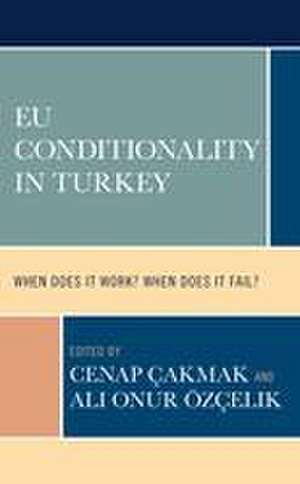
EU Conditionality in Turkey: When Does It Work? When Does It Fail?
Editat de Cenap Çakmak, Ali Onur Özçelik Contribuţii de Neriman Hocaoglu Bahadir, Sinem Bal, Anthony Costello, Seven Erdogan, Devrim Sahin, Ahmet Sözen, Hüsrev Tabak, Mustafa Yaylalien Limba Engleză Hardback – aug 2022
Preț: 526.41 lei
Preț vechi: 816.67 lei
-36%
Puncte Express: 790
Carte tipărită la comandă
Livrare economică 07-21 decembrie
Livrare prin curier în România Termenul estimat este afișat lângă disponibilitate.
Transport gratuit pentru acest produs Plată online sau ramburs, în funcție de opțiunile comenzii.
Retur gratuit în 14 zile Comandă securizată și suport în română.
Specificații
ISBN-13: 9781666910698
ISBN-10: 1666910694
Pagini: 240
Ilustrații: 9 graphs;
Dimensiuni: 160 x 227 x 24 mm
Greutate: 0.52 kg
Editura: Bloomsbury Publishing
Colecția Lexington Books
Locul publicării:New York, United States
ISBN-10: 1666910694
Pagini: 240
Ilustrații: 9 graphs;
Dimensiuni: 160 x 227 x 24 mm
Greutate: 0.52 kg
Editura: Bloomsbury Publishing
Colecția Lexington Books
Locul publicării:New York, United States
Cuprins
Introduction by Ali Onur Özçelik and Cenap Çakmak
Chapter 1: Expectations, Benchmarks and Tensions: Exploring Turkey's Political U-Turn from Brussels by Anthony Costello
Chapter 2: The Rule of Law as "Arrested Development": The Turkish Experiment with the Political Condition by Mustafa Yaylali
Chapter 3: The Collapse of Turkey's Three-Pillar Engagement Policy as a Part of Reversed Third Wave by Devrim Sahin and Ahmet Sözen
Chapter 4: A Search for Effective Governance at the Cost of Turkey's EU Democratization Process by Devrim Sahin and Ahmet Sözen
Chapter 5: Turkey on the Frontline between the West and the Middle East: A Buffer State or More? by Devrim Sahin and Ahmet Sözen
Chapter 6: EU Accession Process and Women's Rights in Turkey: The Effects on Family Values and Culture by Cenap Çakmak and Ali Onur Özçelik
Chapter 7: The EU's Civil Society Conditionality in Turkey: Applying a Gramscian Lens to Procedural Diffusion by Sinem Bal
Chapter 8: EU Conditionality in the Europeanization of Turkish Env
Chapter 1: Expectations, Benchmarks and Tensions: Exploring Turkey's Political U-Turn from Brussels by Anthony Costello
Chapter 2: The Rule of Law as "Arrested Development": The Turkish Experiment with the Political Condition by Mustafa Yaylali
Chapter 3: The Collapse of Turkey's Three-Pillar Engagement Policy as a Part of Reversed Third Wave by Devrim Sahin and Ahmet Sözen
Chapter 4: A Search for Effective Governance at the Cost of Turkey's EU Democratization Process by Devrim Sahin and Ahmet Sözen
Chapter 5: Turkey on the Frontline between the West and the Middle East: A Buffer State or More? by Devrim Sahin and Ahmet Sözen
Chapter 6: EU Accession Process and Women's Rights in Turkey: The Effects on Family Values and Culture by Cenap Çakmak and Ali Onur Özçelik
Chapter 7: The EU's Civil Society Conditionality in Turkey: Applying a Gramscian Lens to Procedural Diffusion by Sinem Bal
Chapter 8: EU Conditionality in the Europeanization of Turkish Env
Recenzii
This volume offers a lucid and insightful analysis of Europeanization and de-Europeanization processes in Turkey in a myriad of policy fields ranging from rule of law, foreign policy, democratization, women's rights to civil society, environmental policy, migration and development aid. It problematizes most of the established discourses on Europeanization and goes beyond the straightjacket of conditionality by fully engaging in both internal and international factors shaping the impact of EU-led processes in Turkey. It also presents a well-balanced analysis of the current stalemate in Turkey-EU relations as well as potential areas of cooperation between the two. This book stands out in the crowded literature of Europeanization and Turkey-EU relations.
An extremely insightful book aiming to understand the role and evolution of EU conditionality in the age of crises for the EU and Turkey. The book boldly touches upon all hot issues such as the rule of law, democratization, women's rights, migration, environment, and foreign policy in the contested period of de-Europeanization in Turkey-EU relations. It will undoubtedly be essential reading for those interested in Turkey-EU relations, EU enlargement, and Europeanization literature.
The contributions to this volume explore the limits and obstacles to EU membership conditionality in the case of Turkey through the phases of democratization, proto-Europeanization and de-Europeanization. They analyze different levels from domestic to global across a variety of policy areas to produce a multi-faceted and empirically rich picture of EU-Turkey relations, drawing on a range of theoretical approaches from explanation to critique. An important contribution to the debate about the EU's impact on its neighborhood-and its failures and unintended consequences.
An extremely insightful book aiming to understand the role and evolution of EU conditionality in the age of crises for the EU and Turkey. The book boldly touches upon all hot issues such as the rule of law, democratization, women's rights, migration, environment, and foreign policy in the contested period of de-Europeanization in Turkey-EU relations. It will undoubtedly be essential reading for those interested in Turkey-EU relations, EU enlargement, and Europeanization literature.
The contributions to this volume explore the limits and obstacles to EU membership conditionality in the case of Turkey through the phases of democratization, proto-Europeanization and de-Europeanization. They analyze different levels from domestic to global across a variety of policy areas to produce a multi-faceted and empirically rich picture of EU-Turkey relations, drawing on a range of theoretical approaches from explanation to critique. An important contribution to the debate about the EU's impact on its neighborhood-and its failures and unintended consequences.