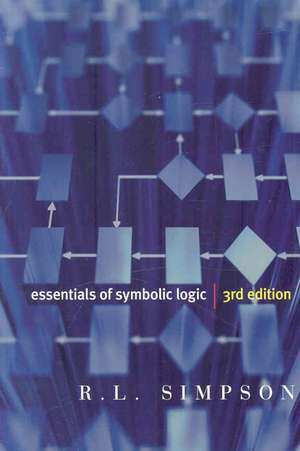
Essentials of Symbolic Logic - Third Edition
Autor R.L. Simpsonen Limba Engleză Paperback – 17 mar 2008
An instructor’s website is available with solutions to all the exercises in the text, including the many new exercises which have been added to this new edition.
Preț: 419.01 lei
Preț vechi: 553.90 lei
-24%
Puncte Express: 629
Carte disponibilă
Livrare economică 10-24 noiembrie
Livrare express 27-31 octombrie pentru 86.50 lei
Livrare prin curier în România Termenul estimat este afișat lângă disponibilitate.
Transport gratuit pentru acest produs Plată online sau ramburs, în funcție de opțiunile comenzii.
Retur gratuit în 14 zile Comandă securizată și suport în română.
Specificații
ISBN-13: 9781551118932
ISBN-10: 1551118939
Pagini: 304
Dimensiuni: 152 x 229 x 17 mm
Greutate: 0.47 kg
Ediția:3. Auflage
Editura: BROADVIEW PR
Colecția Broadview Press
Locul publicării:Peterborough, Canada
ISBN-10: 1551118939
Pagini: 304
Dimensiuni: 152 x 229 x 17 mm
Greutate: 0.47 kg
Ediția:3. Auflage
Editura: BROADVIEW PR
Colecția Broadview Press
Locul publicării:Peterborough, Canada
V-ar putea interesa
-
 Wittgenstein: A Very Short IntroductionA. C. Grayling-19%Preț: 57.40 lei71.23 lei
 -
 -37%Preț: 460.97 lei734.78 lei
 -
 -28%Preț: 484.95 lei677.82 lei
 -
 -22%Preț: 481.15 lei619.74 lei
 -
 The Worlds of Possibility: Modal Realism and the Semantics of Modal LogicCharles S. Chihara-28%Preț: 427.14 lei595.55 lei
 -
 Ludwig Wittgenstein: A MemoirNorman Malcolm-12%Preț: 337.88 lei384.00 lei
 -
 Papers on Time and TenseArthur N. Prior-28%Preț: 424.84 lei593.72 lei
 -
 -28%Preț: 363.17 lei503.26 lei
 -
 Descriptions and BeyondMarga Reimer-28%Preț: 546.66 lei757.43 lei
 -
 VaguenessTimothy WilliamsonPreț: 418.49 lei
 -
 Logical Investigations Volume 1Edmund HusserlPreț: 367.39 lei
 -
 What I BelieveBertrand RussellPreț: 133.78 lei
 -
 Naming and NecessitySaul A. KripkePreț: 209.09 lei
 -
 -23%Preț: 455.51 lei591.57 lei
 -
 A Companion to WittgensteinHans-Johann Glock-9%Preț: 1286.32 lei1413.54 lei
 -
 Preț: 360.44 lei
 -
 -24%Preț: 83.14 lei109.97 lei
 -
 Discursive analytical strategiesNiels Åkerstrøm AndersenPreț: 326.85 lei
Recenzii
The third edition of Essentials of Symbolic Logic is a concise and clearly written introduction to the topic. Based on years of use in colleges and universities, the book provides an accessible and thorough grounding in sentence logic and predicate logic. While technical jargon is kept to a minimum, all necessary logical concepts and vocabulary are explained clearly. A standard system of natural deduction is developed, and readers are given suggestions for developing strategies for creating derivations (proofs) in this system.
An instructor’s website is available with solutions to all the exercises in the text, including the many new exercises which have been added to this new edition.
“This is an excellent introduction to natural deduction systems—clear and very readable. It introduces rules gently and in a way that students will appreciate. A very good text.” — Ed Mares, Victoria University, New Zealand
“Essentials of Symbolic Logic is particularly good at encouraging students to develop strategies for producing derivations in sentence and predicate logic, without ever suggesting that this is an easy task, so that students who persevere can end their courses with a genuine sense of real achievement. I have also liked the text because it is totally reliable—and my students have liked and respected it too.” — Ian Tipton, University of Wales-Swansea
An instructor’s website is available with solutions to all the exercises in the text, including the many new exercises which have been added to this new edition.
“This is an excellent introduction to natural deduction systems—clear and very readable. It introduces rules gently and in a way that students will appreciate. A very good text.” — Ed Mares, Victoria University, New Zealand
“Essentials of Symbolic Logic is particularly good at encouraging students to develop strategies for producing derivations in sentence and predicate logic, without ever suggesting that this is an easy task, so that students who persevere can end their courses with a genuine sense of real achievement. I have also liked the text because it is totally reliable—and my students have liked and respected it too.” — Ian Tipton, University of Wales-Swansea
Cuprins
CHAPTER ONE
INTRODUCTION
§1.1: The Aims of this Book
§1.2: Primarily for the Student
§1.3: Primarily for the Instructor
CHAPTER TWO
SENTENCE LOGIC
§2.1: The Fundamentals
§2.2: Truth Functions
§2.3: Sentence Letters and Symbols
§2.4: Metalanguage
§2.5: Well-Formed Formulas
§2.6: Exercises
§2.7: Simple Translation: Negation
§2.8: Simple Translation: Conjunction
§2.9: Simple Translation: Disjunction
§2.10: Simple Translation: the Horseshoe
§2.11: Simple Translation: the Triplebar
§2.12: Translating Complicated Sentences
§2.13: Exercises
§2.14: Defining the Operators
§2.15: Truth Tables
§2.16: Exercises
§2.17: Types of Formulas
§2.18: Exercises
§2.19: Truth-Functional Equivalences
§2.20: Exercises
§2.21: Arguments
§2.22: Exercises
§2.23: Translating Arguments
§2.24: Exercises
§2.25: Summary of Topics
CHAPTER THREE
DERIVATIONS IN SENTENCE LOGIC
§3.1: Derivation Basics
§3.2: Conjunction Introduction
§3.3: Conjunction Elimination
§3.4: Negation Elimination
§3.5: Disjunction Introduction
§3.6: Horseshoe Elimination
§3.7: Triplebar Elimination
§3.8: Exercises
§3.9: Constructing Derivations
§3.10: Exercises
§3.11: Assumptions
§3.12: Reiteration
§3.13: Horseshoe Introduction
§3.14: Triplebar Introduction
§3.15: Negation Introduction
§3.16: Disjunction Elimination
§3.17: Exercises
§3.18: More Derivation Construction
§3.19: Exercises
§3.20: Indirect Proof
§3.21: Exercises
§3.22: Categorical Derivations
§3.23: Exercises
§3.24: Summary of Topics
CHAPTER FOUR
PREDICATE LOGIC
§4.1: Individuals and Predicates
§4.2: One-Place and Multi-Place Predicates
§4.3: Choices in Translation
§4.4: Exercises
§4.5: Quantifiers
§4.6: The Existential Quantifier
§4.7: The Universal Quantifier
§4.8: Using Both Quantifiers
§4.9: Exercises
§4.10: People and Things
§4.11: Exercises
§4.12: Identity
§4.13: Exercises
§4.14: Translation Problems and Domains
§4.15: Exercises
§4.16: Arguments in Predicate Logic
§4.17: Exercises
§4.18: Simple Interpretations
§4.19: Exercises
§4.20: Summary of Topics
CHAPTER FIVE
DERIVATIONS IN PREDICATE LOGIC
§5.1: Predicate Logic Derivations
§5.2: Existential Quantifier Introduction
§5.3: Universal Quantifier Elimination
§5.4: Existential Quantifier Elimination
§5.5: Universal Quantifier Introduction
§5.6: Identity Introduction
§5.7: Identity Elimination
§5.8: Exercises
§5.9: Derivation Strategies
§5.10: Exercises
§5.11: More Derivation Strategies
§5.12: Exercises
§5.13: Categorical Derivations in Predicate Logic
§5.14: Exercises
§5.15: Summary of Topics
CHAPTER SIX
MISCELLANEOUS MATTERS
§6.1: The Scope of the Text
§6.2: Existence and Translation Problems
§6.3: The Names of the Rules
§6.4: Unfamiliar Terminology and Symbols
§6.5: A Glimpse at Modal Logic
§6.6: Additional Derivation Rules
§6.7: Replacement Rules
§6.8: Avoiding Reiteration
§6.9: Joint Denial and the Sheffer Stroke
§6.10: Consistency and Truth Trees
INDEX
Technical Terms
INTRODUCTION
§1.1: The Aims of this Book
§1.2: Primarily for the Student
§1.3: Primarily for the Instructor
CHAPTER TWO
SENTENCE LOGIC
§2.1: The Fundamentals
§2.2: Truth Functions
§2.3: Sentence Letters and Symbols
§2.4: Metalanguage
§2.5: Well-Formed Formulas
§2.6: Exercises
§2.7: Simple Translation: Negation
§2.8: Simple Translation: Conjunction
§2.9: Simple Translation: Disjunction
§2.10: Simple Translation: the Horseshoe
§2.11: Simple Translation: the Triplebar
§2.12: Translating Complicated Sentences
§2.13: Exercises
§2.14: Defining the Operators
§2.15: Truth Tables
§2.16: Exercises
§2.17: Types of Formulas
§2.18: Exercises
§2.19: Truth-Functional Equivalences
§2.20: Exercises
§2.21: Arguments
§2.22: Exercises
§2.23: Translating Arguments
§2.24: Exercises
§2.25: Summary of Topics
CHAPTER THREE
DERIVATIONS IN SENTENCE LOGIC
§3.1: Derivation Basics
§3.2: Conjunction Introduction
§3.3: Conjunction Elimination
§3.4: Negation Elimination
§3.5: Disjunction Introduction
§3.6: Horseshoe Elimination
§3.7: Triplebar Elimination
§3.8: Exercises
§3.9: Constructing Derivations
§3.10: Exercises
§3.11: Assumptions
§3.12: Reiteration
§3.13: Horseshoe Introduction
§3.14: Triplebar Introduction
§3.15: Negation Introduction
§3.16: Disjunction Elimination
§3.17: Exercises
§3.18: More Derivation Construction
§3.19: Exercises
§3.20: Indirect Proof
§3.21: Exercises
§3.22: Categorical Derivations
§3.23: Exercises
§3.24: Summary of Topics
CHAPTER FOUR
PREDICATE LOGIC
§4.1: Individuals and Predicates
§4.2: One-Place and Multi-Place Predicates
§4.3: Choices in Translation
§4.4: Exercises
§4.5: Quantifiers
§4.6: The Existential Quantifier
§4.7: The Universal Quantifier
§4.8: Using Both Quantifiers
§4.9: Exercises
§4.10: People and Things
§4.11: Exercises
§4.12: Identity
§4.13: Exercises
§4.14: Translation Problems and Domains
§4.15: Exercises
§4.16: Arguments in Predicate Logic
§4.17: Exercises
§4.18: Simple Interpretations
§4.19: Exercises
§4.20: Summary of Topics
CHAPTER FIVE
DERIVATIONS IN PREDICATE LOGIC
§5.1: Predicate Logic Derivations
§5.2: Existential Quantifier Introduction
§5.3: Universal Quantifier Elimination
§5.4: Existential Quantifier Elimination
§5.5: Universal Quantifier Introduction
§5.6: Identity Introduction
§5.7: Identity Elimination
§5.8: Exercises
§5.9: Derivation Strategies
§5.10: Exercises
§5.11: More Derivation Strategies
§5.12: Exercises
§5.13: Categorical Derivations in Predicate Logic
§5.14: Exercises
§5.15: Summary of Topics
CHAPTER SIX
MISCELLANEOUS MATTERS
§6.1: The Scope of the Text
§6.2: Existence and Translation Problems
§6.3: The Names of the Rules
§6.4: Unfamiliar Terminology and Symbols
§6.5: A Glimpse at Modal Logic
§6.6: Additional Derivation Rules
§6.7: Replacement Rules
§6.8: Avoiding Reiteration
§6.9: Joint Denial and the Sheffer Stroke
§6.10: Consistency and Truth Trees
INDEX
Technical Terms