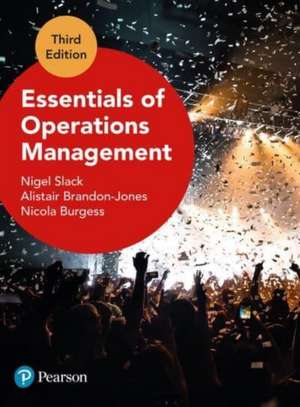
Essentials of Operations Management
Autor Nigel Slack, Alistair Brandon-Jones, Nicola Burgessen Limba Engleză Paperback – mar 2023
Multe organizații cad în capcana de a privi managementul operațiunilor ca pe o simplă funcție tehnică, izolată de obiectivele comerciale. Essentials of Operations Management demontează acest mit, demonstrând că eficiența operațională este, în fapt, motorul principal al strategiei de business. Subliniem modul în care Nigel Slack, alături de Alistair Brandon-Jones și Nicola Burgess, reușesc să simplifice concepte complexe fără a le dilua rigoarea academică. Dacă Operations Management v-a oferit cadrul teoretic extins, această ediție „Essentials” oferă instrumentele practice și sinteza necesară pentru o implementare rapidă. Ne-a atras atenția structura extrem de disciplinată a volumului. Fiecare capitol este construit în jurul unor întrebări fundamentale — de la „Ce fac managerii de operațiuni?” până la „Cum se aliniază strategia operațională cu cerințele pieței?”. Găsim în această carte o progresie logică: se începe cu definirea proceselor de transformare input-output și se avansează către ierarhia proceselor și reconcilierea celor patru perspective strategice (top-down, outside-in, bottom-up și inside-out). Față de lucrarea sa anterioară, Service Operations Management, care se concentra pe provocările specifice sectorului terțiar, acest volum sintetizează principiile universale aplicabile oricărui tip de organizație. Prin includerea secțiunilor de „Probleme și aplicații”, textul transformă cititorul din observator în practicant. Autorii nu se limitează la a descrie ce este managementul operațiunilor, ci forțează o analiză critică a modului în care resursele operaționale pot genera un avantaj competitiv sustenabil. Este o resursă esențială pentru cei care doresc să înțeleagă nu doar cum funcționează o afacere, ci cum poate fi ea optimizată structural.
Preț: 490.10 lei
Preț vechi: 538.57 lei
-9%
Carte disponibilă
Livrare economică 17 noiembrie-01 decembrie
Livrare express 31 octombrie-06 noiembrie pentru 59.67 lei
Specificații
ISBN-10: 1292449268
Pagini: 536
Dimensiuni: 195 x 265 x 29 mm
Greutate: 1.14 kg
Ediția:3. Auflage
Editura: Pearson
V-ar putea interesa
-
 -27%Preț: 939.26 lei1286.66 lei
 -
 Operations Management For Dummies, 2nd EditionEdward J. AndersonPreț: 202.65 lei
 -
 Operations Management: An International PerspectiveDavid Barnes-31%Preț: 418.70 lei606.28 lei
 -
 Essential Operations ManagementAlex Hill-26%Preț: 406.83 lei551.39 lei
 -
 Operations ManagementWilliam J Stevenson-23%Preț: 2288.79 lei2972.45 lei
 -
 Operations and Supply Chain Management: The Core: 2025 Release ISEF. Robert Jacobs-4%Preț: 363.17 lei378.30 lei
 -
 Operations Management: 2025 Release ISEGerard Cachon-4%Preț: 376.39 lei392.07 lei
 -
 -27%Preț: 380.83 lei519.95 lei
 -
 Managing Operations Across The Supply Chain ISEMorgan Swink-25%Preț: 391.23 lei524.67 lei
 -
 Operations and Supply Chain Management ISEF. Robert Jacobs-8%Preț: 483.89 lei525.97 lei
 -
 Operations and Supply Chain Management: 2024 Release ISEWilliam J Stevenson-35%Preț: 408.48 lei624.94 lei
 -
 -11%Preț: 659.38 lei740.88 lei
 -
 -9%Preț: 564.35 lei620.16 lei
 -
 Operations StrategyNigel Slack-9%Preț: 550.95 lei605.44 lei
 -
 Operations and Process ManagementNigel Slack-9%Preț: 578.43 lei635.64 lei
 -
 -9%Preț: 555.52 lei610.47 lei
 -
 Service Operations ManagementRobert Johnston-19%Preț: 542.80 lei670.12 lei
 -
 Operations Management 2/eSteve Paton-25%Preț: 380.23 lei506.19 lei
 -
 -15%Preț: 668.91 lei786.95 lei
De ce să citești această carte
Această carte este ideală pentru studenții și profesioniștii care au nevoie de o înțelegere clară și pragmatică a fluxurilor de producție și servicii. Veți câștiga capacitatea de a alinia procesele interne cu strategia globală a firmei. Este recomandată celor care caută eficiență maximă în utilizarea resurselor și vor să stăpânească mecanismele care fac o organizație să funcționeze coerent.
Despre autor
Professor Nigel Slack este profesor emerit de Management Operațional și Strategie la Warwick Business School. Cu o carieră academică prestigioasă, el a condus grupul de Management al Operațiunilor și a activat ca și consultant pentru giganți globali precum BMW, Shell, Nestle și HSBC. Expertiza sa vastă se reflectă în capacitatea de a traduce teoria academică în soluții aplicabile pentru provocările reale ale pieței, fiind unul dintre cei mai respectați autori în literatura de specialitate din domeniul afacerilor.
Cuprins
Operations management and performance
IntroductionKey questions- What is operations management?
- What is the inputtransformation output process?
- Why is operations management important to an organisations performance?
- What is the process hierarchy?
- How do operations (and processes) differ?
- What do operations managers do?
Operations strategy
IntroductionKey questions- What is strategy and what is operations strategy?
- How does operations strategy align with business strategy (top-down)?
- How does operations strategy align with market requirements (outside-in)?
- How does operations strategy align with operational experience (bottom-up)?
- How does operations strategy align with operations resources (inside-out)?
- How are the four perspectives of operations strategy reconciled?
- How can the process of operations strategy be organised?
Product and service innovation
IntroductionKey questions- What is product and service innovation?
- What is the strategic role of product and service innovation?
- What are the stages of product and service innovation?
- What are the benefits of interactive product and service innovation?
Process design resources
IntroductionKey questions- Why is choosing the right resources important?
- Do processes match volumevariety requirements?
- Are process layouts appropriate?
- Are job designs appropriate?
Process design analysis
IntroductionKey questions- Why is it important to get the details of process design correct?
- What should be the objectives of process design?
- How are processes currently designed?
- Are process tasks and capacity configured appropriately?
- Is process variability recognised?
Supply chain management
IntroductionKey questions- What is supply chain management?
- How should supply chains compete?
- How should relationships in supply chains be managed?
- How is the supply side managed?
- How is the demand side managed?
- What are the dynamics of supply chains
Capacity management
IntroductionKey questions- What is capacity management?
- How is demand measured?
- How is capacity measured?
- How is the demand side managed?
- How is the supply side managed?
- How can operations understand the consequences of their capacity management decisions?
Inventory management
IntroductionKey questions- What is inventory?
- Why do you need inventory?
- How much should you order? (The volume decision)
- When should you order? (The timing decision)
- How can you control inventory?
Resource planning and control
IntroductionKey questions- What is resource planning and control?
- What is the difference between planning and control?
- How do supply and demand affect planning and control?
- What are the activities of planning and control?
- What is enterprise resource planning (ERP)?
Operations improvement
IntroductionKey questions- Why is improvement so important in operations management?
- What are the key elements of operations improvement?
- What are the broad approaches to improvement?
- What techniques can be used for improvement?
- Why is risk management also improvement?
Lean operations
IntroductionKey questions- What is lean?
- How does lean consider flow?
- How does lean consider (and reduce) waste?
- How does lean consider improvement?
- How does lean consider the role of people?
- How does lean apply throughout the supply network?
Quality management
IntroductionKey questions- What is quality and why is it so important?
- What steps lead towards conformance to specification?
- What is total quality management (TQM)?
Project management
IntroductionKey questions- What are projects?
- What is project management?
- How is the project environment understood?
- How are projects defined?
- How are projects planned?
- How are projects controlled and learned from?
Notă biografică
Alistair Brandon-Jones is a Full Chaired Professor in Operations and Supply Chain Management, and Head of the Information, Decisions, and Operations Division at the University of Bath, School of Management. He is also an Adjunct Professor for Hult International Business School and Danish Technical University.
Nicola Burgess is a Reader in Operations Management at W;arwick Business School. She has worked extensively with public sector organisations to understand operations management and improvement in a public sector context.