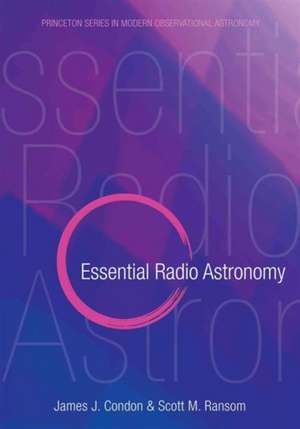
Essential Radio Astronomy
Autor James J Condon, Scott M Ransomen Limba Engleză Hardback – 5 apr 2016
În cadrul programelor de studiu dedicate astrofizicii, studiul radioastronomiei reprezintă un pilon esențial pentru înțelegerea universului invizibil în spectrul optic. Essential Radio Astronomy, semnată de James J Condon și Scott M Ransom, se instalează ca o resursă de bază pentru studenții de la nivel licență avansat și masterat, oferind o sinteză riguroasă a fundamentelor teoretice și a aplicațiilor practice. Reținem faptul că acest volum, publicat de Princeton University Press, nu este doar o prezentare teoretică, ci un instrument didactic rafinat prin ani de experiență la catedră, menit să clarifice intersecția dintre fizica particulelor și tehnologia observațională. Notăm cu interes structura echilibrată a lucrării: primele secțiuni sunt dedicate instrumentarului — de la funcționarea receptorilor la complexitatea interferometriei — în timp ce partea a doua explorează mecanismele de emisie și natura surselor radio. Cititorii familiarizați cu Fundamentals of Radio Astronomy de Jonathan Marr vor aprecia în acest volum abordarea unitară care reunește într-un singur tom atât bazele matematice, cât și datele actualizate despre surse extragalactice sau radiația cosmică de fond. Spre deosebire de textele care se concentrează strict pe tehnici de observare, lucrarea de față pune un accent deosebit pe fizica subiacentă, explicând de ce și cum emit obiectele cerești în banda radio. Stilul este unul academic precis, eliminând ambiguitățile și oferind derivări matematice clare, esențiale pentru orice cercetător care utilizează date radioastronomice în activitatea sa.
Preț: 659.18 lei
Preț vechi: 784.75 lei
-16%
Carte disponibilă
Livrare economică 11-25 noiembrie
Livrare express 28 octombrie-03 noiembrie pentru 55.98 lei
Specificații
ISBN-10: 069113779X
Pagini: 384
Dimensiuni: 185 x 261 x 30 mm
Greutate: 0.99 kg
Editura: Princeton University Press
V-ar putea interesa
-
 Signature in the CellStephen C MeyerPreț: 147.25 lei
 -
 Physics DeMYSTiFieD, Second EditionStan Gibilisco-26%Preț: 131.90 lei178.27 lei
 -
 -25%Preț: 102.01 lei136.12 lei
 -
 How We Live and Why We DieLewis WolpertPreț: 91.24 lei
 -
 The Odd QuantumSam TreimanPreț: 279.05 lei
 -
 Mathematical Excursions to the World's Great BuildingsAlexander J. HahnPreț: 535.38 lei
 -
 Princeton Field Guide to Prehistoric MammalsDonald R. ProtheroPreț: 256.89 lei
 -
 The Best Writing on Mathematics 2013Mircea PiticiPreț: 192.12 lei
 -
 eEli MaorPreț: 112.76 lei
 -
 The Wavewatcher's CompanionGavin Pretor-Pinney-27%Preț: 89.06 lei121.57 lei
 -
 Physics Over EasyLeonid V. AzaroffPreț: 392.15 lei
De ce să citești această carte
Această carte este recomandată studenților și profesioniștilor care au nevoie de o bază solidă în radioastronomie. Cititorul câștigă o înțelegere profundă a modului în care telescoapele radio captează semnalele și a proceselor fizice care le generează. Este un manual de referință care face trecerea de la cursurile introductive de fizică la cercetarea de nivel înalt, fiind apreciat de experți de la Harvard și Berkeley pentru claritatea și rigoarea sa.
Descriere scurtă
"This book provides advanced undergraduates, graduate students, and astronomers with an invaluable introduction to the key ideas in radio astronomy. Written by two highly respected astronomers, Essential Radio Astronomy explains the underlying physics, the properties of astronomical sources ranging from active galactic nuclei to the cosmic microwave background, as well as how radio telescopes observe the sky."--David N. Spergel, Princeton University
"Fantastic. I have been teaching radio astronomy at Harvard for more than forty years, and this is the book I wish I had had to teach from--and the book I wish I had written myself. It is destined to become the essential resource for all aspiring radio astronomers and for anyone who uses radio astronomical data."--James M. Moran, Harvard-Smithsonian Center for Astrophysics
"This book, honed over many years in the classroom, fills a clear need for a single volume covering the physical and mathematical foundations of radio astronomy. It is greatly to be welcomed and will surely find its place on the shelves of most professional radio astronomers and students of the discipline."--Peter Wilkinson, University of Manchester