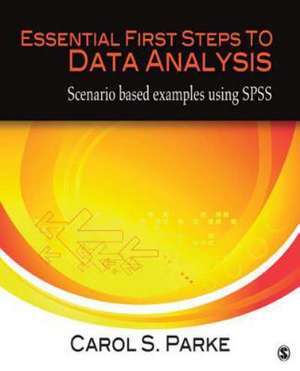
Essential First Steps to Data Analysis: Scenario-Based Examples Using SPSS
Autor Carol S. Parkeen Limba Engleză Electronic book text – 24 iun 2013
Preț: 269.02 lei
Puncte Express: 404
Indisponibil temporar
Doresc să fiu notificat când acest titlu va fi disponibil:
Se trimite...
Specificații
ISBN-13: 9781483310343
ISBN-10: 1483310345
Pagini: 288
Dimensiuni: 187 x 232 mm
Ediția:1
Editura: SAGE Publications
Colecția Sage Publications, Inc
Locul publicării:Thousand Oaks, United States
ISBN-10: 1483310345
Pagini: 288
Dimensiuni: 187 x 232 mm
Ediția:1
Editura: SAGE Publications
Colecția Sage Publications, Inc
Locul publicării:Thousand Oaks, United States
V-ar putea interesa
-
 Internet Research SkillsNiall O. DochartaighPreț: 389.70 lei
 -
 Projects in Linguistics and Language StudiesAlison WrayPreț: 416.74 lei
 -
 Preț: 430.34 lei
 -
 Qualitative Data Analysis Using a Dialogical ApproachPaul SullivanPreț: 445.53 lei
Recenzii
Having
different
research
studies
presented
rather
than
using
the
same
context
throughout
the
text
helps
keep
the
material
more
interesting
for
the
reader,
as
well
as
helping
students
generalize
their
learning
across
different
research
contexts.
The ‘real world’ scenarios captivate the reader but also provide pertinent context to see just how it relates to the content area at hand in each module.
The strength of the text is in how the author identifies the goals of the analysis under discussion and then steps the reader through the tasks necessary to realize those goals.
There are not many texts on data preparation in the field, so I believe this text would provide a unique contribution. …I agree wholeheartedly with the preface, that the other guides are simple “how-to” books that do not effectively connect students with real examples that can serve as a guideline in their own analysis experiences.
A key strength of this text is that it focuses on the practical aspects of MANAGING research data rather than statistical programming or statistical analysis.
I like that the book is written with cases/stories—I think that especially for counseling/psych students, these stories are going to help them contextualize the ideas more so than they would without these stories. I also like that the book give the students example write-ups. I think that is a priceless addition to any textbook about conducting statistical tests.
The ‘real world’ scenarios captivate the reader but also provide pertinent context to see just how it relates to the content area at hand in each module.
The strength of the text is in how the author identifies the goals of the analysis under discussion and then steps the reader through the tasks necessary to realize those goals.
There are not many texts on data preparation in the field, so I believe this text would provide a unique contribution. …I agree wholeheartedly with the preface, that the other guides are simple “how-to” books that do not effectively connect students with real examples that can serve as a guideline in their own analysis experiences.
A key strength of this text is that it focuses on the practical aspects of MANAGING research data rather than statistical programming or statistical analysis.
I like that the book is written with cases/stories—I think that especially for counseling/psych students, these stories are going to help them contextualize the ideas more so than they would without these stories. I also like that the book give the students example write-ups. I think that is a priceless addition to any textbook about conducting statistical tests.
Cuprins
Section
1.
The
Sample
Module 1. Checking the Representativeness of a Sample
Module 2. Splitting a File, Selecting Cases, Creating Standardized Values and Ranks
Section 2. Nature and Distribution of Variables
Module 3. Recoding, Counting, and Computing Variables
Module 4. Determining the Scale of a Variable
Module 5. Identifying and Addressing Outliers
Section 3. Model Assumptions
Module 6. Evaluating Model Assumptions for Testing Mean Differences
Module 7. Evaluating Model Assumptions for Multiple Regression Analysis
Section 4. Missing Data
Module 8. Determining the Quantity and Nature of Missing Data
Module 9. Quantifying Missing Data and Diagnosing its Patterns
Section 5. Working with Multiple Data Files
Module 10. Merging Files
Module 11. Aggregating Data and Restructuring Files
Module 12. Identifying a Cohort of Students
Module 1. Checking the Representativeness of a Sample
Module 2. Splitting a File, Selecting Cases, Creating Standardized Values and Ranks
Section 2. Nature and Distribution of Variables
Module 3. Recoding, Counting, and Computing Variables
Module 4. Determining the Scale of a Variable
Module 5. Identifying and Addressing Outliers
Section 3. Model Assumptions
Module 6. Evaluating Model Assumptions for Testing Mean Differences
Module 7. Evaluating Model Assumptions for Multiple Regression Analysis
Section 4. Missing Data
Module 8. Determining the Quantity and Nature of Missing Data
Module 9. Quantifying Missing Data and Diagnosing its Patterns
Section 5. Working with Multiple Data Files
Module 10. Merging Files
Module 11. Aggregating Data and Restructuring Files
Module 12. Identifying a Cohort of Students
Descriere
Provides
instruction
and
guidance
on
preparing
quantitative
data
sets
prior
to
answering
a
study's
research
questions
Notă biografică
Carol S. Parke, Ph.D. is an Associate Professor in the Department of Educational Foundations and Leadership at Duquesne University, teaching statistics, research, and measurement courses in masters and doctoral programs in the School of Education. She has a Ph.D. in Research Methodology and an M.A. in Mathematics/Statistics from the University of Pittsburgh as well as a B.S. in Secondary Mathematics Education from Indiana University of Pennsylvania. Dr. Parke's 20 years of research ranges from the design and analysis of large-scale, long-term state and national assessment projects to working intimately with teachers in the classroom to show them how to collect and use data to make decisions and real-time, real-world improvement. Her work has appeared in research and practitioner journals in measurement, assessment, mathematics education, and statistics and includes "Using Assessment to Improve Middle-Grades Mathematics Teaching and Learning," a book for teachers on using performance assessment in mathematics classrooms.