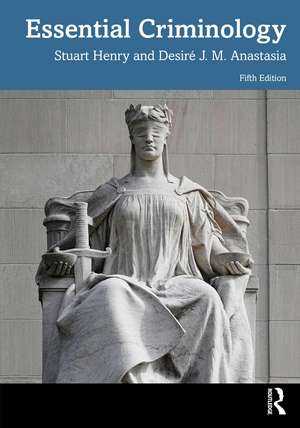
Essential Criminology
Autor Stuart Henry, Desiré J. M. Anastasiaen Limba Engleză Paperback – 9 apr 2025
This significantly expanded edition of Essential Criminology covers the broadest range of criminological theories — the essential criminological theories — from longstanding ones such as classical theory and strain theory to recently introduced ones such as ultra-realism and green cultural criminology. Whether all are “essential” depends on one’s theoretical stance. The value of this text is its carefully designed comparative analysis, which helps readers consider their relative contribution to the field.
Originally designed as an alternative to lengthy and expensive introductory texts, Essential Criminology provides a concise, yet comprehensive overview of the field. The book offers a clear, structured, student-friendly, critical analytical examination of the nature of crime, theories of crime causation, and their criminal justice policy implications. Causal theories covered range from micro-level classical and rational choice to biological psychological, social learning, social control, and interactionist perspectives, to macro-level social ecology, anomie/strain, conflict, Marxist, feminist, and postmodernist theories. Over its 26-year history the book has added new theoretical perspectives as these have gained prominence. New to this edition are chapters on critical and ultra-realism, and critical green criminology and discussions of zemiology, critical race theory, and quantum holographic criminology. The authors have also expanded some theoretical frameworks that had previously been underdeveloped such as opportunity theory, subcultural theory, and social constructionism.
Essential Criminology contextualizes criminology in the globally interdependent 21st century, addressing the crimes of terrorism, global pandemics, and climate change. With its cutting-edge updates, illustrative real-world examples, and student-friendly study tools, including analytically comparable summary charts exposing each theory's ontological assumptions, this text was designed primarily for undergraduate criminology courses, but has also been adopted by community colleges and graduate programs in criminology, sociology, and political science.
Preț: 370.88 lei
Recomandat
Carte disponibilă
Livrare economică 27 octombrie-10 noiembrie
Livrare express 10-16 octombrie pentru 53.85 lei
Specificații
ISBN-10: 0367755416
Pagini: 516
Ilustrații: 36
Dimensiuni: 178 x 254 x 31 mm
Greutate: 0.89 kg
Ediția:5
Editura: Taylor & Francis
Colecția Routledge
Locul publicării:Oxford, United Kingdom
V-ar putea interesa
-
 -23%Preț: 461.13 lei598.87 lei
 -
 Real CriminologyMarie-Helen Maras-23%Preț: 644.03 lei836.41 lei
 -
 CriminologyStephen Jones-11%Preț: 375.05 lei419.86 lei
 -
 The Oxford Handbook of CriminologyAlison Liebling-19%Preț: 408.21 lei502.95 lei
 -
 The Psychology of Criminal and Violent BehaviourDavid R. Lyon-24%Preț: 650.89 lei859.36 lei
 -
 Criminology: A Very Short IntroductionTim Newburn-21%Preț: 55.72 lei70.43 lei
 -
 CriminologyChris Hale-20%Preț: 413.03 lei517.28 lei
 -
 CriminologyLarry Siegel-22%Preț: 570.32 lei730.04 lei
 -
 Psychology and Crime: 2nd editionAidan SammonsPreț: 444.01 lei
 -
 -23%Preț: 985.30 lei1279.61 lei
 -
 Criminological TheoryStephen G. Tibbetts-22%Preț: 881.92 lei1130.67 lei
 -
 Crime, Deviance and SocietyAna Rodas-19%Preț: 515.33 lei636.21 lei
 -
 Criminology for DummiesSteven BriggsPreț: 133.24 lei
 -
 Criminology: A Sociological IntroductionEamon CarrabinePreț: 404.42 lei
 -
 Crime and Society in BritainHazel Croall-9%Preț: 534.19 lei587.02 lei
 -
 Cross, N: Law Express: CriminologyNoel CrossPreț: 127.15 lei
 -
 Preț: 372.63 lei
 -
 Criminological Theory - International Student EditionFrancis T. Cullen-22%Preț: 1035.37 lei1327.40 lei
 -
 -19%Preț: 45.71 lei56.73 lei
 -
 Key Readings in CriminologyTim Newburn-8%Preț: 521.62 lei566.98 lei
Public țintă
Postgraduate and Undergraduate AdvancedRecenzii
Paul Leighton, Eastern Michigan University
"Essential Criminology brings a breath of fresh air to my course at the same time it
provides the materials to cover a very important but very difficult topic: theorizing about
crime itself."
Sandra Quinn, St. Ambrose University
"No other text on theories of crime can compete with Essential Criminology's precise
coverage of core theories in crime causation or with its seductive encouragement to
actively engage the respective theories. This book will not only appeal to students but also
to those seeking a comprehensive, critical reference text."
Dragan Milovanovic, Northeastern Illinois University
Cuprins
1. What is Crime? Defining the Problem
2. What is Criminology? The Study of Crime, Criminals, and Victims
3. Crime and Criminology in a Global Context?
4. Measuring Crime: How Criminologists Obtain Data on the Extent of Crime and Victimization
5. Crime as Free Will– Myth or Reality? Classical, and Neoclassical Theories
6. Crime as Opportunity: Situational Rational-Choice, and Routine Activities Theories
7. “Born to Be Bad”: Biological, Physiological, and Biosocial Theories of Crime
8. Criminal Minds: Psychoanalytical, Personality Traits and Learning Theories of Crime
9. Learning Criminal Behavior: Socio-Psychological Theories
10. “Everybody Does it”: Neutralization and Moral Disengagement Theory
11. “Poor Parenting:” Social Control, Social Bonding, and Self-Control Theories
12. Crime Over Time: Developmental and Life-Course Theories
13. Reaction to Social Control Labeling and Social Constructionist Theories
14. Crimes of Place: Social Ecology and Social Disorganization Theories
15. The Sick Society: Anomie and Strain Theories
16. Cultures of Crime: Subcultural Theories and Cultural Criminology
17. Capitalism as a Criminogenic Society: Conflict and Radical Theories of Crime
18. Critical Criminology: Power and Difference in Postmodern Society
19. Patriarchy, Gender and Crime: Feminist Criminological Theory
20. Grounding Critical Criminology: Critical Realist and Critical Green Criminology
21 Toward a Unified Criminology: Integrated Theories
Notă biografică
Stuart Henry, Ph.D., is Professor Emeritus of Criminology and Criminal Justice at San Diego State University where he was Director of the School of Public Affairs (2006-2017). He is the author/coauthor of 37 books and 125 articles in academic journals and book chapters. His published co-authored works include: Social Deviance (2019), Responding to School Violence (2014), Criminological Theory (2006), and Constitutive Criminology: Beyond Postmodernism (1996).
Desiré J. M. Anastasia, Ph.D. is Professor of Sociology at Metropolitan State University of Denver and Instructor of Criminal Justice at San Diego State University. She is the co-author of four books and three articles in academic books and book chapters. Employed as a teaching scholar, she has instructed over 240 sections of courses in Sociology, Criminology, and Criminal Justice.
Descriere
This significantly expanded edition of Essential Criminology covers the broadest range of criminological theories — the essential criminological theories — from longstanding ones such as classical theory and strain theory to recently introduced ones such as ultra-realism and green cultural criminology.