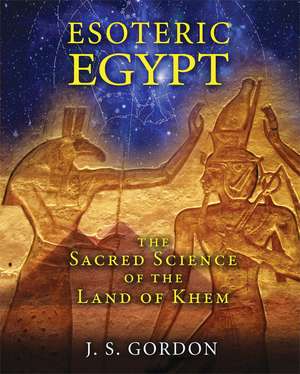
Esoteric Egypt: The Sacred Science of the Land of Khem
Autor J. S. Gordonen Limba Engleză Paperback – 26 feb 2015
Gordon explores the magical and esoteric meanings behind Egyptian sacred ritual and temple art, drawing parallels to the Mystery School process of initiation. Explaining the fundamental unity of the Egyptian pantheon and the structure of the after-death state, he shows that the Egyptians clearly believed in reincarnation and a spiritual evolutionary process. Revealing the ancient sacred science of the Land of Khem, teachings passed down from the earliest times, he examines the psychospiritual nature of the human being and the function of our spiritual identity and our souls.
Preț: 126.58 lei
Preț vechi: 149.58 lei
-15%
Puncte Express: 190
Carte disponibilă
Livrare economică 13-25 noiembrie
Livrare prin curier în România Termenul estimat este afișat lângă disponibilitate.
Transport gratuit de la 400.00 lei Plată online sau ramburs, în funcție de opțiunile comenzii.
Retur gratuit în 14 zile Comandă securizată și suport în română.
Specificații
ISBN-13: 9781591431961
ISBN-10: 1591431964
Pagini: 416
Ilustrații: 134 b&w illustrations
Dimensiuni: 203 x 254 x 23 mm
Greutate: 0.84 kg
Editura: Inner Traditions/Bear & Company
Colecția Bear & Company
ISBN-10: 1591431964
Pagini: 416
Ilustrații: 134 b&w illustrations
Dimensiuni: 203 x 254 x 23 mm
Greutate: 0.84 kg
Editura: Inner Traditions/Bear & Company
Colecția Bear & Company
V-ar putea interesa
-
 Stained GlassJanet HannaPreț: 141.33 lei
 -
 That Moment When...Taryn McCormackPreț: 117.98 lei
 -
 SynergySolomon ReynoldsPreț: 48.88 lei
 -
 Leaving the AbbeyKathryn H-FPreț: 82.38 lei
 -
 And Then Came Simon ...Anna De LucaPreț: 73.10 lei
 -
 The Joy of FellowshipEdward J. JonesPreț: 63.16 lei
 -
 My Daddy Said...Lori ShebetkaPreț: 65.81 lei
 -
 The Agony and Ecstasy of the Bipolar MindJoy a. PazPreț: 93.31 lei
 -
 Lessons of Love from My Heavenly FatherMarie a. HyltonPreț: 63.70 lei
 -
 The Gifted ChoiceKatrina HeadPreț: 79.76 lei
 -
 Whisperings in the WingsPaulette C. HammackPreț: 61.99 lei
 -
 Method to My MadnessUche Ohalete OgbonnaPreț: 93.31 lei
 -
 A Voice from the PewsPaul Jr. SheldonPreț: 73.67 lei
 -
 Life LessonsAnn RedlakPreț: 62.57 lei
 -
 Send the ReignClyde FraserPreț: 81.41 lei
 -
 The Measure of FaithRandy OsenbachPreț: 66.19 lei
 -
 A View from the MiddleDebbie CraigPreț: 78.11 lei
 -
 -26%Preț: 107.94 lei145.80 lei
 -
 -18%Preț: 76.56 lei93.36 lei
 -
 -24%Preț: 164.18 lei216.92 lei
 -
 The Life Navigator DeckJane Delaford Taylor-15%Preț: 66.86 lei78.42 lei
Notă biografică
J. S. Gordon (1946-2013) held a master’s degree in Western esotericism from the University of Exeter and was a senior fellow of the Theosophical Society of England, where he lectured on ancient history and metaphysics. Known for his in-depth knowledge on the ancient Egyptian mystical tradition, he wrote several books, including The Path of Initiation and Land of the Fallen Star Gods.
Extras
Chapter Six
Man, The Multiple Being
If we were to point to one outstanding difference between the modern and the ancient consciousness, it would be this: that whereas the modern consciousness feels that it contains within itself an inner world, the ancient consciousness felt itself to be surrounded by an inner world. And whereas the modern consciousness feels that objects are contained in external space, or at least separated from each other by a space that is “ between” them, the ancient consciousness felt that objects contained, and therefore could reveal, an inner metaphysical space. It was this experience of a non-subjective, inner dimension to the world that nourished and sustained the ancient symbolic worldview.
--Jeremy Naydler, Temple of the Cosmos
To understand the nature of ancient Egyptian thought as regards both mankind and the nature of Matter and manifest existence, we have to commence from their perception of there being a fundamental distinction between an organic entity and the many faceted spirit that animated it. As far as they were concerned, the spirit was an emanation of divinity itself and was therefore both eternal and incorruptible. The organism, however--on whatever plane(s) of being it existed--was made up of a multiplicity of spirit natures, gathered within a spectrum of soul entities, like the very cells in our own bodies. It was these latter which, when brought together by the principle of Mind, produced the organic entity that was subject to the process of Life and Death. Thus we are told in the Hermetica:
You must understand that every living body, be it immortal or mortal, rational or irrational, is composed of matter and soul . . . and there is likewise soul by itself, laid up in the Maker’s keeping, for soul is the substance of which Life is made. How then can the life which is in the immortals be other than the life which is in mortal creatures?
Over the temple doorway we see the double serpent-headed, triple winged solar disk, which the ancient Egyptians called Kneph (the Greek Cnophis). This archetypal image is symbolic of the threefold Eternal Spirit and the dual soul supporting the sphere of individualized Being, the name derived from K (or Kh) and Nef--the latter being the first part of the word Nefer (from which the Hebrew Nephesch is also derived). Now, as Nefer-Tem was the son of Ptah and Sekhet, and Ptah was born immaculately from an egg that emerged from the mouth of Kneph, the symbolic relationships appear self-evident. The fact that the Kneph symbol was always found over temple doorways is indicative of the fact that only the Spirit was regarded as being able to pass back and forth between different soul-states (thus different rooms).
As regards the overshadowing (kosmic) Mind which brings together the many soul types to produce either the mortal or immortal entity, we are told:
The Mind cannot naked and alone take up its abode in an earthly body. A body of Earth could not endure the presence of that mighty and immortal being; nor could so great a power submit to contact with a body defiled by passion. And so the Mind takes to itself the soul for a wrap. . . . Mind, which is the keenest of all things incorporeal, has for its body Fire, the keenest of all the material elements. Mind is the maker of all things and in making things, it uses Fire as its instrument.
Arising out of this latter statement we then find the basis of instinctive Intelligence as a homogeneous principle in Universal Nature:
The Kosmos also, Aesclepius, has sense and thought; but its sense and thought are of a kind peculiar to itself, not like the sense and thought of man, nor varying like his, but mightier and less diversified. The sense and thought of the kosmos are occupied solely in making all things and dissolving them again into itself. . . . It is the swiftness of the movement of the kosmos that causes the diversity of births. For the kosmic Life-breath, working without intermission, conveys into bodies a succession of qualities and therewith makes of the universe one mass of life.
These three quotations from the esoteric teachings of the Egyptians provide us with a rationale for understanding their view of Man as a multiple being--in both his macrocosmic and microcosmic personae--whose Mind utilizes both Soul and the two polarities of Spirit-Matter through which to express itself. They also awaken us to the fact that the Egyptians saw the universe as having a dynamic rationale of its own, which clearly does not coincide with modern man’s rather self-centered view of things. The latter of course provides a fertile source of constant conflict in our own subjective nature--until we realize what we essentially are (in spiritual terms) and why such conflicts arise. The Ancients took the view that while Universal Matter was entirely subservient to the Will and Purpose of the Logos as expressed via the focused and spiritually self-conscious Mind of Man, mankind’s unconscious subjective activity is the source of all problems.
In chapter 5 we looked at the divine and semi-divine nature of Man and the sequence of unfoldment of his consciousness from these elevated states of being down through the various planes of solar existence. We shall take a closer look at some of these aspects and the way the ancient Egyptians adapted their social and religious beliefs and customs to ensure their properly sympathetic association with the structure of the inner Man. First let us summarize the various aspects as follows:
(A)Kh -- Divine Spirit
Sekhem -- Emanating Power of the Akh
Sah -- Spiritual (or Causal) Soul Body
Ba -- Astral Soul Body
Khaibit -- “Shadow”
Kha -- Vital Principle (within the human being)
Ka & Thesu -- “Double” & its system of chakras
Khat -- Physical Body
Ab -- Heart
Ren -- “Name”
Man, The Multiple Being
If we were to point to one outstanding difference between the modern and the ancient consciousness, it would be this: that whereas the modern consciousness feels that it contains within itself an inner world, the ancient consciousness felt itself to be surrounded by an inner world. And whereas the modern consciousness feels that objects are contained in external space, or at least separated from each other by a space that is “ between” them, the ancient consciousness felt that objects contained, and therefore could reveal, an inner metaphysical space. It was this experience of a non-subjective, inner dimension to the world that nourished and sustained the ancient symbolic worldview.
--Jeremy Naydler, Temple of the Cosmos
To understand the nature of ancient Egyptian thought as regards both mankind and the nature of Matter and manifest existence, we have to commence from their perception of there being a fundamental distinction between an organic entity and the many faceted spirit that animated it. As far as they were concerned, the spirit was an emanation of divinity itself and was therefore both eternal and incorruptible. The organism, however--on whatever plane(s) of being it existed--was made up of a multiplicity of spirit natures, gathered within a spectrum of soul entities, like the very cells in our own bodies. It was these latter which, when brought together by the principle of Mind, produced the organic entity that was subject to the process of Life and Death. Thus we are told in the Hermetica:
You must understand that every living body, be it immortal or mortal, rational or irrational, is composed of matter and soul . . . and there is likewise soul by itself, laid up in the Maker’s keeping, for soul is the substance of which Life is made. How then can the life which is in the immortals be other than the life which is in mortal creatures?
Over the temple doorway we see the double serpent-headed, triple winged solar disk, which the ancient Egyptians called Kneph (the Greek Cnophis). This archetypal image is symbolic of the threefold Eternal Spirit and the dual soul supporting the sphere of individualized Being, the name derived from K (or Kh) and Nef--the latter being the first part of the word Nefer (from which the Hebrew Nephesch is also derived). Now, as Nefer-Tem was the son of Ptah and Sekhet, and Ptah was born immaculately from an egg that emerged from the mouth of Kneph, the symbolic relationships appear self-evident. The fact that the Kneph symbol was always found over temple doorways is indicative of the fact that only the Spirit was regarded as being able to pass back and forth between different soul-states (thus different rooms).
As regards the overshadowing (kosmic) Mind which brings together the many soul types to produce either the mortal or immortal entity, we are told:
The Mind cannot naked and alone take up its abode in an earthly body. A body of Earth could not endure the presence of that mighty and immortal being; nor could so great a power submit to contact with a body defiled by passion. And so the Mind takes to itself the soul for a wrap. . . . Mind, which is the keenest of all things incorporeal, has for its body Fire, the keenest of all the material elements. Mind is the maker of all things and in making things, it uses Fire as its instrument.
Arising out of this latter statement we then find the basis of instinctive Intelligence as a homogeneous principle in Universal Nature:
The Kosmos also, Aesclepius, has sense and thought; but its sense and thought are of a kind peculiar to itself, not like the sense and thought of man, nor varying like his, but mightier and less diversified. The sense and thought of the kosmos are occupied solely in making all things and dissolving them again into itself. . . . It is the swiftness of the movement of the kosmos that causes the diversity of births. For the kosmic Life-breath, working without intermission, conveys into bodies a succession of qualities and therewith makes of the universe one mass of life.
These three quotations from the esoteric teachings of the Egyptians provide us with a rationale for understanding their view of Man as a multiple being--in both his macrocosmic and microcosmic personae--whose Mind utilizes both Soul and the two polarities of Spirit-Matter through which to express itself. They also awaken us to the fact that the Egyptians saw the universe as having a dynamic rationale of its own, which clearly does not coincide with modern man’s rather self-centered view of things. The latter of course provides a fertile source of constant conflict in our own subjective nature--until we realize what we essentially are (in spiritual terms) and why such conflicts arise. The Ancients took the view that while Universal Matter was entirely subservient to the Will and Purpose of the Logos as expressed via the focused and spiritually self-conscious Mind of Man, mankind’s unconscious subjective activity is the source of all problems.
In chapter 5 we looked at the divine and semi-divine nature of Man and the sequence of unfoldment of his consciousness from these elevated states of being down through the various planes of solar existence. We shall take a closer look at some of these aspects and the way the ancient Egyptians adapted their social and religious beliefs and customs to ensure their properly sympathetic association with the structure of the inner Man. First let us summarize the various aspects as follows:
(A)Kh -- Divine Spirit
Sekhem -- Emanating Power of the Akh
Sah -- Spiritual (or Causal) Soul Body
Ba -- Astral Soul Body
Khaibit -- “Shadow”
Kha -- Vital Principle (within the human being)
Ka & Thesu -- “Double” & its system of chakras
Khat -- Physical Body
Ab -- Heart
Ren -- “Name”
Cuprins
Acknowledgments
Introduction
Part One
Celestial and Metaphysical Background
1 The Spheres of Creation
2 The Astronomical and Astrological Dimensions of Creation
3 The Multi-Sevenfold Mill of the Gods
Part Two
The Subtle Nature of Existence
4 Kosmic Genesis--The Origin and Nature of the Gods
5 Sidereal Genesis--The Origin and Nature of Man
6 Man, the Multiple Being
Part Three
Egypt's Historical Background
7 The River Nile and Its Symbolism
8 The Ancient Colonization of Egypt
9 The Spread and Decline of Ancient Mystic Culture
Part Four
Ancient Egyptian Civilization and Culture
10 Egypt’s Sacred Art, Architecture, and Statuary
11 The Ritualized Magic of Egypt
12 The Mystery Tradition and the Process of Initiation
EPILOGUE
The Future of the Sacred Mystery Tradition
Appendices
A The Geometrical Correspondence to the Cycle of Involution and Evolution
B Polar Misconceptions
C The Funeral Positions of Orion-Osiris
D The Primary Celtic Festivals
E The Slaughter of Mankind
F Correlations between the Ancient Egyptian and Tibetan Mystic Systems
Notes
Bibliography
Index
Introduction
Part One
Celestial and Metaphysical Background
1 The Spheres of Creation
2 The Astronomical and Astrological Dimensions of Creation
3 The Multi-Sevenfold Mill of the Gods
Part Two
The Subtle Nature of Existence
4 Kosmic Genesis--The Origin and Nature of the Gods
5 Sidereal Genesis--The Origin and Nature of Man
6 Man, the Multiple Being
Part Three
Egypt's Historical Background
7 The River Nile and Its Symbolism
8 The Ancient Colonization of Egypt
9 The Spread and Decline of Ancient Mystic Culture
Part Four
Ancient Egyptian Civilization and Culture
10 Egypt’s Sacred Art, Architecture, and Statuary
11 The Ritualized Magic of Egypt
12 The Mystery Tradition and the Process of Initiation
EPILOGUE
The Future of the Sacred Mystery Tradition
Appendices
A The Geometrical Correspondence to the Cycle of Involution and Evolution
B Polar Misconceptions
C The Funeral Positions of Orion-Osiris
D The Primary Celtic Festivals
E The Slaughter of Mankind
F Correlations between the Ancient Egyptian and Tibetan Mystic Systems
Notes
Bibliography
Index
Recenzii
“More than anyone else I’ve known, John Gordon shows a deep insight into the esoteric mind-set of the ancient Egyptians. I fully recommend this book to all who want to understand and relate to ancient Egypt’s spiritual message.”
“An important investigation into the deep prehistory of ancient Egypt and the lost roots of ancient Egyptian spiritual wisdom.”
“In his last book, Esoteric Egypt, the late John Gordon delves deeply into the origin of ancient Egyptian beliefs and explains the mystery of their symbolism about Man and the Cosmos. It was in Egypt that man first recognized his two dimensions: physical and spiritual. While the body dies, the spirit joins the heavenly beings awaiting resurrection.”
“An important investigation into the deep prehistory of ancient Egypt and the lost roots of ancient Egyptian spiritual wisdom.”
“In his last book, Esoteric Egypt, the late John Gordon delves deeply into the origin of ancient Egyptian beliefs and explains the mystery of their symbolism about Man and the Cosmos. It was in Egypt that man first recognized his two dimensions: physical and spiritual. While the body dies, the spirit joins the heavenly beings awaiting resurrection.”
Descriere
A study of the 100,000-year-old spiritual science of ancient Egypt.