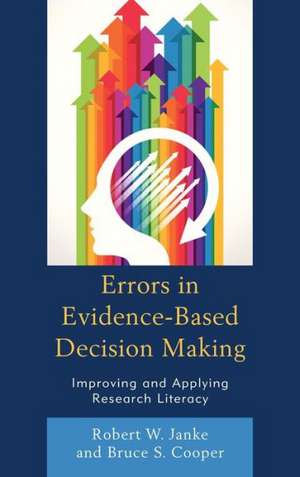
Errors in Evidence-Based Decision Making: Improving and Applying Research Literacy
Autor Robert W. Janke, Bruce S. Cooperen Limba Engleză Hardback – 25 iun 2014
This is a research methods textbook for students who fear research textbooks. The diversity of topics in this book permits application to research methods courses in these academic fields: Economics, Education, Political Science, Psychology, and Sociology. This should be the first book for all students to introduce research and develop "research literacy".
| Toate formatele și edițiile | Preț | Express |
|---|---|---|
| Paperback (1) | 269.69 lei 6-8 săpt. | |
| Bloomsbury Publishing – 25 iun 2014 | 269.69 lei 6-8 săpt. | |
| Hardback (1) | 453.99 lei 6-8 săpt. | |
| Bloomsbury Publishing – 25 iun 2014 | 453.99 lei 6-8 săpt. |
Preț: 453.99 lei
Preț vechi: 631.39 lei
-28%
Puncte Express: 681
Preț estimativ în valută:
80.35€ • 93.90$ • 69.76£
80.35€ • 93.90$ • 69.76£
Carte tipărită la comandă
Livrare economică 20 februarie-06 martie
Preluare comenzi: 021 569.72.76
Specificații
ISBN-13: 9781475810806
ISBN-10: 1475810806
Pagini: 204
Ilustrații: 1 Table
Dimensiuni: 150 x 230 x 18 mm
Greutate: 0.44 kg
Ediția:New.
Editura: Bloomsbury Publishing
Colecția Rowman & Littlefield Publishers
Locul publicării:New York, United States
ISBN-10: 1475810806
Pagini: 204
Ilustrații: 1 Table
Dimensiuni: 150 x 230 x 18 mm
Greutate: 0.44 kg
Ediția:New.
Editura: Bloomsbury Publishing
Colecția Rowman & Littlefield Publishers
Locul publicării:New York, United States
Cuprins
Preface
Introduction
Chapter 1 Identifying Errors
Chapter 2 Dispositions and Ethics
Chapter 3 Problem Development
Chapter 4 Variables
Chapter 5 Measurement Foundations
Chapter 6 Data Collection Instruments
Chapter 7 Sampling Methods
Chapter 8 External and Internal Validity Threats to Evidence
Chapter 9 Research Design
Chapter 10 Data Analysis
Chapter 11 Statistical Probability and Interpretation
Chapter 12 Personal Biases in Interpretation
Chapter 13 The Age of Misinformation
Chapter 14 Religion and Science
Epilogue--- How Will We Apply Research to Improve Our Lives?
Introduction
Chapter 1 Identifying Errors
Chapter 2 Dispositions and Ethics
Chapter 3 Problem Development
Chapter 4 Variables
Chapter 5 Measurement Foundations
Chapter 6 Data Collection Instruments
Chapter 7 Sampling Methods
Chapter 8 External and Internal Validity Threats to Evidence
Chapter 9 Research Design
Chapter 10 Data Analysis
Chapter 11 Statistical Probability and Interpretation
Chapter 12 Personal Biases in Interpretation
Chapter 13 The Age of Misinformation
Chapter 14 Religion and Science
Epilogue--- How Will We Apply Research to Improve Our Lives?
Recenzii
Important book to read, as Bob Janke and Bruce Cooper warn us, that: "Individuals and groups purposively create misinformation through distortion or manipulation to influence the beliefs and behaviors of others." Truth matters in everyone's life, as this book shows.
I enjoyed the thorough listing of best practices, common errors, and the like.
Yet another great book by Bruce Cooper and his colleague, Robert Janke, one of the most sensible and realistic observers of the American education scene for the past 40+ years. This book is readable and on-target.
Drs. Janke and Cooper's book is essential reading for students and laypeople alike. The world of big data is giving the impression that all analysis is research and all research is valid and reliable. The book offers an understanding of how to strengthen research and reduce errors. Readers will benefit from a close read, in both wisdom and humility.
A comedy of errors in education is not funny! Decisions and polices must be based on honest investigation and clear, critical thinking. This book is invaluable in pointing the (best) way to improving our schools for all children.
A non-traditional text that engages students with humor and provocative real-world examples of the consequences of research errors in many academic areas. This text shows why it is important to be able to separate accurate from inaccurate research evidence.
At a time when "scientifically proven methods" and "data driven instruction" have become catchwords in education, this bookis essential reading for students, teachers and anyone interested understanding research. Written in language that is non-technical and easy to read, Errors in Evidence-Based Decision Making helps users of research to understand and identify bias and misinformation, while also providing an excellent foundation for advanced courses in research.
An increasingly common bureaucratic imperative in selecting policies is that they be "research based," "proven," and in accord with "best practices." While politics requires that sort of justifying evidence, many political scientists observe that choices are usually made on the basis of unrealistic expectations, uncertain technologies, and unreliable implementation scenarios. This book provides useful ways of better evaluating evidence and thereby moving the exercise beyond justification.
I enjoyed the thorough listing of best practices, common errors, and the like.
Yet another great book by Bruce Cooper and his colleague, Robert Janke, one of the most sensible and realistic observers of the American education scene for the past 40+ years. This book is readable and on-target.
Drs. Janke and Cooper's book is essential reading for students and laypeople alike. The world of big data is giving the impression that all analysis is research and all research is valid and reliable. The book offers an understanding of how to strengthen research and reduce errors. Readers will benefit from a close read, in both wisdom and humility.
A comedy of errors in education is not funny! Decisions and polices must be based on honest investigation and clear, critical thinking. This book is invaluable in pointing the (best) way to improving our schools for all children.
A non-traditional text that engages students with humor and provocative real-world examples of the consequences of research errors in many academic areas. This text shows why it is important to be able to separate accurate from inaccurate research evidence.
At a time when "scientifically proven methods" and "data driven instruction" have become catchwords in education, this bookis essential reading for students, teachers and anyone interested understanding research. Written in language that is non-technical and easy to read, Errors in Evidence-Based Decision Making helps users of research to understand and identify bias and misinformation, while also providing an excellent foundation for advanced courses in research.
An increasingly common bureaucratic imperative in selecting policies is that they be "research based," "proven," and in accord with "best practices." While politics requires that sort of justifying evidence, many political scientists observe that choices are usually made on the basis of unrealistic expectations, uncertain technologies, and unreliable implementation scenarios. This book provides useful ways of better evaluating evidence and thereby moving the exercise beyond justification.