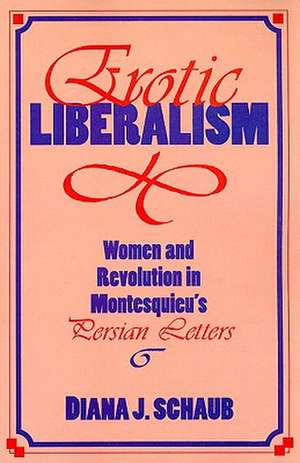
Erotic Liberalism: Women and Revolution in Montesquieu's Persian Letters
Autor Diana J. Schauben Limba Engleză Paperback – 2 mai 1995
Preț: 362.49 lei
Preț vechi: 483.85 lei
-25%
Puncte Express: 544
Carte tipărită la comandă
Livrare economică 11-25 noiembrie
Livrare prin curier în România Termenul estimat este afișat lângă disponibilitate.
Transport gratuit de la 400.00 lei Plată online sau ramburs, în funcție de opțiunile comenzii.
Retur gratuit în 14 zile Comandă securizată și suport în română.
Specificații
ISBN-13: 9780847680405
ISBN-10: 0847680401
Pagini: 199
Dimensiuni: 152 x 229 x 25 mm
Greutate: 0.34 kg
Editura: Bloomsbury Publishing
Colecția Rowman & Littlefield
Locul publicării:New York, United States
ISBN-10: 0847680401
Pagini: 199
Dimensiuni: 152 x 229 x 25 mm
Greutate: 0.34 kg
Editura: Bloomsbury Publishing
Colecția Rowman & Littlefield
Locul publicării:New York, United States
Recenzii
It is no small compliment to say that Diana Schaub's study is worthy of its engrossing subject. With her guidance-deft, nuanced, and sometimes bold-we join Montesquieu on a wondrous journey of self-discovery. It is a memorable trip.
In an elegant work Diana Schaub claims the ^RPersian Letters^I for political philosophy and connects it to liberalism today. With many revelations she brings to light the little games that Montesquieu plays with his readers, and she brings to life the matters of love that formal liberalism ignores. The book is no less delightful than serious.
A brief review cannot do justice to the wealth and subtlety of Schaub's detailed analyses of the novel . . . By being attentive to the literary form that Montesquieus chose to investigate sexual politics, Schaub has succeeded in reinstating the two Montesquieus, the novelist and the political philosopher.
Schaub offers scholars a new reading of Montesquieu's ^RPersian Letters^I....Her interpretations are persuasively defended.
In an elegant work Diana Schaub claims the ^RPersian Letters^I for political philosophy and connects it to liberalism today. With many revelations she brings to light the little games that Montesquieu plays with his readers, and she brings to life the matters of love that formal liberalism ignores. The book is no less delightful than serious.
A brief review cannot do justice to the wealth and subtlety of Schaub's detailed analyses of the novel . . . By being attentive to the literary form that Montesquieus chose to investigate sexual politics, Schaub has succeeded in reinstating the two Montesquieus, the novelist and the political philosopher.
Schaub offers scholars a new reading of Montesquieu's ^RPersian Letters^I....Her interpretations are persuasively defended.