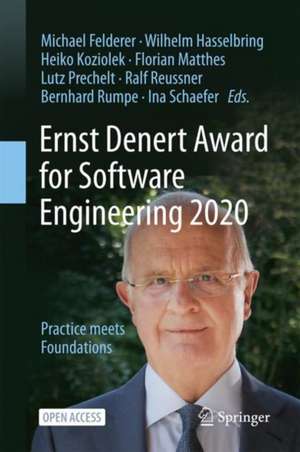
Ernst Denert Award for Software Engineering 2020
Editat de Michael Felderer, Wilhelm Hasselbring, Heiko Koziolek, Florian Matthes, Lutz Prechelt, Ralf Reussner, Bernhard Rumpe, Ina Schaeferen Limba Engleză Paperback – mar 2022
Structura volumului urmărește o progresie riguroasă, de la definirea conceptelor de cercetare la implementarea și validarea lor în medii industriale complexe. Reținem că fiecare dintre cele unsprezece lucrări selectate pentru Ernst Denert Award for Software Engineering 2020 nu se rezumă la teorie pură, ci demonstrează o utilitate directă în optimizarea proceselor de dezvoltare. Remarcăm modul în care cuprinsul ghidează cititorul prin diverse arii de specialitate: de la reducerea timpului de analiză a erorilor prezentată de Mojdeh Golagha, până la arhitecturile Fog scalabile explorate de Dominic Henze. Ca și Stan Jarzabek în Integrating Research and Practice in Software Engineering, autorii distilează experiența reală în principii acționabile, punând accent pe ceea ce este necesar pentru a migra soluțiile inovatoare către platforme industriale stabile. Apreciem în mod deosebit studiul lui Franz Zieris despre Pair Programming, care oferă o perspectivă tehnică asupra mecanismelor ce guvernează colaborarea eficientă între programatori. Această lucrare se poziționează ca o continuare firească a volumului Ernst Denert Award for Software Engineering 2019, consolidând o serie care analizează critic cele mai bune practici emergente. Spre deosebire de Evaluation of Novel Approaches to Software Engineering de Hermann Kaindl, care se concentrează pe evaluarea metodologiilor la nivel de conferință, volumul de față oferă o profunzime suplimentară prin actualizările post-disertație ale autorilor, reflectând lecțiile învățate după aplicarea rezultatelor în proiecte reale. Este un instrument de lucru pentru profesioniștii care caută fundamente solide pentru deciziile de arhitectură și proces software.
Preț: 252.29 lei
Preț vechi: 315.36 lei
-20%
Carte disponibilă
Livrare economică 11-25 mai
Livrare express 25 aprilie-01 mai pentru 32.96 lei
Specificații
ISBN-10: 3030831302
Pagini: 300
Ilustrații: VI, 293 p. 89 illus., 66 illus. in color.
Dimensiuni: 155 x 235 x 17 mm
Greutate: 0.46 kg
Ediția:1st edition 2022
Editura: Springer
Locul publicării:Cham, Switzerland
V-ar putea interesa
-
 Reliability Engineering in the CloudCarlos RojasPreț: 302.16 lei
 -
 -20%Preț: 256.41 lei320.51 lei
 -
 Software Architecture in PracticeLen Bass-20%Preț: 401.85 lei502.32 lei
 -
 Modern Software EngineeringDavid Farley-20%Preț: 227.02 lei283.77 lei
 -
 -20%Preț: 230.82 lei288.53 lei
 -
 Software Design DecodedMarian Petre-20%Preț: 79.20 lei99.00 lei
 -
 Lessons Learned in Software TestingBret Pettichord-20%Preț: 241.72 lei302.15 lei
 -
 Code Complete: A practical handbook of software constructionSteve McConnell-20%Preț: 294.79 lei368.50 lei
 -
 Github Copilot Certification Study GuideTom TaulliPreț: 361.22 lei
 -
 Coding for Dummies, All New EditionPaul McFedries-20%Preț: 111.94 lei139.93 lei
 -
 Specification by ExampleGojko Adzic-20%Preț: 266.47 lei333.08 lei
 -
 Formal Techniques for Distributed Objects, Components, and SystemsMohammad Reza Mousavi-20%Preț: 424.40 lei530.50 lei
 -
 New Perspectives in Software EngineeringJezreel Mejía-20%Preț: 1407.89 lei1759.86 lei
 -
 -20%Preț: 778.71 lei973.39 lei
 -
 -20%Preț: 391.93 lei489.91 lei
 -
 -20%Preț: 323.23 lei404.04 lei
 -
 Strategic Software EngineeringFilipe Ximenes-20%Preț: 205.57 lei256.97 lei
 -
 .NET 10 RevealedKajetan Duszy¿ski-20%Preț: 231.42 lei289.28 lei
 -
 Mastering ASP.NET Core 10Mabrouk Mahdhi-20%Preț: 361.75 lei452.18 lei
De ce să citești această carte
Recomandăm acest volum inginerilor software și arhitecților de sistem care doresc să acceseze soluții validate pentru probleme complexe de dezvoltare. Cititorul câștigă o perspectivă tehnică asupra unsprezece arii critice, de la DevOps și modelare de sistem la testare și mentenanță. Este o resursă practică ce demonstrează cum cercetarea de vârf poate fi aplicată pentru a îmbunătăți calitatea și eficiența software-ului în mediul de producție industrial.
Despre autor
Michael Felderer este un cercetător și editor de prestigiu în domeniul ingineriei software, fiind implicat activ în promovarea metodelor empirice și a calității sistemelor informatice. În calitate de co-editor al acestei serii Springer, el coordonează selecția lucrărilor care ating excelența atât în rigoarea științifică, cât și în aplicabilitatea practică. Expertiza sa este reflectată în lucrări precum Contemporary Empirical Methods in Software Engineering, unde analizează impactul datelor concrete în dezvoltarea software. Contribuția sa în volumele Ernst Denert Award for Software Engineering 2020 și edițiile adiacente subliniază angajamentul pentru transferul de cunoștințe între mediul academic și cel industrial.
Descriere scurtă
The book contains eleven papers that describe the works by Jonathan Brachthäuser (EPFL Lausanne) entitled What You See Is What You Get: Practical Effect Handlers in Capability-Passing Style, Mojdeh Golagha’s (Fortiss, Munich) thesis How to Effectively Reduce Failure Analysis Time?, Nikolay Harutyunyan’s (FAU Erlangen-Nürnberg) work on Open Source Software Governance, Dominic Henze’s (TU Munich) research about Dynamically Scalable Fog Architectures, Anne Hess’s (Fraunhofer IESE, Kaiserslautern) work on Crossing Disciplinary Borders to Improve Requirements Communication, Istvan Koren’s (RWTH Aachen U) thesis DevOpsUse: A Community-Oriented Methodology for Societal Software Engineering, Yannic Noller’s (NU Singapore) work on Hybrid Differential Software Testing, Dominic Steinhofel’s (TU Darmstadt) thesis entitled Ever Change a Running System: Structured Software Reengineering Using Automatically Proven-Correct Transformation Rules, Peter Wägemann’s (FAU Erlangen-Nürnberg) work Static Worst-Case Analyses and Their Validation Techniques for Safety-Critical Systems, Michael von Wenckstern’s (RWTH Aachen U) research on Improving the Model-Based Systems Engineering Process, and Franz Zieris’s (FU Berlin) thesis on Understanding How Pair Programming Actually Works in Industry: Mechanisms, Patterns, and Dynamics – which actually won the award.
The chapters describe key findings of the respective works, show their relevance and applicability to practice and industrial software engineering projects, and provide additional information and findings that have only been discovered afterwards, e.g. when applying the results in industry. This way, the book is not only interesting to other researchers, but also to industrial software professionals who would like to learn about the application of state-of-the-art methods in their daily work.