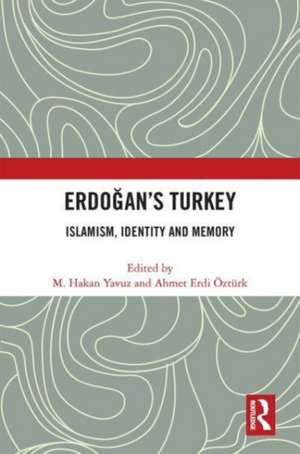
Erdoğan’s Turkey: Islamism, Identity and Memory
Editat de M. Hakan Yavuz, Ahmet Erdi Öztürken Limba Engleză Paperback – 25 sep 2023
Considerăm necesar să precizăm de la început că volumul Erdoğan’s Turkey, apărut sub egida Routledge, a fost publicat inițial ca un număr special al revistei Middle East Critique. Această ediție reunește cercetări de specialitate axate pe transformarea politică a Turciei sub conducerea președintelui Recep Tayyip Erdoğan și a Partidului Dreptății și Dezvoltării (AKP), investigând alunecarea regimului spre autoritarism în ultimele două decenii. Structura cărții este organizată în opt capitole tematice care indică o progresie clară de la analiza premiselor democratizării și a populismului intern, până la evoluții geopolitice majore. Cuprinsul evidențiază o acoperire riguroasă a unor teme sensibile: se analizează nostalgia neo-otomană, discursul de securitate de după tentativa de lovitură de stat din 15 iulie 2016, evoluția problemei kurde, managementul diasporei, re-securitizarea politicii externe față de Siria și controversa istorică armeano-turcă. Volumul depășește intenționat dihotomia clasică dintre islamism și secularism, propunând o perspectivă mult mai complexă asupra factorilor ideologici și sociali locali. Cititorii familiarizați cu Islam, Populism and Regime Change in Turkey vor aprecia modul în care acest volum extinde analiza transformărilor instituționale interne și a politicii externe post-2016, oferind perspective nuanțate asupra conceptului de autoritarism transnațional. De asemenea, în raport cu Erdoğan’s ‘New’ Turkey de Nikos Christofis, lucrarea de față pune un accent deosebit pe gestionarea traumei și a insecurității ontologice în discursul politic oficial de după evenimentele din 2016. Această abordare continuă linia de cercetare a editorului M. Hakan Yavuz, reflectată în lucrări anterioare precum The Torn Republic sau Secularism and Muslim Democracy in Turkey, unde acesta a analizat traiectoria politică a Turciei moderne și evoluția AKP de la o poziție conservator-democrată spre dinamica naționalistă actuală. Reținem că volumul este adaptat pentru curriculumul universitar, fiind o resursă esențială pentru programele de masterat în științe politice și relații internaționale.
Preț: 366.98 lei
Preț vechi: 410.56 lei
-11%
Carte indisponibilă temporar
Specificații
ISBN-10: 0367759136
Pagini: 136
Dimensiuni: 174 x 246 x 12 mm
Greutate: 0.2 kg
Ediția:1
Editura: Taylor & Francis
Colecția Routledge
Locul publicării:Oxford, United Kingdom
Public țintă
Postgraduate, Undergraduate Advanced, and Undergraduate CoreDe ce să citești această carte
Recomandăm această carte studenților avansați și cercetătorilor în științe politice și sociologie. Cititorul câștigă o înțelegere profundă a mecanismelor prin care AKP a transformat instituțiile statului turc după anul 2002. Volumul oferă un instrument analitic indispensabil pentru a înțelege cum tentativa de lovitură de stat din 2016 a reconfigurat nu doar politica internă, ci și relațiile diplomatice ale Turciei cu marile puteri regionale.
Despre autor
M. Hakan Yavuz este profesor asociat în cadrul Departamentului de Științe Politice și al Centrului pentru Studii de Orientul Mijlociu de la Universitatea din Utah. Activitatea sa academică este strâns legată de analiza dinamicii politice și religioase din Turcia. În cercetările sale anterioare, inclusiv în volumele Toward an Islamic Enlightenment și Turkish Islam and the Secular State, Yavuz a investigat mișcările islamice moderne, precum mișcarea Gülen, și reformele culturale autohtone, poziționându-se ca un expert recunoscut în evoluția islamului politic și a democrației în spațiul turc.
Notă biografică
Ahmet Erdi Öztürk is Associate Professor of Politics and International Relations and Marie Sklodowska-Curie Fellow at London Metropolitan University, Coventry University and GIGA in Germany. He is also an associate researcher (Chercheur Associé) at Institut Français d'Études Anatoliennes, fellow at ELIAMEP and editor of Edinburgh Studies on Modern Turkey and International Journal of Religion. He was a Swedish Institute Pre- and Post-Doctoral Fellow at the Institute for Research on Migration, Ethnicity and Society (REMESO), at Linköping University, Scholar in Residence at the University of Notre Dame’s Kroc Institute for International Peace Studies. He is the author of more than 20 peer-reviewed journal articles, numerous policy reports, opinion pieces and co-editor of four special issues on religion and politics and Turkish politics. Dr Öztürk is the co-editor of Authoritarian Politics in Turkey: Elections, Resistance and the AKP (2017), Ruin or Resilience? The Future of the Gulen Movement in Transnational Political Exile (Routledge, 2018) and Islam, Populism and Regime Change in Turkey (Routledge, 2019). His first solo-authored book, Religion, Identity and Power: Turkey and the Balkans in the Twenty-First Century was published in January 2021. He is a regular contributor to media outlets such as Open Democracy, The Conversation, Huffington Post and France 24.
Descriere scurtă
Erdoğan’s Turkey is a significant new contribution to the study of Turkish politics and politics in general, and will be a great resource for academics, researchers and advanced students of Political Science, International Relations, History, Geography and Sociology.
The chapters in this book were originally published as a special issue of the journal Middle East Critique.