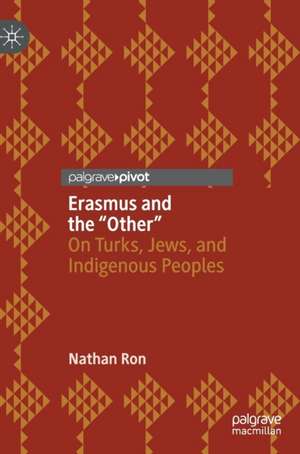
Erasmus and the "Other"
Autor Nathan Ronen Limba Engleză Hardback – 16 aug 2019
Preț: 399.89 lei
Puncte Express: 600
Carte tipărită la comandă
Livrare economică 02-16 decembrie
Livrare prin curier în România Termenul estimat este afișat lângă disponibilitate.
Transport gratuit de la 400.00 lei Plată online sau ramburs, în funcție de opțiunile comenzii.
Retur gratuit în 14 zile Comandă securizată și suport în română.
Specificații
ISBN-13: 9783030249281
ISBN-10: 303024928X
Pagini: 212
Ilustrații: XIV, 196 p. 1 illus.
Dimensiuni: 153 x 216 x 17 mm
Greutate: 0.35 kg
Ediția:1st ed. 2019
Editura: Springer International Publishing
Locul publicării:Cham, Switzerland
ISBN-10: 303024928X
Pagini: 212
Ilustrații: XIV, 196 p. 1 illus.
Dimensiuni: 153 x 216 x 17 mm
Greutate: 0.35 kg
Ediția:1st ed. 2019
Editura: Springer International Publishing
Locul publicării:Cham, Switzerland
Cuprins
1. Introduction: Eurocentrism and Racism.- 2. Turkish Essence.- 3. Conversion or War.- 4. The Origin of the Turks.- 5. Erasmus and Nicholas of Cusa on Islam.- 6. Erasmus’ and Las Casas’ Conception of Barbarian Peoples.- 7. Displays of Tolerance toward Islam.- 8. Methodological Remarks.- 9. Shimon Markish Revisited.- 10. Purification.- 11. By Race Jews, by Religion Christians.- 12. Learned Converts and Erasmians.- 13. Muslims are Superior to Jews.- 14. Conclusions.
Recenzii
“The book does not dethrone Erasmus as the ‘Prince of Humanists’, yet it does put a timely and welcome big asterisk after that lofty title.” (Koen Scholten, Studia Rosenthaliana, Vol. 48 (1), 2022)
“Nathan Ron’s book helps us to gain some insight not only into Erasmus but also into our own process of understanding the past and our present condition, as scholars and intellectuals.” (William Barker, Renaissance and Reformation, Vol. 43 (1), 2020)
“Nathan Ron’s book helps us to gain some insight not only into Erasmus but also into our own process of understanding the past and our present condition, as scholars and intellectuals.” (William Barker, Renaissance and Reformation, Vol. 43 (1), 2020)
Notă biografică
Nathan Ron is Research Fellow at the School of History, The University of Haifa, Israel.
Textul de pe ultima copertă
This book investigates how Erasmus viewed non-Christians and different races, including Muslims, Jews, the indigenous people of the Americas, and Africans. Nathan Ron argues that Erasmus was devoted to Christian Eurocentrism and not as tolerant as he is often portrayed. Erasmus’ thought is situated vis-à-vis the thought of contemporaries such as the cosmographer and humanist Aeneas Sylvius Piccolomini who became Pope Pius II; the philosopher, scholar, and Cardinal, Nicholas of Cusa; and the Dominican missionary and famous defender of the Native Americans, Bartolomé Las Casas. Additionally, the relatively moderate attitude toward Islam which was demonstrated by Michael Servetus, Sebastian Franck, and Sebastian Castellio is analyzed in comparison with Erasmus’ harsh attitude toward Islam/Turks.
Caracteristici
Defines and classifies Erasmus' attitudes toward non-Christian peoples and groups. Explores Erasmus’ attitudes toward Turks and Jews synthetically and comparatively. Analyzes Erasmus' attitude toward Amerindians and Black Africans.