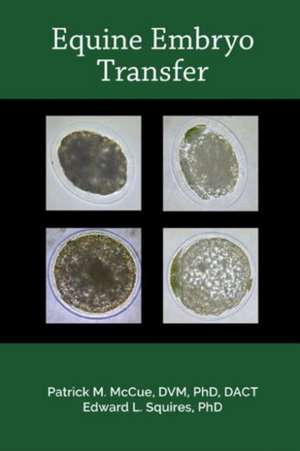
Equine Embryo Transfer: Teton NewMedia
Autor Patrick M. McCue, Edward L. Squiresen Limba Engleză Paperback – 18 feb 2015
Preț: 489.11 lei
Preț vechi: 531.65 lei
-8%
Puncte Express: 734
Carte disponibilă
Livrare economică 13-27 noiembrie
Livrare express 30 octombrie-05 noiembrie pentru 29.44 lei
Livrare prin curier în România Termenul estimat este afișat lângă disponibilitate.
Transport gratuit pentru acest produs Plată online sau ramburs, în funcție de opțiunile comenzii.
Retur gratuit în 14 zile Comandă securizată și suport în română.
Specificații
ISBN-13: 9781591610472
ISBN-10: 1591610478
Pagini: 184
Ilustrații: 132 colour illustrations
Dimensiuni: 152 x 229 x 12 mm
Greutate: 0.36 kg
Ediția:1
Editura: Teton New Media
Colecția Teton New Media
Seria Teton NewMedia
ISBN-10: 1591610478
Pagini: 184
Ilustrații: 132 colour illustrations
Dimensiuni: 152 x 229 x 12 mm
Greutate: 0.36 kg
Ediția:1
Editura: Teton New Media
Colecția Teton New Media
Seria Teton NewMedia
V-ar putea interesa
-
 Manual of Equine ReproductionSteven P. Brinsko-28%Preț: 486.82 lei674.79 lei
 -
 -5%Preț: 656.80 lei691.36 lei
 -
 -5%Preț: 506.39 lei533.04 lei
 -
 Diagnostic Techniques in Equine MedicineFrank G. R. Taylor-24%Preț: 608.75 lei804.48 lei
 -
 -5%Preț: 831.87 lei875.65 lei
 -
 Cardiology of the HorseCelia Marr-31%Preț: 564.24 lei816.17 lei
 -
 Saunders Equine FormularyDerek C. Knottenbelt-5%Preț: 500.38 lei526.72 lei
 -
 -5%Preț: 539.04 lei567.41 lei
 -
 Manual of Veterinary Transfusion Medicine and Blood BankingKenichiro Yagi-5%Preț: 756.43 lei796.25 lei
 -
 Bovine ReproductionRichard M Hopper-5%Preț: 2176.93 lei2291.51 lei
 -
 Manual of Equine Anesthesia and AnalgesiaTom Doherty-5%Preț: 1036.62 lei1091.17 lei
 -
 Aaevt's Equine Manual for Veterinary TechniciansSally Denotta-5%Preț: 526.01 lei553.69 lei
 -
 Equine OphthalmologyBrian C. Gilger-5%Preț: 1548.54 lei1630.05 lei
 -
 Equine Injury, Therapy and RehabilitationMary Bromiley-5%Preț: 345.52 lei363.70 lei
 -
 Equine Breeding Management and Artificial InseminationJuan C. Samper-27%Preț: 764.22 lei1045.18 lei
 -
 Equine SurgeryJorg A. Auer-28%Preț: 1099.85 lei1533.73 lei
 -
 Equine Emergencies: Treatment and ProceduresJames A. Orsini-25%Preț: 581.34 lei779.40 lei
 -
 Robinson's Current Therapy in Equine MedicineKim A. Sprayberry-24%Preț: 788.97 lei1035.54 lei
 -
 Animal Biotechnology 1Heiner Niemann-18%Preț: 784.49 lei956.70 lei
 -
 Human Embryo TransferGautam N. Allahbadia-5%Preț: 381.15 lei401.21 lei
Public țintă
Academic and PostgraduateRecenzii
"... a well-written book. It covers everything involved in equine embryo transfer work from start to finish. The book is written in a manner that will provide valuable information to anyone interested in learning embryo transfer or someone who is already doing some embryo transfer but would like more information. ... I particularly liked the pictures and charts, because they nicely complimented and augmented the text. This book also contains a lot of descriptive statistics for a large number of embryo transfers. It is a good value and will be a nice addition to the library of anyone interested in equine embryo transfer."
—Shawn Jensen, DVM, Bluff Country Equine, Winona, Minnesota, USA, from Vet Med Today: Book Reviews, JAVMA, Vol 247, No. 6, September 15, 2015
—Shawn Jensen, DVM, Bluff Country Equine, Winona, Minnesota, USA, from Vet Med Today: Book Reviews, JAVMA, Vol 247, No. 6, September 15, 2015
Cuprins
Contents 1. Introduction General Introduction (i.e. what is ET) Advantages and uses of embryo transfer Changes in the ET Industry Breed regulations (include a Table of most major breeds; ET, frozen embryos, etc.) Per cycle ET Success = Embryo Collection Rate (50-60%) x Embryo Transfer Pregnancy Rate (70-80%)Goals of the Manual 2. History of equine embryo transfer Livestock Horses Domestic horses as surrogates for endangered equids(?) 3. Reproductive Anatomy and Physiology of the MareAnatomy of the mare Physiology of the estrous cycle Physiology of early embryonic development and early pregnancy 4. Management of the donor mare Selection of the donor Evaluation of the donor (BSE)Management and Day of breeding (fresh, cooled, frozen semen) Palpation/ultrasound examinations relative to flush; daily vs every 6-8 hrs for frozen semen; BID if goal is to collect a small embryo at day 6.5 for cryopreservation Induction of ovulation (hCG and deslorelin) Donor mare management (PMIE, fluid, etc.)Estrous cycle control (Lights, P&E, PGF, hCG, Deslorelin, Regumate) Allow a mare to carry to term by approximately 10 years of age Allowing mare to carry own every 3-4 years Effect of repeated flushing on uterine health and embryo recovery # flushes per year recommendedFertility of mares after flushing (i.e. same season)Problem mares (i.e. PMIE, etc.) Maiden mares (young vs older)Post partum mares (i.e. flushing on foal heat) 5. SuperovulationHistoryTechniques EFSH Optimal follicle size at onset Problems - same stallion vs. goal of different stallions Not every mare responds to FSHPAF's and HAF's 6. Embryo Collection Equipment (Box Table) Facilities (stocks vs stall, etc.) Procedure; (incl. clean out and wash up) Ultrasound prior to flush in problem
Descriere
This book briefly reviews the history of equine embryo transfer, covering in clinically practical terms the techniques, equipment, and management protocols currently in use.