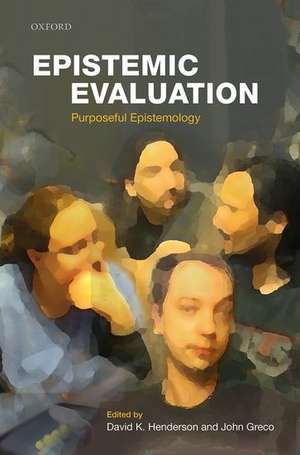
Epistemic Evaluation: Purposeful Epistemology
Editat de David K. Henderson, John Grecoen Limba Engleză Hardback – oct 2015
Preț: 688.71 lei
Preț vechi: 979.01 lei
-30%
Puncte Express: 1033
Carte tipărită la comandă
Livrare economică 18-29 decembrie
Livrare prin curier în România Termenul estimat este afișat lângă disponibilitate.
Transport gratuit pentru acest produs Plată online sau ramburs, în funcție de opțiunile comenzii.
Retur gratuit în 14 zile Comandă securizată și suport în română.
Specificații
ISBN-13: 9780199642632
ISBN-10: 019964263X
Pagini: 302
Dimensiuni: 174 x 240 x 25 mm
Greutate: 0.62 kg
Editura: OUP OXFORD
Colecția OUP Oxford
Locul publicării:Oxford, United Kingdom
ISBN-10: 019964263X
Pagini: 302
Dimensiuni: 174 x 240 x 25 mm
Greutate: 0.62 kg
Editura: OUP OXFORD
Colecția OUP Oxford
Locul publicării:Oxford, United Kingdom
V-ar putea interesa
-
 Pyrrhonian Reflections on Knowledge and JustificationRobert J. Fogelin-30%Preț: 833.34 lei1190.56 lei
-
 African Philosophy: New and Traditional PerspectivesLee M. Brown-10%Preț: 353.78 lei394.29 lei
-
 -15%Preț: 119.38 lei139.99 lei
-
 -13%Preț: 348.00 lei398.23 lei
-
 -24%Preț: 222.10 lei293.71 lei
-
 -11%Preț: 453.95 lei510.05 lei
-
 Reasoning: A Social PictureAnthony Simon Laden-19%Preț: 314.51 lei387.89 lei
-
 Epistemological DisjunctivismDuncan PritchardPreț: 214.71 lei
-
 Knowledge on TrustPaul Faulkner-19%Preț: 296.54 lei367.31 lei
-
 Knowing Right From WrongKieran Setiya-20%Preț: 279.48 lei347.47 lei
-
 Epistemology: New EssaysQuentin Smith-10%Preț: 389.72 lei431.40 lei
-
 Internalism and Externalism in Semantics and EpistemologySanford C. Goldberg-30%Preț: 834.42 lei1191.20 lei
-
 Scientific Representation: Paradoxes of PerspectiveBas C. van Fraassen-13%Preț: 303.91 lei350.26 lei
-
 Free: Why Science Hasn't Disproved Free WillAlfred R. Mele-22%Preț: 108.85 lei139.26 lei
-
 -30%Preț: 657.34 lei936.37 lei
-
 Social EpistemologyAdrian Haddock-31%Preț: 776.49 lei1129.36 lei
-
 -19%Preț: 362.59 lei449.83 lei
-
 Scepticism and Perceptual JustificationDylan Dodd-30%Preț: 721.73 lei1027.32 lei
-
 Knowledge: A Very Short IntroductionJennifer Nagel-19%Preț: 57.85 lei71.12 lei
-
 -11%Preț: 314.13 lei353.45 lei
-
 Quitting Certainties: A Bayesian Framework Modeling Degrees of BeliefMichael G. Titelbaum-17%Preț: 336.92 lei407.60 lei
-
 Putting Skeptics in Their PlaceJohn GrecoPreț: 216.53 lei
-
 Achieving KnowledgeJohn GrecoPreț: 185.88 lei
-
 TruthChase WrennPreț: 193.94 lei
-
 Groups as AgentsDeborah Perron TollefsenPreț: 177.51 lei
-
 The Blackwell Companion to HermeneuticsNiall Keane-9%Preț: 1283.03 lei1409.92 lei
-
 Tentacles Longer Than NightEugene ThackerPreț: 85.46 lei
-
 Broken VowsJohn GrecoPreț: 53.50 lei
Recenzii
This volume shows a way to do post-Gettier epistemology. ... In addition to casting light on the nature, purpose and value of epistemic evaluation, purposeful epistemology also facilitates progress on a variety of epistemological issues, such as the relationship between knowledge and practical reasoning, the semantics of knowledge ascriptions and the internalism/externalism debate. This is not to suggest that purposeful epistemology is the only method epistemologists should use. But it is, as the editors point out, 'an important an underappreciated item in the toolbox' (3). I highly recommend this book.
Notă biografică
David Henderson is Robert R Chambers Distinguished Professor of Philosophy at the University of Nebraska-Lincoln.John Greco holds the Leonard and Elizabeth Eslick Chair in Philosophy at Saint Louis University.
Cuprins
- Introduction: The Point And Purpose Of Epistemic Evaluation
- Philosophical Methods and Evaluative Purposes
- 1: Georgi Gardiner: Teleologies and the Methodology of Epistemology
- 2: Elizabeth Fricker: Know First, Tell Later: The Truth about Craig on Knowledge
- 3: David Henderson and Terence Horgan: What's the Point?
- Contextualism and Pragmatic Enchroachment
- 4: Stephen R. Grimm: Knowledge, Practical Interests, and Rising Tides
- 5: Matthew McGrath: Two Purposes of Knowledge Attribution and the Contextualism Debate
- Does Knowledge Always Require Reasons?
- 6: Michael Williams: Knowledge in Practice
- 7: Jonathan M. Weinberg: Regress-Stopping and Disagreement for Epistemic Neopragmatists
- The Internalism/Externalism Debate
- 8: Sanford C. Goldberg: What is the subject-matter of the theory of epistemic justification?
- 9: Declan Smithies: Why Justification Matters
- Epistemic Norms as Social Norms
- 10: Peter J. Graham: Epistemic Normativity and Social Norms
- 11: John Greco: Testimonial Knowledge and the Flow of Information