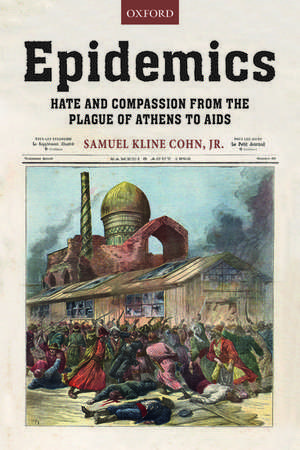
Epidemics: Hate and Compassion from the Plague of Athens to AIDS
Autor Jr. Samuel K. Cohnen Limba Engleză Hardback – 5 apr 2018
Preț: 349.53 lei
Preț vechi: 446.28 lei
-22%
Puncte Express: 524
Carte tipărită la comandă
Livrare economică 27 noiembrie-02 decembrie
Livrare prin curier în România Termenul estimat este afișat lângă disponibilitate.
Transport gratuit de la 400.00 lei Plată online sau ramburs, în funcție de opțiunile comenzii.
Retur gratuit în 14 zile Comandă securizată și suport în română.
Specificații
ISBN-13: 9780198819660
ISBN-10: 0198819668
Pagini: 656
Ilustrații: 13 black and white images/maps
Dimensiuni: 164 x 242 x 42 mm
Greutate: 1.12 kg
Editura: OUP OXFORD
Colecția OUP Oxford
Locul publicării:Oxford, United Kingdom
ISBN-10: 0198819668
Pagini: 656
Ilustrații: 13 black and white images/maps
Dimensiuni: 164 x 242 x 42 mm
Greutate: 1.12 kg
Editura: OUP OXFORD
Colecția OUP Oxford
Locul publicării:Oxford, United Kingdom
V-ar putea interesa
-
 -24%Preț: 479.69 lei628.91 lei
 -
 The Brain Takes Shape: An Early HistoryRobert L. Martensen-24%Preț: 575.16 lei757.40 lei
 -
 -26%Preț: 311.53 lei419.72 lei
 -
 -25%Preț: 1156.83 lei1549.52 lei
 -
 Joseph Babinski: A BiographyJacques MD Philippon-26%Preț: 520.01 lei698.01 lei
 -
 Raymond Adams: A Life of Mind and MuscleRobert Laureno, MD-26%Preț: 612.88 lei828.47 lei
 -
 A History of the Treatment of Renal Failure by DialysisJ Stewart Cameron-26%Preț: 1838.43 lei2501.07 lei
 -
 Coleridge and the Doctors: 1795-1806Neil Vickers-27%Preț: 1088.36 lei1481.48 lei
 -
 -17%Preț: 506.29 lei607.38 lei
 -
 Alternative Medicine?: A HistoryRoberta Bivins-21%Preț: 166.54 lei211.00 lei
 -
 Cultures of Plague: Medical thinking at the end of the RenaissanceJr. Samuel K. Cohn-22%Preț: 402.93 lei518.04 lei
 -
 Readings In American Health Care: Current Issues In Socio-Historical PerspectiveWilliam G. Rothstein-5%Preț: 141.41 lei148.85 lei
 -
 -5%Preț: 283.42 lei298.33 lei
 -
 The Black Death Transformed: Disease and Culture in Early Renaissance EuropeJr. Samuel K. Cohn-15%Preț: 280.18 lei330.71 lei
 -
 Man and MicrobesArno Karlen-5%Preț: 103.61 lei109.06 lei
 -
 The Case of Sigmund FreudGilman-5%Preț: 227.51 lei239.48 lei
 -
 The Care of StrangersRosenberg-5%Preț: 262.38 lei276.19 lei
 -
 Living in the Shadow of DeathRothman-5%Preț: 249.34 lei262.46 lei
 -
 Learning to HealLudmerer-5%Preț: 251.96 lei265.22 lei
 -
 Technology in the HospitalHowell-5%Preț: 229.95 lei242.05 lei
 -
 -5%Preț: 223.20 lei234.94 lei
 -
 Medicine and CultureLynn Payer-5%Preț: 103.93 lei109.40 lei
 -
 Feminizing Venereal DiseaseMary Spongberg-23%Preț: 628.15 lei815.77 lei
 -
 Medical BlundersRobert Youngson-5%Preț: 781.62 lei822.75 lei
Recenzii
...It is a lens that has once again become relevantto current events, and Cohn's book may well serve as a useful resourcefor other researchers who are taking a renewed interest in epidemics.
Epidemics, conceived in the influenza scare of 2009, is in itself a commemoration of all the deadliest plagues to have afflicted our species. ... covering the major infections from 430 BC, through the Black Death (134751) and syphilis (14945), to cholera (1832 onwards), smallpox in nineteenth-century America, plague in India since 1894, yellow fever (Southern USA), and the Great Influenza, with a coda on HIV/AIDS ... Cohn's aim is not just to tell their stories (although there are stories aplenty), but to tell them from a new perspective.
...this is a work of considerable value. Thanks to Cohn, subsequent generations of historians may be inclined to study epidemics as a potential unifying force rather than merely a destructive one.
In a number of distinct contexts, Cohn uncovers responses of sympathy and mutual assistance crossing class, religious, gender or ethnic divides. These take very different forms - some grassroots movements and some organized centrally. Here, as in all other parts of the discussion, Cohn establishes that responses to epidemics are complicated by the specific nature of the disease as well as the context in which it develops. The mentalities, memories and manifestations of each varied. By reintroducing a number of complexities and ambiguities into the study of epidemic disease, Cohn illustrates the richness of the comparative history of disease, and his work will likely act as a point of reference and inspiration for many years to come.
The historical breadth of this book, with its meticulous attention to varied sources and contexts, is simply breathtaking. ... This book will interest students of the history of medicine as well as anyone seeking a historical and comparative exploration of epidemics. It is dense and detailed reading ... this book will appeal chiefly to specialists at the graduate level and above.
Epidemics, conceived in the influenza scare of 2009, is in itself a commemoration of all the deadliest plagues to have afflicted our species. ... covering the major infections from 430 BC, through the Black Death (134751) and syphilis (14945), to cholera (1832 onwards), smallpox in nineteenth-century America, plague in India since 1894, yellow fever (Southern USA), and the Great Influenza, with a coda on HIV/AIDS ... Cohn's aim is not just to tell their stories (although there are stories aplenty), but to tell them from a new perspective.
...this is a work of considerable value. Thanks to Cohn, subsequent generations of historians may be inclined to study epidemics as a potential unifying force rather than merely a destructive one.
In a number of distinct contexts, Cohn uncovers responses of sympathy and mutual assistance crossing class, religious, gender or ethnic divides. These take very different forms - some grassroots movements and some organized centrally. Here, as in all other parts of the discussion, Cohn establishes that responses to epidemics are complicated by the specific nature of the disease as well as the context in which it develops. The mentalities, memories and manifestations of each varied. By reintroducing a number of complexities and ambiguities into the study of epidemic disease, Cohn illustrates the richness of the comparative history of disease, and his work will likely act as a point of reference and inspiration for many years to come.
The historical breadth of this book, with its meticulous attention to varied sources and contexts, is simply breathtaking. ... This book will interest students of the history of medicine as well as anyone seeking a historical and comparative exploration of epidemics. It is dense and detailed reading ... this book will appeal chiefly to specialists at the graduate level and above.
Notă biografică
Samuel K. Cohn, Jr. is Professor of Medieval History at the University of Glasgow, an Honorary Fellow of the Institute for Advanced Studies in Humanities at the University of Edinburgh, and a Fellow of the Royal Society of Edinburgh. Over the past sixteen years, he has focused on the history of popular unrest in late medieval and early modern Europe and on the history of disease and medicine. Cohn's latest two books are Popular Protest in Late Medieval English Towns (2013) and Cultures of Plague: Medical Thinking at the End of the Renaissance (OUP, 2010).
Cuprins
- Introduction: Hate, Politics, and Compassion
- Part One: Antiquity and the Middle Ages
- 1: Epidemics in Antiquity: The Moral Universe and Natural Causes
- 2: Ancient Epidemics: What the Oracles Had To Say
- 3: Black Death Persecution and Abandonment
- 4: Mechanisms for Unity: Saints and Plagues
- Part Two: Early Modernity
- 5: Syphilis: Naming and Blaming?
- 6: Plague Spreaders
- Part Three: Modernity: Epidemics of Hate
- 7: Cholera's First European Tour: The Story in the British Isles
- 8: Cholera on the Continent and in America
- 9: Cholera Violence: An Italian Story in Comparative Perspective
- 10: Cholera: A Comparative History of Disturbance
- 11: Smallpox Cruelty: The Case of North America
- 12: Smallpox and Collective Violence
- 13: Smallpox Violence in Victorian Britain
- Part IV: Modernity: Plagues of Politics
- 14: Plague since 1894: India
- 15: Plague Beyond India
- 16: Myths of Plague
- Part V: Modernity: Plagues of Compassion
- 17: Yellow Fever: Stories from Philadelphia and Memphis
- 18: Yellow Fever: The Broader Picture
- 19: The Great Influenza: A Forgotten Pandemic?
- 20: Quarantine and Blame
- 21: A Pandemic of Compassion
- 22: Comparative Vistas (I): The Great Influenza
- 23: Comparative Vistas (II): Beyond the Battlefields
- 24: Conclusion
- 25: Epilogue. HIV/AIDS: An Epidemic of Hate, Compassion, and Politics
- Bibliography and Appendix of Newspapers