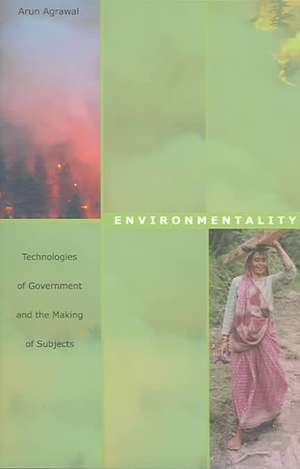
Environmentality
Autor Arun Agrawalen Limba Engleză Paperback – 6 apr 2005
Preț: 234.40 lei
Puncte Express: 352
Carte disponibilă
Livrare economică 12-26 noiembrie
Livrare express 28 octombrie-03 noiembrie pentru 34.68 lei
Livrare prin curier în România Termenul estimat este afișat lângă disponibilitate.
Transport gratuit de la 400.00 lei Plată online sau ramburs, în funcție de opțiunile comenzii.
Retur gratuit în 14 zile Comandă securizată și suport în română.
Specificații
ISBN-13: 9780822334927
ISBN-10: 0822334925
Pagini: 346
Ilustrații: 3 photographs, 17 tables, 3 figures
Dimensiuni: 152 x 229 x 19 mm
Greutate: 0.5 kg
Ediția:New.
Editura: Duke University Press
ISBN-10: 0822334925
Pagini: 346
Ilustrații: 3 photographs, 17 tables, 3 figures
Dimensiuni: 152 x 229 x 19 mm
Greutate: 0.5 kg
Ediția:New.
Editura: Duke University Press
V-ar putea interesa
-
 The Goldilocks Challenge: Right-Fit Evidence for the Social SectorMary Kay Gugerty-18%Preț: 352.10 lei427.23 lei
 -
 Multinationals, the State and Control of the Nigerian EconomyThomas J. Biersteker-23%Preț: 1028.84 lei1336.15 lei
 -
 Regional Modernities: The Cultural Politics of Development in IndiaK. SivaramakrishnanPreț: 251.86 lei
 -
 Agrarian EnvironmentsArun AgrawalPreț: 261.50 lei
 -
 Nature in the Global SouthPaul GreenoughPreț: 282.20 lei
 -
 Prioritizing DevelopmentBjorn LomborgPreț: 360.32 lei
 -
 The Creative Wealth of NationsPatrick Kabanda-NaN%Preț: 852.20 lei852.20 lei
 -
 Modern Evolutionary EconomicsRichard R. NelsonPreț: 249.51 lei
 -
 Circular Business ModelsMats Larsson-18%Preț: 1264.55 lei1542.12 lei
 -
 South Asian Migration in the GulfMehdi Chowdhury-18%Preț: 978.34 lei1193.09 lei
 -
 Agency Theory and Sustainability in the Global Supply ChainEmanuela DelbufaloPreț: 392.55 lei
 -
 Achieving Sustainable Business ExcellenceFlevy Lasrado-15%Preț: 664.72 lei782.03 lei
 -
 Sustainable Business ModelsLars Moratis-18%Preț: 2178.80 lei2657.06 lei
 -
 Sustainable FashionSarah Margaretha Jastram-15%Preț: 518.90 lei610.48 lei
 -
 Refugee and Mixed Migration FlowsBimal Ghosh-18%Preț: 748.98 lei913.40 lei
 -
 Entrepreneurship in Post-Communist CountriesJelena Budak-18%Preț: 920.46 lei1122.51 lei
 -
 Organizational LegitimacyEmilio Díez-De-Castro-18%Preț: 985.92 lei1202.34 lei
 -
 CSR im GesundheitswesenKatrin KellerPreț: 284.64 lei
 -
 Employment Guarantee Programme and Dynamics of Rural Transformation in IndiaMadhusudan BhattaraiPreț: 415.12 lei
 -
 Xi Jinping's New Development PhilosophyAngang Hu-15%Preț: 522.23 lei614.39 lei
Recenzii
Arun Agrawal achieves, in Environmentality, something of a breakthrough to new analytical territory where the binaries of state and society, structure and agency, public and private are transcended. He parlays the humble subject of community-based forestry and Foucaults concept of governmentality into the makings of an original and subtle analysis of modernity and nature.James C. Scott, Yale UniversityArun Agrawal has written an amazing book that draws on a very-long-term case study to make general lessons. He analyzes the development of the mentality of citizens and officials related to the environment in a particular setting undergoing major shifts from centralization to a form of decentralization. All of us can take some important lessons from this book about how peoples mentalities change when they have power and knowledge to cope with a problem. That shift in knowledge and power took time and effort, but is one of the rare success stories of recent history.Elinor Ostrom, coeditor of Seeing the Forest and the Trees: Human-Environment Interactions in Forest Ecosystems"Dealing with challenging theoretical concepts, yet building from a wealth of richempirical data, Environmentality has much to offer . . . "--ENVIRONMENT ANDPLANNING A, 2006 Throughout the chapters, the analyses are of high quality. The authors know their cases and present them well. At the same time, they connect to the broader issues the volume intends to raise and to the rising literature on materiality. . .Peter Wagner, American Journal of SociologyThis is an important book that readers of Technology and Culture should find both challenging and rewarding. . . . Marcia-Anne Dobres, Technology and CultureFor museum scholars, careful consideration of materialityand of the ideologies of the material world conveyed by museum practiceis imperative. This volume will be an important resource for such a project. Jessica Cattelino, Museum AnthropologyA lively volume. . . . This book makes the reader engage with a range of old and new arguments on materiality and pushes their boundaries in a way that makes it important reading for a broad anthropological public. Francesca Merlan, Journal of the Royal Anthropological Institute
"Arun Agrawal achieves, in Environmentality, something of a breakthrough to new analytical territory where the binaries of state and society, structure and agency, public and private are transcended. He parlays the humble subject of community-based forestry and Foucault's concept of 'governmentality' into the makings of an original and subtle analysis of modernity and nature."--James C. Scott, Yale University "Arun Agrawal has written an amazing book that draws on a very-long-term case study to make general lessons. He analyzes the development of the mentality of citizens and officials related to the environment in a particular setting undergoing major shifts from centralization to a form of decentralization. All of us can take some important lessons from this book about how people's mentalities change when they have power and knowledge to cope with a problem. That shift in knowledge and power took time and effort, but is one of the rare success stories of recent history."--Elinor Ostrom, coeditor of Seeing the Forest and the Trees: Human-Environment Interactions in Forest Ecosystems "Dealing with challenging theoretical concepts, yet building from a wealth of rich empirical data, Environmentality has much to offer ... "--ENVIRONMENT AND PLANNING A, 2006 "Throughout the chapters, the analyses are of high quality. The authors know their cases and present them well. At the same time, they connect to the broader issues the volume intends to raise and to the rising literature on 'materiality...'"--Peter Wagner, American Journal of Sociology "This is an important book that readers of Technology and Culture should find both challenging and rewarding..." --Marcia-Anne Dobres, Technology and Culture "For museum scholars, careful consideration of materiality--and of the ideologies of the material world conveyed by museum practice--is imperative. This volume will be an important resource for such a project." --Jessica Cattelino, Museum Anthropology "A lively volume... This book makes the reader engage with a range of old and new arguments on materiality and pushes their boundaries in a way that makes it important reading for a broad anthropological public."-- Francesca Merlan, Journal of the Royal Anthropological Institute
"Arun Agrawal achieves, in Environmentality, something of a breakthrough to new analytical territory where the binaries of state and society, structure and agency, public and private are transcended. He parlays the humble subject of community-based forestry and Foucault's concept of 'governmentality' into the makings of an original and subtle analysis of modernity and nature."--James C. Scott, Yale University "Arun Agrawal has written an amazing book that draws on a very-long-term case study to make general lessons. He analyzes the development of the mentality of citizens and officials related to the environment in a particular setting undergoing major shifts from centralization to a form of decentralization. All of us can take some important lessons from this book about how people's mentalities change when they have power and knowledge to cope with a problem. That shift in knowledge and power took time and effort, but is one of the rare success stories of recent history."--Elinor Ostrom, coeditor of Seeing the Forest and the Trees: Human-Environment Interactions in Forest Ecosystems "Dealing with challenging theoretical concepts, yet building from a wealth of rich empirical data, Environmentality has much to offer ... "--ENVIRONMENT AND PLANNING A, 2006 "Throughout the chapters, the analyses are of high quality. The authors know their cases and present them well. At the same time, they connect to the broader issues the volume intends to raise and to the rising literature on 'materiality...'"--Peter Wagner, American Journal of Sociology "This is an important book that readers of Technology and Culture should find both challenging and rewarding..." --Marcia-Anne Dobres, Technology and Culture "For museum scholars, careful consideration of materiality--and of the ideologies of the material world conveyed by museum practice--is imperative. This volume will be an important resource for such a project." --Jessica Cattelino, Museum Anthropology "A lively volume... This book makes the reader engage with a range of old and new arguments on materiality and pushes their boundaries in a way that makes it important reading for a broad anthropological public."-- Francesca Merlan, Journal of the Royal Anthropological Institute
Textul de pe ultima copertă
"Arun Agrawal has written an amazing book that draws on a very-long-term case study to make general lessons. He analyzes the development of the mentality of citizens and officials related to the environment in a particular setting undergoing major shifts from centralization to a form of decentralization. All of us can take some important lessons from this book about how people's mentalities change when they have power and knowledge to cope with a problem. That shift in knowledge and power took time and effort, but is one of the rare success stories of recent history."--Elinor Ostrom, coeditor of "Seeing the Forest and the Trees: Human-Environment Interactions in Forest Ecosystems"
Descriere
An investigation of environmental politics in light of Foucault's work, drawing on and extending work done in feminist environmentalism, political ecology, and common property scholarship, explains why villagers in the Kumaon Himalaya have begun to conserve forests.