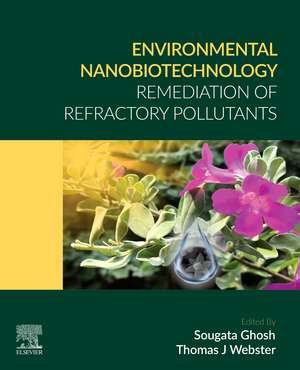
Environmental Nanobiotechnology: Remediation of Refractory Pollutants
Editat de Sougata Ghosh, Thomas J Websteren Limba Engleză Paperback – 20 iul 2026
Furthermore, it discusses the environmental toxicity and regulatory concerns associated with nanotechnology, ensuring a well-rounded understanding of the field. This is an essential resource for researchers, environmental scientists, and students in fields such as nanotechnology, environmental engineering, and biotechnology. It serves as a guideline for those looking to harness the potential of biogenic nanoparticles in combating environmental pollution, offering a pathway to sustainable solutions and innovative research opportunities.
- Explains the latest advancements in nanotechnology-driven solutions for sustainable environmental remediation
- Describes the biogenic synthesis mechanisms of various nanoparticles, offering detailed insights into their application for the effective removal of recalcitrant pollutants
- Explores the fabrication techniques of diverse nanostructures, including metal, metal oxide, and carbon-based nanoparticles
- Evaluates the effectiveness of nanobiomaterials in remediating a wide range of pollutants, such as hazardous dyes and microplastics
- Integrates interdisciplinary perspectives from major scientific fields
Preț: 1189.43 lei
Preț vechi: 1714.13 lei
-31%
Puncte Express: 1784
Carte tipărită la comandă
Livrare economică 23 noiembrie-07 decembrie
Livrare prin curier în România Termenul estimat este afișat lângă disponibilitate.
Transport gratuit pentru acest produs Plată online sau ramburs, în funcție de opțiunile comenzii.
Retur gratuit în 14 zile Comandă securizată și suport în română.
Specificații
ISBN-13: 9780443440991
ISBN-10: 0443440999
Pagini: 438
Dimensiuni: 191 x 235 mm
Editura: ELSEVIER SCIENCE
ISBN-10: 0443440999
Pagini: 438
Dimensiuni: 191 x 235 mm
Editura: ELSEVIER SCIENCE
Cuprins
1. Refractory pollutants: Introductions, impact and various remediation approaches
2. Bionanomaterials for removal of hazardous dyes
3. Biogenic nanoparticles with pesticide-removing capacity
4. Nanotechnology-driven solutions for the removal of polyaromatic hydrocarbons (PAHs) and per- and polyfluoroalkyl substances (PFAS)
5. Prospects of nanotechnology for oil spill management
6. Nanotechnology for removal of microplastics
7. Biochar-mediated removal of pollutants
8. Biopolymer based hydrogel for water treatment and decontamination
9. Nanotechnological perspective of heavy metal removal
10. E-waste management using nanobiotechnology
11. Bionanocomposite membrane filters for environmental application
12. Nanotechnology for biofuel production
13. Anaerobic ammonium oxidation by engineered nanoparticles
14. Nanoremediation of Pharmaceuticals and Personal Care Products (PPCPs)
15. Environmental toxicity, industrial and regulatory concerns with nanotechnology
2. Bionanomaterials for removal of hazardous dyes
3. Biogenic nanoparticles with pesticide-removing capacity
4. Nanotechnology-driven solutions for the removal of polyaromatic hydrocarbons (PAHs) and per- and polyfluoroalkyl substances (PFAS)
5. Prospects of nanotechnology for oil spill management
6. Nanotechnology for removal of microplastics
7. Biochar-mediated removal of pollutants
8. Biopolymer based hydrogel for water treatment and decontamination
9. Nanotechnological perspective of heavy metal removal
10. E-waste management using nanobiotechnology
11. Bionanocomposite membrane filters for environmental application
12. Nanotechnology for biofuel production
13. Anaerobic ammonium oxidation by engineered nanoparticles
14. Nanoremediation of Pharmaceuticals and Personal Care Products (PPCPs)
15. Environmental toxicity, industrial and regulatory concerns with nanotechnology