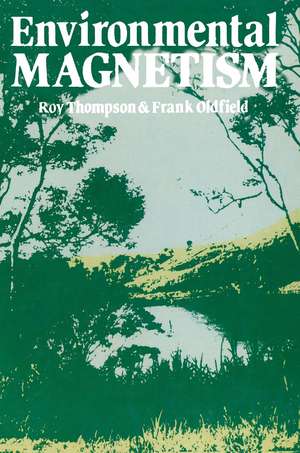
Environmental Magnetism
Autor Roy Thompsonen Limba Engleză Paperback – 29 apr 2012
Preț: 372.96 lei
Puncte Express: 559
Carte tipărită la comandă
Livrare economică 08-22 decembrie
Livrare prin curier în România Termenul estimat este afișat lângă disponibilitate.
Transport gratuit de la 400.00 lei Plată online sau ramburs, în funcție de opțiunile comenzii.
Retur gratuit în 14 zile Comandă securizată și suport în română.
Specificații
ISBN-13: 9789401180382
ISBN-10: 9401180385
Pagini: 240
Ilustrații: XII, 228 p. 47 illus.
Dimensiuni: 155 x 235 x 14 mm
Greutate: 0.37 kg
Ediția:Softcover reprint of the original 1st ed. 1986
Editura: Springer
Locul publicării:Dordrecht, Netherlands
ISBN-10: 9401180385
Pagini: 240
Ilustrații: XII, 228 p. 47 illus.
Dimensiuni: 155 x 235 x 14 mm
Greutate: 0.37 kg
Ediția:Softcover reprint of the original 1st ed. 1986
Editura: Springer
Locul publicării:Dordrecht, Netherlands
V-ar putea interesa
-
 A Treatise on Electricity and Magnetism: Volume 2James Clerk Maxwell-26%Preț: 392.00 lei532.80 lei
 -
 Electromagnetic TheoryA. Kovetz-30%Preț: 583.13 lei831.62 lei
 -
 Principles of DielectricsB. K. P. Scaife-32%Preț: 764.01 lei1122.11 lei
 -
 Synchrotron Radiation: Production and PropertiesPhilip Duke-27%Preț: 342.31 lei467.52 lei
 -
 Physics of Ferromagnetism 2eSoshin Chikazumi-24%Preț: 569.20 lei745.21 lei
 -
 The Physics of Vibrations and Waves 6eH. John Pain-19%Preț: 441.24 lei544.73 lei
 -
 Electromagnetism 2eI. S. GrantPreț: 421.60 lei
 -
 MagnetismDerek J Craik-9%Preț: 844.72 lei928.27 lei
 -
 Electricity, Relativity and MagnetismDerek J Craik-9%Preț: 2951.49 lei3243.40 lei
 -
 Quaternary Climates, Environments and MagnetismBarbara A. MaherPreț: 453.98 lei
 -
 The Manga Guide to ElectricityKazuhiro Fujitaki-18%Preț: 141.00 lei172.15 lei
 -
 Electromagnetic Theory, Volume 3Oliver HeavisidePreț: 180.41 lei
 -
 -27%Preț: 1330.90 lei1813.16 lei
Public țintă
ResearchCuprins
1 Introduction.- 2 Magnetic properties of solids.- 2.1 Introduction.- 2.2 Basic magnetic properties.- 2.3 Hysteresis.- 2.4 Effects of crystal size, shape and structure.- 2.5 Time dependence of magnetisation.- 2.6 Grain interactions.- 2.7 Summary.- Further reading.- 3 Natural magnetic minerals.- 3.1 Iron and its abundance.- 3.2 Iron oxides.- 3.3 Pyrrhotite and the iron sulphides.- 3.4 Iron hydroxides and oxyhydroxides.- 3.5 Other magnetic minerals.- 3.6 Formation of natural magnetic minerals.- 3.7 Summary.- Further reading.- 4 Magnetic properties of natural materials.- 4.1 Introduction.- 4.2 Units.- 4.3 Magnetic remanence.- 4.4 Magnetic susceptibility.- 4.5 Anisotropy of susceptibility.- 4.6 Magnetic hysteresis.- 4.7 General magnetic properties of natural materials.- 4.8 Temperature dependence of magnetic properties.- 4.9 Summary.- Further reading.- 5 The Earth’s magnetic field.- 5.1 Geomagnetism.- 5.2 Palaeomagnetism.- 5.3 Summary.- Further reading.- 6 Techniques of magnetic measurements.- 6.1 Introduction.- 6.2 Measurement of remanent magnetisation.- 6.3 Measurement of initial susceptibility.- 6.4 Measurement of induced magnetisation.- 6.5 Magnetic cleaning techniques.- 6.6 Magnetic fields.- 6.7 Portable instruments.- 6.8 A basic environmental magnetic kit.- 6.9 Summary.- Further reading.- 7 Magnetic minerals and environmental systems.- 7.1 Surface processes and magnetic minerals.- 7.2 Primary and secondary magnetic minerals.- 7.3 Magnetic minerals and material flux.- 7.4 Natural remanence and mineral magnetic properties.- 7.5 Sampling and measurement.- 7.6 Summary.- 8 Soil magnetism.- 8.1 Introduction.- 8.2 Magnetic properties of soil minerals.- 8.3 Weathering and magnetic properties.- 8.4 The magnetic enhancement of surface soils.- 8.5 Particle size relationships.-8.6 Some representative soil profiles.- 8.7 The effects of gleying on magnetic properties.- 8.8 Soil magnetism and slope processes.- 8.9 The persistence of magnetic oxides in the soil.- 8.10 Soil magnetism and archaeology.- 8.11 Conclusions.- 9 Magnetic minerals and fluvial processes.- 9.1 Introduction.- 9.2 Suspended sediment sources.- 9.3 Magnetic tagging and tracing of stream bedload.- 9.4 Magnetic measurements of stormwatersuspended solids.- 9.5 Conclusions.- 10 Mineral magnetic studies of lake sediments.- 10.1 Lake sediments and environmental reconstruction.- 10.2 The origin of magnetic minerals in lake sediments.- 10.3 Sampling and measurement.- 10.4 Prospecting, core correlation and sediment accumulation rates.- 10.5 Sediment resuspension and focusing.- 10.6 Sediment sources and ecological change.- 10.7 Magnetic measurements and fire.- 10.8 Lake sediment magnetism and climatic change.- 10.9 Summary and conclusions.- 11 Magnetic minerals in the atmosphere.- 11.1 Introduction.- 11.2 Sources of magnetic minerals in the atmosphere.- 11.3 Magnetic properties and aerosol modes.- 11.4 Magnetic-heavy metal linkages.- 11.5 Peat magnetism and the history of atmospheric particulate deposition.- 11.6 Contemporary particulate pollution monitoring.- 11.7 Magnetic particulates in ice and snow.- 11.8 Global dust studies.- 11.9 Summary and conclusions.- 12 Mineral magnetism in marine sediments.- 12.1 Introduction.- 12.2 The origin and flux of marine magnetic minerals.- 12.3 Core correlation in marine sediments.- 12.4 Mineral magnetism and palaeoclimate in deep-sea sediments.- 12.5 Particulate pollution monitoring in coastal waters.- 12.6 Summary and conclusions.- 13 Reversal magnetostratigraphy.- 13.1 Introduction.- 13.2 Geomagnetic signatures.- 13.3 The geomagnetic polarity timescale.- 13.4 Polarity transitions.- 13.5 Summary.- 14 Secular variation magnetostratigraphy.- 14.1 Introduction.- 14.2 Experimental methods.- 14.3 Magnetic dating and magnetostratigraphy.- 14.4 Origin of palaeolimnomagnetic secular variation.- 14.5 Palaeomagnetic pitfalls.- 14.6 Excursions and the reinforcement syndrome.- 14.7 Summary.- 15 Biomagnetism.- 15.1 Introduction.- 15.2 Magnetic navigation.- 15.3 Pneumomagnetism.- 15.4 Cardiomagnetism.- 15.5 Neuromagnetism.- 15.6 Summary.- 16 The Rhode River, Chesapeake Bay, an integrated catchment study.- 16.1 Physical setting.- 16.2 Sediment sources.- 16.3 Study aims.- 16.4 Methods.- 16.5 The magnetic mineralogy of the Rhode River catchment.- 16.6 Suspended sediment samples.- 16.7 Estuarine sediment cores: mineral magnetic characteristics.- 16.8 Chronology and links with land-use change.- 16.9 Summary and implications.- 17 Prospects.- 17.1 Palaeomagnetism of recent sediments.- 17.2 The mineral magnetic approach.- Glossary of magnetic terms.- References.