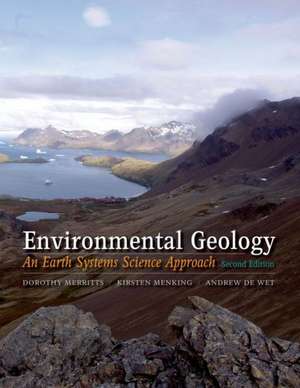
Environmental Geology
Autor Andrew DeWet, Dorothy Merritts, Kirsten Menkingen Limba Engleză Paperback – 28 mar 2014
Considerăm că a doua ediție a lucrării Environmental Geology, semnată de Dorothy Merritts, Kirsten Menking și Andrew DeWet, reprezintă un instrument metodologic esențial prin prisma modului în care reorganizează materia. Structura este construită în jurul conceptului de „sisteme terestre”, o abordare care depășește prezentarea liniară a fenomenelor geologice în favoarea unei viziuni integrate. Volumul debutează cu o introducere solidă în dinamica sistemelor de energie și mediu, stabilind cadrul pentru analiza impactului uman prin prisma resurselor și a poluării, înainte de a trece la studiul riguros al geosferei. Progresia conținutului este logică și graduală: după stabilirea fundamentelor sistemice în prima parte, autorii detaliază în Partea a II-a mecanismele interne ale planetei. Capitolele dedicate tectonicii plăcilor, seismologiei și vulcanologiei nu sunt doar descrieri tehnice, ci analize ale riscurilor și metodelor de minimizare a acestora. Această abordare pragmatică diferențiază textul de alte lucrări academice mai abstracte. De exemplu, lucrarea completează perspectiva oferită de Introduction to Environmental Geology de Edward A. Keller, adăugând o metodologie de tip „sisteme terestre” mai pronunțată și o concizie care lipsește adesea din manualele introductive voluminoase. În timp ce Living with Earth de Travis Hudson mizează pe un ton informal pentru studenții fără background științific, Environmental Geology păstrează o rigoare academică precisă, fiind ideală pentru curriculumul universitar care solicită o înțelegere profundă a ciclurilor geologice și a timpului geologic. Editura W. H. Freeman oferă aici un format echilibrat între teorie și studii de caz relevante, facilitând tranziția de la observația geologică la managementul riscurilor de mediu.
Preț: 529.77 lei
Preț vechi: 886.70 lei
-40%
Carte disponibilă
Livrare economică 09-23 noiembrie
Livrare express 24-30 octombrie pentru 185.66 lei
Specificații
ISBN-10: 1429237430
Pagini: 500
Dimensiuni: 215 x 274 x 27 mm
Greutate: 1.24 kg
Ediția:Revizuită
Editura: Macmillan Learning
Locul publicării:New York, United States
V-ar putea interesa
-
 Basin AnalysisPhilip A. Allen-19%Preț: 452.79 lei559.00 lei
 -
 Tools in Fluvial GeomorphologyG Mathias Kondolf-9%Preț: 925.78 lei1017.35 lei
 -
 Remote Sensing of the CryosphereMarco Tedesco-23%Preț: 614.81 lei798.46 lei
 -
 The Ice AgeJ. Ehlers-23%Preț: 446.14 lei579.41 lei
 -
 Soil Science Simplified 6eN Eash-19%Preț: 469.32 lei579.41 lei
 -
 Meteorological MeasurementsHarrison-8%Preț: 611.80 lei665.00 lei
 -
 Metal SustainabilityReed M Izatt-9%Preț: 1073.15 lei1179.29 lei
 -
 Stanley, S: Earth System HistorySteven M. Stanley-18%Preț: 1625.61 lei1982.45 lei
 -
 Earth TransformedWilliam Ruddiman-37%Preț: 292.19 lei462.18 lei
De ce să citești această carte
Recomandăm această carte studenților și profesioniștilor care caută o sinteză modernă a geologiei mediului. Față de manualele clasice, aceasta utilizează abordarea sistemelor terestre pentru a explica interdependența dintre fenomenele naturale și activitatea umană. Cititorul câștigă o înțelegere clară a riscurilor geologice (cutremure, vulcani) și a modului în care limitele planetare influențează gestionarea resurselor, totul într-un format concis și bine structurat.
Despre autor
Dorothy Merritts, Kirsten Menking și Andrew DeWet sunt cadre didactice și cercetători recunoscuți în domeniul geștiințelor. Dorothy Merritts este profesor de geoștiințe la Franklin & Marshall College, specializată în geomorfologie și geologie ambientală, având o experiență vastă în studiul impactului antropic asupra peisajelor fluviale. Kirsten Menking aduce expertiză în modelarea sistemelor climatice și hidrologie, în timp ce Andrew DeWet contribuie cu cercetări în geologia planetară și utilizarea sistemelor informatice geografice (GIS). Împreună, autorii combină rigoarea cercetării de teren cu o pedagogie modernă, adaptată cerințelor actuale ale învățământului superior de profil.
Cuprins
1. Dynamic Earth Systems
Earth System Science
The Concept of Systems
Earth's Environmental Systems
Earth's Energy Systems
Population, Resources, Pollution, Hazards, and Planetary Boundaries
Part II: Solid Earth Systems and Geologic Time
2. Plate Tectonics: Solid Earth in Motion
An Early Conundrum and the Scientific Method
Plate Properties and Motions
Piecing the Theory Together
The Driver of Plate Tectonics
3. Earthquakes: Their Causes, Hazards, and Risks
The Build-up and Release of Seismic Energy
Assessing Earthquake Hazards
Minimizing the Risks from Earthquakes
4. Earth Materials: Elements, Minerals, and Rocks
Minerals: Building blocks of the lithosphere
Rocks and the Rock Cycle
Rock and Mineral Resources
5. Volcanoes
Volcanic Eruptions
Volcanic Hazards
Minimizing the Risks from Volcanic Eruptions
6. Geologic Time
Scales of Time and Earth System Cycles
Measuring Time: Relative and Absolute Age Dating
Fossils, Evolution, and Relative Geologic Time
Global Change over Different Scales of TimePart III Earth's Surface Systems
7. The Biosphere
Biosphere Structure and Functioning
Ecosystem Services
Water Purification
Human Impacts on the Biosphere
8. Soil and Weathering Systems
The Pedosphere: A Geomembrane to Other Earth Systems
Biological Processes and their Role in Weathering
Pedosphere Resources: Soils, Clays, and Mineral Ores
Soil Erosion Hazards, Land Degradation, and Soil Conservation
Soil Erosion: A Quiet Crisis
Mass Movement Hazards and Their Mitigation
Part IV Fluid Earth Systems
9. Earth
The Hydrologic Cycle
Drainage Basins and Streams
Floods
Altered Streams
Wetlands
Managing and Restoring Streams and Wetlands
Water Resources and Protection
Droughts
10. The Groundwater System
Water in the Ground
Groundwater As a Resource
Groundwater Hazards
Groundwater Pollution and Its Cleanup
11. The Atmospheric System
The Atmosphere: An Envelope of Gases
Atmospheric Circulation and Climate
Storms
Severe Weather
Tropical Storms and Hurricanes
Human Influence on Atmospheric Chemistry
Air Pollution and Environmental Management
12. The Ocean and Coastal System
The Ocean Basins
Coastlines
Sea Level Changes
Seawater Chemistry
Ocean Structure and Circulation
Circulation in the Surface Mixed Layer
Circulation in the Deep Ocean
Coastal Processes and Hazards of Living by the Sea
Coastal Erosion and Attempts to Control It
Controlling Cliff Erosion
Human Impacts on the Seas
Waste Disposal and Polluted Runoff Along Continental Shelves
Part V Energy, Changing Earth, and Human-Earth Interactions
13. Energy
Energy and Humans
Earth's Energy System
Petroleum: Crude Oil and Natural Gas
Renewable Energy: Solar, Wind, And Hydroelectric
The "New Energy Era": Green Buildings and the Road Taken
14. Understanding Climatic and Environmental Change
Climate on Terrestrial Planets
Causes of Climatic Change
Influence of Plate Tectonics on Climate
Indicators of Environmental Change
Global Climate Models
15. Humans and the Whole Earth System: Living in the Anthropocene
Planetary Boundaries
Anthropogenic Climate Change
Impacts of Rising Greenhouse Gas Concentrations
Sea Level Rise
Coming to Grips with the Anthropocene
Notă biografică
Kirsten Menking is an environmental Earth scientist in the Department of Earth Science and Geography at Vassar College, USA. Her current research involves quantifying the amount of road salt entering the groundwater system, a topic of concern both for people dependent on well water and for aquatic ecosystems.
Andrew de Wet is a classically trained geologist specializing in Geographic Information Systems (GIS) and remote sensing, and their application to environmental problems on Earth and geological processes on Mars. He teaches environmental geology, GIS and Natural Resources, and an interdisciplinary course on comparative planetology with a focus on Mars. He has published articles on geological pedagogy in the Journal of Geological Education and on shared faculty positions in the Journal of Women and Minorities in Science and Engineering and Geotimes. He is a member of the Geological Society of America and the American Geophysical Union. He is involved in a long-standing collaboration with researchers at NASA's Goddard Space Flight Center and publishes on environmental issues and planetary geology.
Caracteristici
A Significantly Enhanced Art Programme The new edition features vividly rendered and carefully labelled diagrams of structures and processes, selected tables and graphs, maps, and impressive photographs
New - Earth Science and Public Policy Boxes: This feature looks at instances where research on Earth system processes was instrumental in formulating public policy or law to deal with a variety of environmental problems
New - Emerging Research Boxes: Here the authors profile recent and often on-going research projects addressing unresolved issues in environmental geology