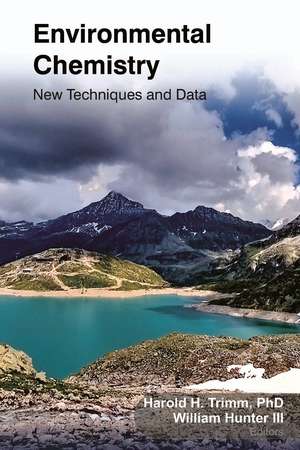
Environmental Chemistry: New Techniques and Data: Research Progress in Chemistry
Editat de Harold H. Trimm, William Hunter, IIIen Limba Engleză Paperback – 31 mar 2021
Environmental chemistry is an interdisciplinary field of study that involves the science of ecology as well as chemistry. Environmental chemistry covers the basic chemistry and biochemistry that occur naturally in the world around us. It focuses on the air, water, and land. Environmental science normally begins by determining the chemical reactions that are occurring in the environment when all systems are in balance and then goes on the discover how chemistry has changed when there is an imbalance caused by stress or pollution. The field is constantly changing, with new discoveries being made all the time. The availability of new and more sensitive instruments in analytical science is enabling the detection of smaller and smaller concentrations of pollutants in the environment. This new volume deals with a host of important topics in environmental chemistry, such as pesticide-related illnesses in humans and plants, the effects of litterfall in the soil of tropical forests, toxicants in various bodies of water, and much more.
Preț: 604.16 lei
Preț vechi: 710.78 lei
-15%
Puncte Express: 906
Carte tipărită la comandă
Livrare economică 02-16 decembrie
Livrare prin curier în România Termenul estimat este afișat lângă disponibilitate.
Transport gratuit pentru acest produs Plată online sau ramburs, în funcție de opțiunile comenzii.
Retur gratuit în 14 zile Comandă securizată și suport în română.
Specificații
ISBN-13: 9781774631928
ISBN-10: 177463192X
Pagini: 288
Dimensiuni: 156 x 234 x 24 mm
Greutate: 0.53 kg
Ediția:1
Editura: Apple Academic Press Inc.
Colecția Apple Academic Press
Seria Research Progress in Chemistry
ISBN-10: 177463192X
Pagini: 288
Dimensiuni: 156 x 234 x 24 mm
Greutate: 0.53 kg
Ediția:1
Editura: Apple Academic Press Inc.
Colecția Apple Academic Press
Seria Research Progress in Chemistry
Public țintă
Academic and PostgraduateCuprins
Pesticide-Related Illness Reported to and Diagnosed in Primary Care: Implications for Surveillance of Environmental Causes of Ill-Health. Heavy Metal Tolerance in Stenotrophomonas maltophilia. Evaluation of Protein Pattern Changes in Roots and Leaves of Zea mays Plants in Response to Nitrate Availability by Two-Dimensional Gel Electrophoresis Analysis. Contamination of Rural Surface and Ground Water by Endosulfan in Farming Areas of the Western Cape, South Africa. Microbial Contamination and Chemical Toxicity of the Rio Grande. Increased Litterfall in Tropical Forests Boosts the Transfer of Soil CO2 to the Atmosphere. Explaining the Evolution of Warning Coloration: Secreted Secondary Defence Chemicals May Facilitate the Evolution of Visual Aposematic Signals. Marine Biofilm Bacteria Evade Eukaryotic Predation by Targeted Chemical Defense. Assessing the Distribution of Volatile Organic Compounds Using Land Use Regression in Sarnia, "Chemical Valley," Ontario, Canada. Chemical and Physical Properties of Some Saline Lakes in Alberta and Saskatchewan. Chemically Diverse Toxicants Converge on Fyn and c-Cbl to Disrupt Precursor Cell Function. Reverse and Conventional Chemical Ecology Approaches for the Development of Oviposition Attractants for Culex Mosquitoes. Estrogen-Like Activity of Seafood Related to Environmental Chemical Contaminants. The Environmental Toxicant 2,3,7,8-Tetrachlorodibenzo-P-Dioxin Disrupts Morphogenesis of the Rat Pre-Implantation Embryo.
Notă biografică
Dr. Harold H. Trimm was born in 1955 in Brooklyn, New York. Dr. Trimm is the chairman of the Chemistry Department at Broome Community College in Binghamton, New York, USA. In addition, he is an Adjunct Analytical Professor, Binghamton University, State University of New York, Binghamton, New York.
He received his Ph.D in chemistry, with a minor in biology, from Clarkson University in 1981 for his work on fast reaction kinetics of biologically important molecules. He then went on to Brunel University in England for a postdoctoral research fellowship in biophysics, where he studied the molecules involved with arthritis by electroptics. He recently authored a textbook on forensic science titled Forensics the Easy Way (2005).
Professor William Hunter III lives in Houghton, New York. He holds a master's degree from the State University of New York at Buffalo with a specific focus on ecology and evolution. He has done extensive research in the fields of limnology and the effect of water quality on aquatic life, and he is in the midst of project funded by the National Science Foundation researching the effects of a new sewer project on the water chemistry and aquatic life of Cuba Lake, New York. A longtime science lover, Professor Hunter has worked for Ward’s Natural Science, Inc. to create new biology, chemistry, and environmental science products to serve the science education community. He currently shares his interest in biology and chemistry with his New York state students to help build another generation of scientists.
He received his Ph.D in chemistry, with a minor in biology, from Clarkson University in 1981 for his work on fast reaction kinetics of biologically important molecules. He then went on to Brunel University in England for a postdoctoral research fellowship in biophysics, where he studied the molecules involved with arthritis by electroptics. He recently authored a textbook on forensic science titled Forensics the Easy Way (2005).
Professor William Hunter III lives in Houghton, New York. He holds a master's degree from the State University of New York at Buffalo with a specific focus on ecology and evolution. He has done extensive research in the fields of limnology and the effect of water quality on aquatic life, and he is in the midst of project funded by the National Science Foundation researching the effects of a new sewer project on the water chemistry and aquatic life of Cuba Lake, New York. A longtime science lover, Professor Hunter has worked for Ward’s Natural Science, Inc. to create new biology, chemistry, and environmental science products to serve the science education community. He currently shares his interest in biology and chemistry with his New York state students to help build another generation of scientists.
Descriere
This title includes a number of Open Access chapters.
Environmental chemistry is an interdisciplinary field of study that involves the science of ecology as well as chemistry. Environmental chemistry covers the basic chemistry and biochemistry that occur naturally in the world around us. It focuses on the air, water, and land. En
Environmental chemistry is an interdisciplinary field of study that involves the science of ecology as well as chemistry. Environmental chemistry covers the basic chemistry and biochemistry that occur naturally in the world around us. It focuses on the air, water, and land. En