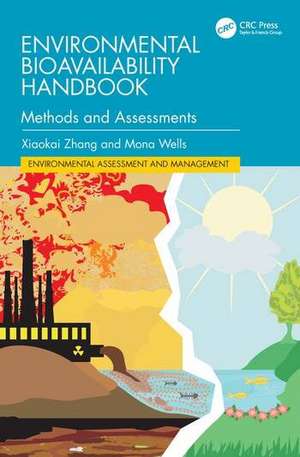
Environmental Bioavailability Handbook: Methods and Assessments: Environmental Assessment and Management
Autor Xiaokai Zhang, Mona Wellsen Limba Engleză Hardback – 7 mai 2026
This book contributes to a deeper understanding of the role of environmental bioavailability in contemporary environmental science in the following ways:
- Provides information on the importance of environmental bioavailability of pollutants.
- Explains, in a “how-to” manner, the use of environmental bioavailability in the context of Environmental Risk Assessment and environmental management decision-making.
- Includes areas of applicability, optimum conditions, and pros and cons for bioavailability methods provided.
- Summarizes state-of-the-art in modeling environmental bioavailability and discusses current best practices.
- Includes case studies illustrating the assessment of bioavailability using different approaches.

Preț: 1400.66 lei
Preț vechi: 1708.12 lei
-18%
Puncte Express: 2101
Carte tipărită la comandă
Livrare economică 23 noiembrie-07 decembrie
Livrare express 17-23 octombrie pentru 103.69 lei
Livrare prin curier în România Termenul estimat este afișat lângă disponibilitate.
Transport gratuit pentru acest produs Plată online sau ramburs, în funcție de opțiunile comenzii.
Retur gratuit în 14 zile Comandă securizată și suport în română.
Specificații
ISBN-13: 9781032404721
ISBN-10: 1032404728
Pagini: 390
Ilustrații: 168
Dimensiuni: 178 x 254 mm
Greutate: 0.89 kg
Ediția:1
Editura: CRC Press
Colecția CRC Press
Seria Environmental Assessment and Management
ISBN-10: 1032404728
Pagini: 390
Ilustrații: 168
Dimensiuni: 178 x 254 mm
Greutate: 0.89 kg
Ediția:1
Editura: CRC Press
Colecția CRC Press
Seria Environmental Assessment and Management
V-ar putea interesa
-
 -22%Preț: 1305.68 lei1681.39 lei
 -
 Environmental Health in Australia and New ZealandNancy Cromar-5%Preț: 620.15 lei652.78 lei
 -
 Clinical ChemistryWilliam J. Marshall-5%Preț: 355.95 lei374.69 leiRecomandat
 -
 Analytical Methods for Environmental MonitoringFrank Taylor-15%Preț: 622.37 lei732.20 lei
 -
 Medical Toxicology of Occupational and Environmental Exposures, Volume 1Donald G Barceloux-23%Preț: 1622.44 lei2107.07 lei
 -
 Casarett & Doull's Essentials of Toxicology, Fourth EditionCurtis Klaassen-32%Preț: 561.63 lei825.43 lei
 -
 -5%Preț: 717.71 lei755.49 lei
 -
 Processes, Assessment and Remediation of Contaminated SedimentsDanny D. ReiblePreț: 414.45 lei
 -
 -9%Preț: 1823.62 lei2003.98 lei
 -
 SnoSverker SörlinPreț: 124.75 lei
 -
 Advances in Environmental Research: Volume 18Justin A Daniels-26%Preț: 730.58 lei992.26 lei
 -
 Environmental Research Summaries: Volume 3Danila S. Melekhin-27%Preț: 1609.31 lei2189.55 lei
 -
 Environmental & Agricultural Research Summaries: Volume 6Lucille T Cacioppo-27%Preț: 1800.26 lei2451.32 lei
 -
 Fish Species in Environmental Risk Assessment StrategiesGuillermo Eli Liwszyc-14%Preț: 1257.03 lei1461.66 lei
 -
 Contaminant Levels and Ecological EffectsBiljana Balabanova-24%Preț: 785.51 lei1033.57 lei
 -
 Contaminated Land and WaterHassan Alshemmari-18%Preț: 808.32 lei985.76 lei
 -
 Applied MetallomicsYu-Feng Li-9%Preț: 911.84 lei1002.02 lei
Public țintă
Postgraduate, Professional, and Undergraduate AdvancedCuprins
Secion 1: Background. 1. Bioavailability and Influencing Factors. 2. Terms and Definitions. 3. Sample Integrity and Avoiding Contamination. 4. Guidance Notes on Quality Assurance and Quality Control. 5. Standard Methods for the Instrumental Analysis of Heavy Metals and Organic Compounds and Ancillary Procedures. Section 2: Biotic Methods: Measurement of “True Bioavailability”. 6. Environmental Monitoring of Bioavailability Using Caged Bivalve Mollusks. 7. Using Worms for the Measurement of Pollutant Bioavailability. 8. Assessing the Bioavailability of Pollutants using Macrophytes. 9. Measuring Bioavailability Using Whole-Cell Bioreporters. Section 3: Abiotic Methods: Measurement of Chemoavailability using Chemical Proxies. 10. Chemoavailability of Pollutants Determined by Diffusive Gradients in Thin Films. 11. Tenax Extraction as a Simple Method to Determine the Chemoavailability of Organic Pollutants. 12. Using Chelating Resins for the Measurement of Heavy Metal Bioavailability. 13. Permeation Liquid Membranes as a Tool for Evaluation of Heavy Metal Chemoavailability. Section 4: Modeling. 14. Introduction to Modeling Bioavailability. 15. Speciation and Biotic Ligand Modeling. Section 5: Case Studies on the Assessment of Bioavailability. 16. Case Study: Evaluating Organ-ic Diffusive Gradients in Thin-Film Devices as Proxies to Measure Bioavailability of Methamphetamine in Zebrafish. 17. Case Study: Assessing a Two-in-One Whole-Cell Bioreporter Approach for Bioavailability and Toxicity of Cadmium and Lead.
Notă biografică
Xiaokai Zhang completed his PhD at the University of Liverpool, focusing on topics involving bioavailability in environmental risk and impact assessment, the use of environmental biotechnology to measure bioavailability, and risk‑based environmental management interventions. Currently, he is an associate professor at Jiangnan University in Wuxi, Jiangsu Province, China, where he continues to work on topics in bioavailability‑based risk and environmental management, as well as the environmental behavior of biochar and remediation of contaminated soils using biochar. His research in his areas of expertise has been published in several book chapters and in notable environmental science journals including Environmental Science & Technology, Water Research, and Environmental Pollution, with some works rated as highly cited papers.
Mona Wells is an interdisciplinary environmental scientist specializing in Environmental Impact Assessment, Environmental Risk Assessment, and environmental management. Her roles have included posts in different locales internationally as an academic and as an environmental practitioner, on projects spanning a broad portfolio including technical project work, research, commercialization, program development, policy advisement, science communication, public consultation, pedagogical development, and continuous improvement.
Mona Wells is an interdisciplinary environmental scientist specializing in Environmental Impact Assessment, Environmental Risk Assessment, and environmental management. Her roles have included posts in different locales internationally as an academic and as an environmental practitioner, on projects spanning a broad portfolio including technical project work, research, commercialization, program development, policy advisement, science communication, public consultation, pedagogical development, and continuous improvement.
Descriere
This practical guide on environmental bioavailability explains the importance of its use and includes specific methods for testing bioavailability of pollutants in the atmosphere, water bodies, soils, and sediments. Detailed methods and techniques are given to measure bioavailability and includes a case study for each approach.